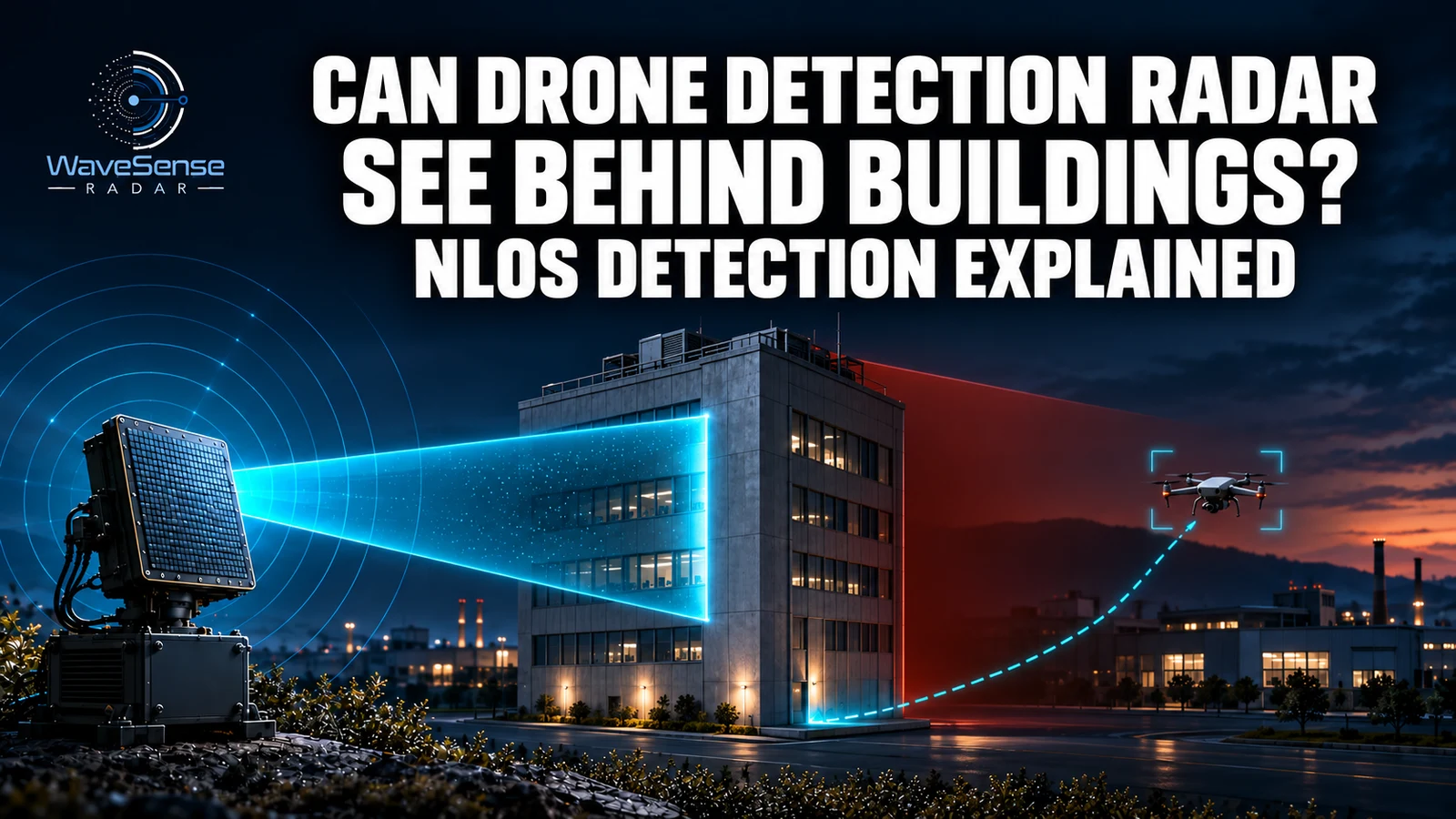
FPV Drone Detection Radar should be evaluated by how reliably it detects and tracks a small UAV close to the ground, not simply by the radar’s maximum advertised range.
FPV drones can be difficult radar targets because they combine small size, low radar cross section, low-altitude flight and fast changes in direction.
The most useful question for a buyer is therefore not:
“Can your radar detect FPV drones?”
It is:
“Which FPV-sized target did you test, at what range, altitude and environment?”
A radar that performs well against a larger commercial quadcopter does not automatically provide the same performance against a smaller FPV drone.
Why Is FPV Drone Detection Radar More Difficult?
The first challenge is the target itself.
Small drones generally produce weaker radar returns than larger UAVs. Their detectability also changes with orientation, materials, frequency and viewing angle.
For a deeper explanation, see our guide to Radar Cross Section Of A Drone.
The second challenge is altitude.
FPV drones may fly close to buildings, trees, terrain or industrial equipment. The radar must therefore separate a weak UAV return from much stronger environmental reflections.
A technical review of radar detection and classification of multirotor drones explains why low RCS and complex target signatures make small-UAV detection different from conventional aircraft surveillance.
This is why a good FPV Drone Detection Radar needs both small-target sensitivity and effective clutter processing.
For the complete detection process, see Drone Detection Radar: How It Detects Small UAVs In Complex Environments.
Do Not Compare FPV Radar Range Without Knowing The Target
Consider two specifications:
A Radar : FPV detection range 5 km
B Radar : drone detection range 8 km
Radar B does not automatically have better FPV performance.
Before comparing the numbers, ask:
- What drone was tested?
- What was the target RCS?
- What altitude was used?
- Was this first detection or stable tracking?
- Was the test conducted in open terrain or real clutter?
A maximum range number without a defined target tells the buyer very little.
The correct comparison is closer to:
Target + Range + Altitude + Tracking Condition + Environment
This is particularly important for FPV Drone Detection Radar, because a small FPV target may be detected at a very different distance from a larger consumer UAV.
What Should Buyers Check In An FPV Drone Detection Radar?
You do not need to compare dozens of parameters.
Focus on five.
| Check | Why It Matters |
|---|---|
| Small-target range | Shows whether the quoted range applies to FPV-sized UAVs |
| Low-altitude performance | Tests the radar near real ground clutter |
| Track stability | Shows whether the UAV can be continuously followed |
| False tracks | Shows whether higher sensitivity creates excessive alerts |
| Classification | Helps separate drones from birds and other targets |
Small-Target Detection Range
Ask the manufacturer to identify the target used during testing.
Ideally, the range should be linked to either:
- A real FPV drone model
- A defined radar cross section
Avoid comparing products using only statements such as:
Maximum Detection Range: 10 km
without knowing what target produced that result.
Why Does Low-Altitude Performance Matter?
An FPV drone flying against clear sky is easier to separate from the background than the same drone flying close to buildings or terrain.
This means a useful FPV Drone Detection Radar test should include representative low-altitude flight.
For sites such as:
- Airports
- Power facilities
- Prisons
- Industrial plants
- Urban infrastructure
the clutter environment can matter almost as much as maximum radar sensitivity.
Research reviews of small-drone detection in protected areas also highlight the difficulty of detecting small UAVs in realistic surveillance environments.
Why Does Track Stability Matter?
Detecting an FPV drone once is not enough.
The radar should maintain a useful track while the drone:
- Approaches
- Turns
- Crosses the radar
- Changes speed
A radar may produce an early detection but repeatedly lose the target during maneuvering.
For the buyer, the practical question is simple:
Did the same track remain stable during the complete flight?
Stable tracking is more useful operationally than one impressive maximum detection point.
Why Should FPV Radar Testing Include False Alarms?
Increasing radar sensitivity can help detect smaller targets.
But it can also increase unwanted detections from:
- Birds
- Vegetation
- Vehicles
- Ground clutter
- Noise
This creates a tradeoff.
A radar that detects an FPV drone farther away but produces many false tracks may not provide better operational performance.
For a detailed explanation of this problem, see Drone Detection Radar False Alarms: What Buyers Should Measure.
A useful test should therefore measure:
FPV detection performance and false-track performance using the same radar settings.
Do not accept one number from the high-sensitivity configuration and another from a different low-false-alarm configuration.
Can Radar Tell An FPV Drone From A Bird?
Radar can improve drone-versus-bird classification by combining several target characteristics.
These may include:
- Speed
- Trajectory
- RCS
- Flight behavior
- Micro-Doppler
Rotating drone propellers can create micro-Doppler features that provide additional information beyond basic target position.
You can learn more in Micro-Doppler Radar: How It Detects And Classifies Drones.
However, buyers should separate:
Detection Range
from:
Classification Range
A radar may detect a small FPV target before it has enough target information to classify it confidently.
Can Radar Detect An FPV Drone Without Its Radio Signal?
Yes.
Radar detects the physical aircraft through reflected electromagnetic energy.
It does not require the drone to transmit a recognizable control, telemetry or video signal.
This matters because different detection technologies solve different problems.
RF detection can provide valuable information when a relevant signal exists.
Radar provides an independent physical detection layer.
For a simple comparison of these technologies, see Drone Detection System: Radar Vs RF Vs EO/IR.
This is why high-security sites often evaluate radar and RF as complementary sensors rather than asking which one should completely replace the other.
How Should FPV Drone Detection Radar Be Tested?
The test does not need to be complicated.
Use a representative FPV drone and repeat several realistic flights.
Test 1: Low-Altitude Approach
Fly the drone toward the radar at the altitude expected in the real application.
Record:
- First detection range
- Stable tracking range
Test 2: Crossing Flight
Fly across the radar rather than directly toward it.
Check whether the radar maintains the same target track.
Test 3: Cluttered Flight
Fly near representative terrain, vegetation or structures.
This shows whether the radar performs well outside a clean open-field environment.
Test 4: Maneuvering
Include turns and changes in direction.
Check whether the target track remains stable.
Test 5: No-Drone Monitoring
Run the radar without the test drone.
Record false tracks under the same settings used during the FPV test.
A simple acceptance table can be enough:
| Metric | Test Result |
|---|---|
| First Detection | ___ km |
| Stable Tracking | ___ km |
| Lowest Tested Altitude | ___ m |
| Track Drops | ___ |
| False Tracks | ___ |
| Drone Classification | Yes / No |
This provides far more useful information than:
“Supports FPV drone detection.”
What Should You Ask The Radar Manufacturer?
When comparing an FPV Drone Detection Radar, ask these questions:
- Which FPV or small drone did you test?
- What was its detection range?
- What was its stable tracking range?
- What altitude was used?
- Was the flight conducted near real clutter?
- How many track drops occurred?
- What false-track performance was recorded using the same configuration?
These questions make different radar products much easier to compare.
They also prevent a supplier from using the detection range of a larger UAV as proof of FPV performance.
Why Small-UAV Radar Design Matters
FPV detection is part of the wider Low, Slow and Small target problem.
Purpose-built Counter-UAS radar is designed to detect targets that can be smaller, lower and harder to separate from clutter than conventional aircraft.
For example, Weibel’s Counter-UAS radar systems specifically focus on low, slow and small airborne threats.
But buyers should still avoid choosing a system based only on terms such as:
LSS capable
or:
FPV capable.
The claim should be supported by a defined target and realistic test conditions.
Conclusion
A reliable FPV Drone Detection Radar should prove its performance against a representative small UAV under realistic low-altitude conditions.
Do not choose a radar only because it has the longest maximum range.
Compare:
Target → Detection Range → Stable Tracking → Altitude → False Tracks
If those five items are defined, the radar specification becomes much more meaningful.
If they are missing, a claim such as:
“FPV detection up to 5 km”
is difficult to evaluate.
For buyers comparing a complete radar system, continue to Counter-UAS Radar: What Buyers Should Compare Before Choosing A System.
The goal is not to buy the radar with the largest number.
It is to choose the radar that reliably detects and tracks the FPV-sized target your site actually needs to monitor.
FAQ
Can FPV Drone Detection Radar Detect Small FPV Drones?
Yes. Purpose-built small-UAV radars can detect FPV-sized targets, but actual performance depends on RCS, altitude, aspect, clutter and radar design.
Why Are FPV Drones Difficult For Radar?
Small FPV drones can produce weak radar returns and frequently operate close to terrain and other sources of ground clutter.
Does A 10 km Radar Detect FPV Drones At 10 km?
Not necessarily. The quoted 10 km range may apply to a larger target. Always ask which UAV or RCS was used for the test.
Can Radar Detect An FPV Drone Without RF Transmission?
Yes. Radar detects the physical aircraft and does not require the drone’s control or video signal.
Is Detection Range The Same As Tracking Range?
No. First detection may occur farther away than the distance at which the radar can establish and maintain a stable track.
How Should Buyers Compare FPV Drone Detection Radar Systems?
Use the same representative target and compare detection range, stable tracking, altitude, clutter conditions and false tracks using comparable test settings.