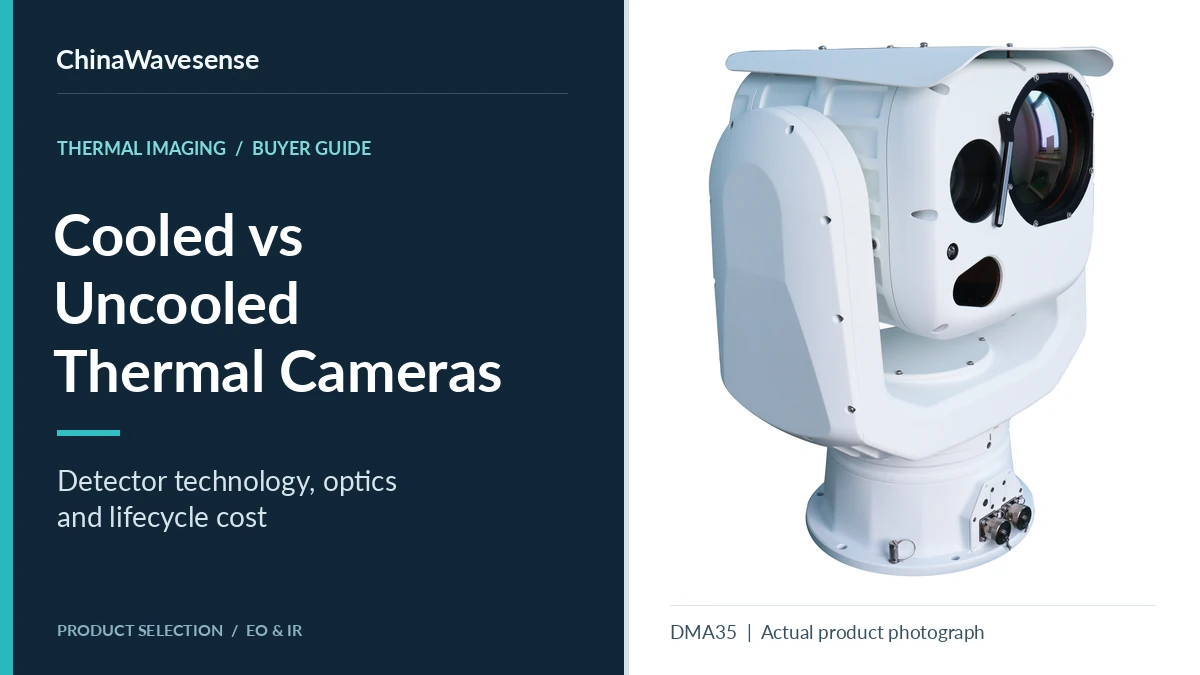
When comparing cooled vs uncooled thermal cameras, buyers should consider the required observation distance, image detail, operating cost, and maintenance needs rather than choosing the most expensive detector.
Uncooled thermal cameras offer a practical solution for many commercial and industrial surveillance projects. Cooled thermal cameras generally provide higher sensitivity and can support demanding long-range imaging applications.
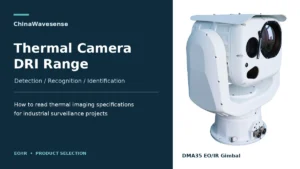
ChinaWavesense offers both technologies within its electro-optical product range. The DMA35 configuration uses an uncooled VOx detector, while the Z50 configuration uses a cooled MCT detector.
Understanding their differences helps buyers select the appropriate imaging system without investing in unnecessary capabilities.
What Is the Difference Between Cooled vs Uncooled Thermal Cameras?
The main difference is how the thermal detector operates.
A cooled thermal camera uses a cryogenic cooling system to reduce detector noise. This improves its ability to distinguish small temperature differences.
An uncooled thermal camera operates without a cryogenic cooler. This simplifies the equipment and generally reduces power consumption and maintenance requirements.
| Feature | Cooled Thermal Camera | Uncooled Thermal Camera |
|---|---|---|
| Detector cooling | Requires a cooler | No cryogenic cooler |
| Thermal sensitivity | Generally higher | Depends on detector configuration |
| Startup time | Requires cooling time | Generally faster |
| Power consumption | Generally higher | Generally lower |
| Maintenance | May require cooler servicing | Simpler detector maintenance |
| Purchase cost | Generally higher | Generally lower |
| Typical application | Demanding long-range observation | Commercial and industrial surveillance |
Teledyne FLIR’s thermal imaging selection guide explains how detector cooling improves sensitivity while introducing additional cost, weight, and maintenance requirements.
The right technology depends on what the customer needs to observe.
Cooled vs Uncooled Thermal Cameras: ChinaWavesense DMA35 and Z50
The ChinaWavesense product manual provides specifications for two EO/IR configurations that illustrate these differences.
| Specification | DMA35 | Z50 |
|---|---|---|
| Thermal detector | Uncooled VOx | Cooled MCT |
| Thermal resolution | 640 × 512 or 1280 × 1024 | 640 × 512 |
| Thermal lens | 31–155 mm | 90–1100 mm |
| Visible-light lens | 25–500 mm | 12.5–775 mm |
| Published UAV tracking distance | ≥2,000 m | ≥5,000 m |
| Radar cueing | Supports compatible integration | Supports compatible integration |
| Automatic tracking | Yes | Yes |
These figures come from the respective product manual configurations.
They illustrate how different detector and optical designs support different surveillance requirements. However, the published tracking distances do not establish a direct performance comparison under identical test conditions.
Buyers should confirm the target size, atmospheric conditions, imaging configuration, and tracking criteria behind each figure.
ChinaWavesense also offers other multi-band optical configurations, including the DMA460 Electro-Optical Gimbal.
Does Higher Thermal Resolution Always Mean Better Image Quality?
No. Thermal resolution represents only one part of imaging performance.
For example, the DMA35 manual lists an optional 1280 × 1024 uncooled detector, while the Z50 configuration uses a 640 × 512 cooled detector.
The DMA35 option provides more detector pixels, but this does not automatically mean it offers better long-range observation.
Image quality also depends on:
- Thermal sensitivity
- Lens focal length and aperture
- Target size and temperature contrast
- Atmospheric visibility
- Image processing and stabilization
The Z50 configuration combines a cooled detector with a substantially longer thermal lens.
This example demonstrates why buyers should compare the complete optical system rather than detector resolution alone.
FLIR’s cooled and uncooled thermal camera comparison provides additional background on how detector technology affects thermal image sensitivity.
When Should You Choose an Uncooled Thermal Camera?
An uncooled thermal camera often provides a practical choice when the project prioritizes reliable operation, manageable equipment costs, and straightforward maintenance.
Typical commercial applications include:
- Industrial perimeter monitoring
- Warehouse and logistics facility surveillance
- Port and terminal security
- Remote infrastructure monitoring
- General day-and-night observation
The ChinaWavesense DMA35 configuration combines uncooled thermal imaging with a motorized visible-light zoom camera.
It also supports automatic target tracking and radar-guided acquisition according to the product manual.
For buyers, the main advantage of an uncooled configuration is not simply a lower purchase price.
It is the possibility of meeting the surveillance requirement with fewer cooling-related maintenance considerations.
When Is a Cooled Thermal Camera Worth the Investment?
A cooled thermal camera becomes more attractive when the application requires greater imaging sensitivity or detailed observation at extended distances.
The ChinaWavesense Z50 configuration uses a cooled MCT thermal detector and a 90–1100 mm continuous zoom thermal lens.
Such a configuration may suit projects that require demanding long-range optical surveillance.
However, a cooled detector introduces additional operational considerations.
Buyers should ask about:
- Cooling-system service life
- Startup time
- Power requirements
- Maintenance intervals
- Replacement and servicing costs
A cooled camera may provide significant imaging advantages, but those advantages must justify the additional investment.
For many projects, a suitable uncooled camera already meets the actual observation requirement.
Can Thermal Cameras Replace Radar?
Thermal cameras and radar perform different surveillance tasks.
Radar searches an area and provides target location and movement information. Thermal imaging provides visual information based on infrared radiation.
An integrated system can use radar to locate an object and direct a compatible camera toward it.
This combination can support surveillance when a camera alone struggles to search a large area.
For more information about these complementary functions, see our Radar Vs RF Vs EO/IR comparison and Drone Detection Radar guide.
Buyers should also consider weather conditions. Dense fog, rain, and limited thermal contrast can reduce optical performance.
Our article on Drone Detection Radar in Rain and Fog explains why radar and optical sensors may respond differently to poor weather.
How Should Buyers Compare Cooled vs Uncooled Thermal Cameras?
Start with the observation task rather than the detector technology.
| Buying Requirement | What to Confirm |
|---|---|
| Target type | Person, vehicle, vessel, or UAV |
| Observation distance | The distance at which useful imagery becomes necessary |
| Image detail | Detection, recognition, or identification requirements |
| Environment | Temperature, humidity, visibility, and weather |
| Maintenance | Expected service intervals and equipment lifetime |
| Integration | Compatibility with radar and security software |
Ask the manufacturer for representative images or video from the proposed optical configuration.
A long tracking distance does not automatically guarantee detailed target recognition.
Likewise, a higher-resolution detector does not automatically deliver better images at every distance.
The best comparison uses the same target, observation distance, and environmental conditions.
Which ChinaWavesense Thermal Camera Should You Choose?
The DMA35 provides an uncooled thermal and visible-light configuration, while the Z50 provides a cooled thermal configuration with longer focal-length optics.
Both offer different advantages depending on the surveillance task.
When comparing cooled vs uncooled thermal cameras, define your required target, observation distance, image detail, installation environment, and maintenance budget first.
ChinaWavesense can review these requirements and discuss suitable EO/IR configurations.
Contact ChinaWavesense to request product specifications, available optical configurations, and representative imaging results for your project.
FAQ
Are Cooled Thermal Cameras Always Better?
No. Cooled cameras generally offer greater thermal sensitivity, but uncooled cameras may meet the required surveillance performance at a lower operating cost.
What Is the Difference Between MCT and VOx Detectors?
MCT stands for Mercury Cadmium Telluride. VOx stands for vanadium oxide. The ChinaWavesense Z50 manual lists a cooled MCT detector, while the DMA35 manual lists an uncooled VOx detector.
Do Uncooled Thermal Cameras Work at Night?
Yes. Thermal cameras detect infrared radiation rather than relying on visible light. Target contrast and atmospheric conditions still affect image quality.
Why Do Cooled Thermal Cameras Cost More?
Cryogenic cooling, detector technology, optical design, and maintenance requirements generally increase equipment and lifecycle costs.
Can Both Types of Thermal Cameras Work With Radar?
Yes, when the equipment supports compatible interfaces and radar-to-camera integration. Buyers should confirm compatibility for the selected models.