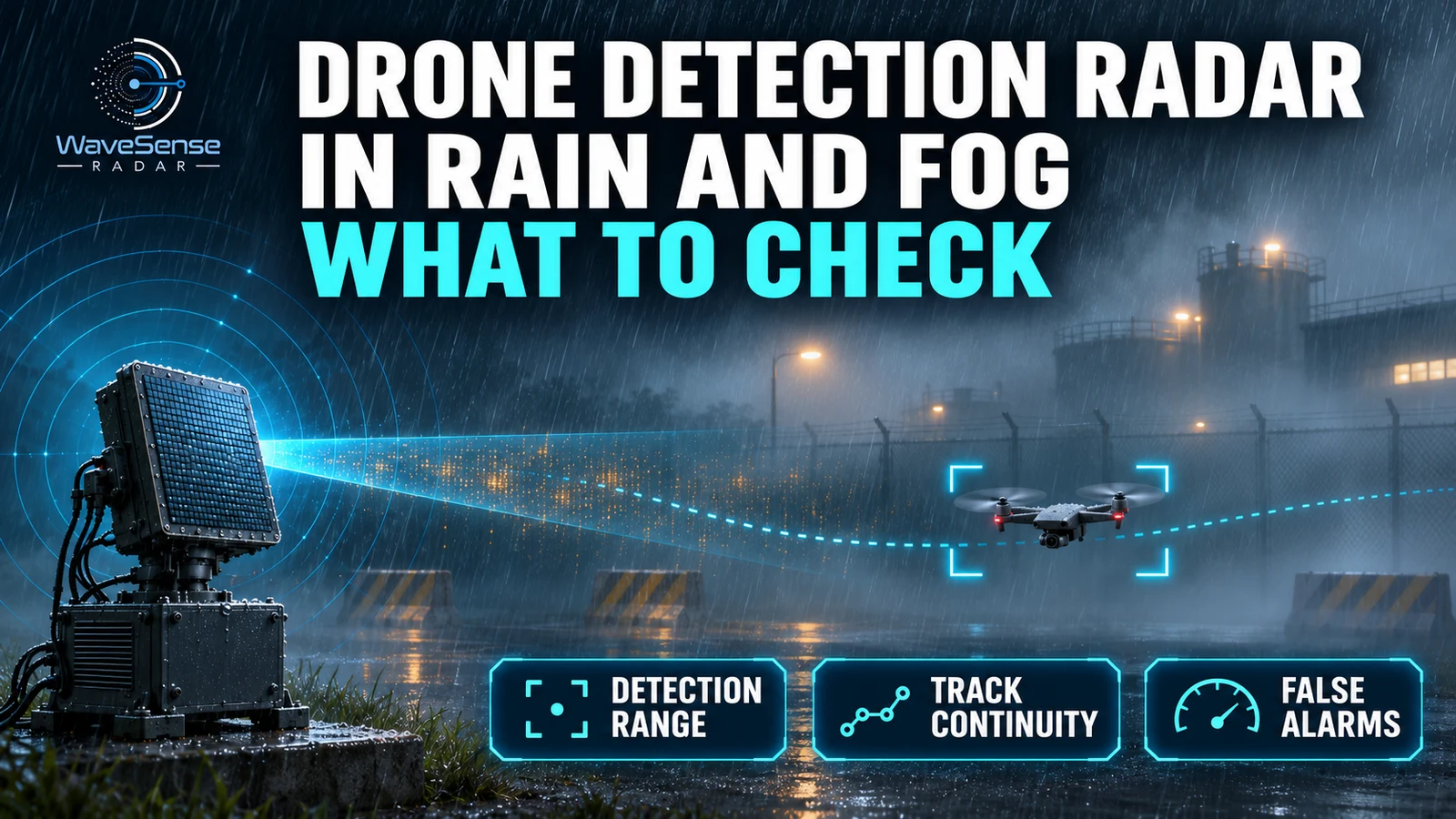
Drone Detection Radar Over Water helps ports, harbors, and coastal facilities detect small UAVs, but sea clutter, drone size, and installation conditions affect its performance.
Maritime environments present different challenges from open land.
Moving waves generate radar reflections. Ships, cranes, and buildings may block the radar’s view. Small drones also produce relatively weak radar signals.
For buyers, the most important question is simple:
Can the radar maintain a stable track on a small drone above water under real operating conditions?
This article explains the main challenges, the specifications buyers should compare, and the tests they should request before purchasing maritime drone radar.
Can Drone Detection Radar Over Water Track Small UAVs?
Yes. A suitable radar can detect and track small drones above water without relying on their radio-control signals.
However, detection performance depends on several factors:
- Drone size and radar cross section (RCS)
- Flight altitude
- Distance from the radar
- Sea conditions
- Radar sensitivity and processing
Small drones often produce weaker radar returns than larger aircraft.
Their materials, shape, and orientation also affect how strongly they reflect radar signals.
Our Radar Cross Section Of A Drone article explains why two similar-sized drones can produce different radar returns.
Buyers should not assume that a radar with a 10 km maximum range can detect every small drone at that distance.
Instead, ask the manufacturer to identify the actual UAV or RCS behind its range claim.
Buying tip: Compare detection and tracking performance using a representative drone, not just maximum radar range.
Why Does Sea Clutter Affect Drone Detection Radar Over Water?
Sea clutter comes from radar signals that reflect off the water surface.
Waves constantly change their shape and movement. These changes create radar returns that can overlap with signals from low-flying drones.
Sea clutter causes two main problems.
1. Missed detections
Strong reflections from waves can hide weaker UAV signals.
2. False tracks
Changing sea reflections can create unwanted detection candidates. Tracking software may occasionally interpret them as real targets.
A 2026 study published in Remote Sensing, Extracting UAV Signatures from Sea Clutter, examines methods for separating UAV signatures from maritime clutter.
The researchers evaluated signal-processing techniques under challenging sea-clutter conditions.
Their research highlights an important principle: effective maritime drone detection requires more than radar sensitivity.
The system must reduce unwanted reflections while preserving real UAV targets.
Buyers should therefore compare detection performance and false tracks together.
Our Drone Detection Radar False Alarms article explains how to evaluate these results.
Can Ordinary Marine Navigation Radar Detect Drones?
Yes, some marine navigation radars can detect small UAVs.
However, buyers should not assume that every navigation radar provides reliable drone tracking or classification.
Marine navigation radar primarily helps vessels identify ships, coastlines, and navigation hazards.
Dedicated drone detection radar focuses on smaller airborne targets.
Researchers investigated this difference in Investigation of UAV Detection by Different Solid-State Marine Radars.
Their experiments demonstrated that some marine radars could detect small drones. However, detection range and performance varied across the tested radar systems and UAVs.
The study also identified limitations involving clutter and target tracking.
| Feature | Marine Navigation Radar | Dedicated Drone Radar |
|---|---|---|
| Main application | Vessel navigation | Small-UAV surveillance |
| Small-drone detection | Depends on radar design | Core design objective |
| Drone tracking | Capability varies | Typically a key function |
| Drone classification | Often limited | May support classification |
| Sea clutter | Supports maritime navigation | Requires UAV-specific testing |
The UK government’s Countering Drone Threats to Shipping guidance also explains why conventional navigation radar may struggle with small drone reflections.
Buying tip: If your port already uses marine radar, check its demonstrated UAV detection and tracking performance before investing in another system.
Is Fixed Port Radar Different from Ship-Mounted Radar?
Yes. Fixed coastal installations and moving vessels create different operating conditions.
Fixed Port Radar
A coastal tower or port building provides a relatively stable radar position.
However, nearby structures can create coverage gaps.
Common obstacles include:
- Container stacks
- Cranes
- Large ships
- Warehouses
- Coastal buildings
These objects can block the radar’s direct view of certain areas.
A radar may provide several kilometers of detection range while nearby structures reduce its practical coverage.
Buyers should therefore review the proposed installation location before choosing a radar.
Ship-Mounted Drone Radar
A moving ship introduces additional challenges.
Pitch, roll, yaw, and vibration change the radar’s orientation.
The system must account for vessel motion to maintain useful target measurements.
Some manufacturers develop maritime-specific radar functions for these conditions.
The UK maritime counter-drone guidance also identifies vessel movement, changing horizons, wave reflections, and radar placement as important considerations.
Buying tip: Do not assume that a radar suitable for a fixed coastal tower will perform equally well on a moving ship.
What Should Buyers Check Before Ordering Maritime Drone Radar?
When comparing Drone Detection Radar Over Water, focus on the specifications that directly affect your surveillance requirements.
| Requirement | What to Confirm |
|---|---|
| Detection range | Which drone or RCS supports the claim? |
| Stable tracking | Can the radar maintain a continuous UAV track? |
| Sea clutter performance | What happens when sea conditions change? |
| Installation coverage | Can buildings or vessels create blind zones? |
| False-track rate | How many unwanted tracks occur? |
| Environmental protection | Can the equipment withstand coastal conditions? |
| Sensor integration | Can the radar share tracks with EO/IR cameras? |
Environmental protection deserves special attention.
Salt spray, humidity, temperature changes, and corrosion can affect equipment reliability.
Buyers should check the manufacturer’s environmental ratings and maintenance requirements.
They should not assume that a waterproof enclosure automatically guarantees long-term salt-corrosion resistance.
Sensor integration also matters.
Radar can provide target coordinates while an EO/IR camera attempts visual confirmation.
Our Drone Detection System: Radar Vs RF Vs EO/IR article explains how these technologies support different detection tasks.
How Should Buyers Test Drone Detection Radar Over Water?
Drone Detection Radar Over Water needs realistic testing to demonstrate reliable small-UAV tracking in maritime conditions.
Buyers can use five practical checks.
1. Test Small-UAV Detection
Choose a representative drone.
Record the first detection range and the distance at which the radar establishes a stable track.
2. Compare Different Sea Conditions
Where safety and local regulations permit, repeat the evaluation under different wind and wave conditions.
Compare tracking distance, track losses, and false tracks.
3. Check Low-Altitude Tracking
Evaluate the UAV at the flight altitudes relevant to the port or coastal facility.
Observe how sea reflections affect detection and tracking.
4. Check Harbor Blind Zones
Review radar coverage near cranes, warehouses, and large vessels.
Identify areas where physical obstacles block the radar’s view.
5. Monitor False Tracks
Operate the radar without the test UAV.
Record unwanted tracks from maritime activity, seabirds, and environmental reflections.
Buyers can use this simple acceptance table:
| Test Metric | Result |
|---|---|
| UAV model / RCS | ___ |
| Installation type | Fixed / Moving |
| Sea conditions | ___ |
| First detection range | ___ km |
| Stable tracking range | ___ km |
| Track losses | ___ |
| False tracks per hour | ___ |
Use the same radar settings when comparing different test conditions.
This approach helps buyers understand actual performance instead of relying on one maximum-range demonstration.
What Should You Ask a Maritime Drone Radar Supplier?
Before purchasing, ask these questions:
- Which UAV model or RCS supports your detection-range claim?
- Have you tested the radar above water?
- What stable tracking range did the radar achieve?
- How do different sea conditions affect performance?
- Does the radar support fixed installations, moving vessels, or both?
- What environmental protection does the equipment offer?
- Can the radar share target information with EO/IR cameras?
These questions help buyers compare suppliers using meaningful evidence.
For more purchasing criteria, read our Counter-UAS Radar Buyer’s Guide.
Choosing the Right Radar for Your Maritime Project
Drone Detection Radar Over Water should provide reliable small-UAV detection and tracking under the conditions that matter to your facility.
For fixed ports, focus on sea clutter, installation location, and surrounding obstacles.
For moving vessels, also examine motion compensation, vibration resistance, and environmental protection.
Do not choose a radar based only on its maximum advertised detection range.
Instead, compare five factors:
Drone Target + Detection Range + Tracking Stability + Sea Conditions + False Tracks
Together, these factors offer a clearer picture of practical performance.
ChinaWavesense can review your surveillance requirements and discuss relevant radar options. Buyers should confirm the proposed model’s capabilities through product specifications and supporting test evidence.
If you are planning a port, harbor, or coastal surveillance project, contact ChinaWavesense with your required drone size, detection distance, installation location, and operating conditions.
FAQ
Can Drone Detection Radar Over Water Detect Small Drones?
Yes. Suitable radar systems can detect small UAVs above water. Actual performance depends on drone RCS, altitude, distance, sea clutter, and radar design.
Can Marine Navigation Radar Detect Drones?
Some marine radars can detect certain UAVs. However, buyers should verify their tracking and classification capabilities separately.
Why Does Sea Clutter Affect Drone Radar?
Moving waves produce changing radar reflections. These signals can hide weak UAV returns or create unwanted detections.
Can a Land-Based Drone Radar Work on a Moving Ship?
Some systems support mobile operation. Others require additional motion compensation and environmental protection.
What Should Ports Test Before Buying Drone Radar?
Test a representative UAV above water. Record detection range, stable tracking, sea conditions, track losses, and false tracks.