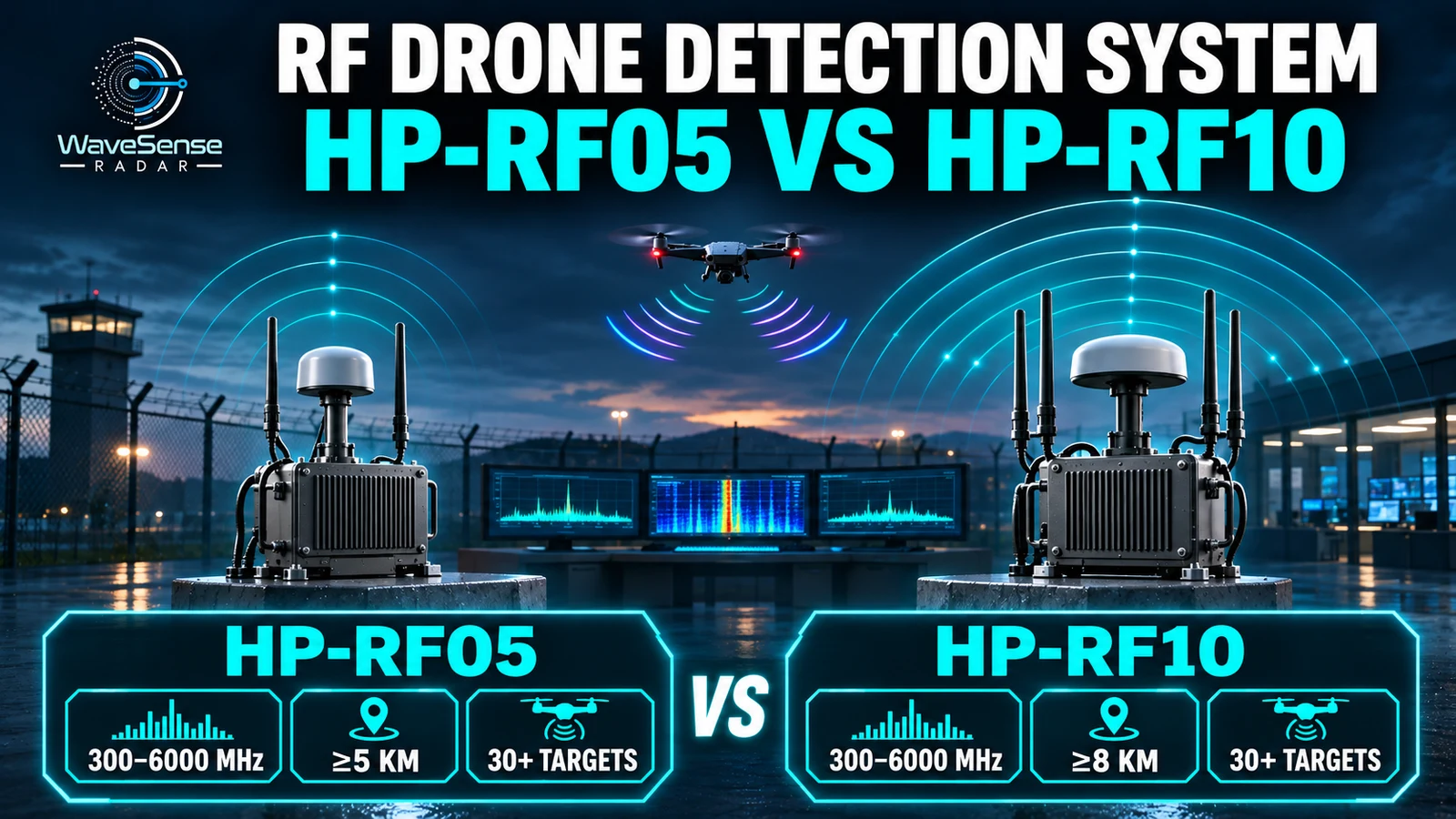
An RF Drone Detection System monitors radio signals associated with UAVs and helps security teams detect suspicious drone activity, identify compatible signal characteristics, and estimate transmitter direction.
ChinaWavesense offers two RF detection configurations in its product catalogue: HP-RF05 and HP-RF10.
Both cover the published frequency range of 300 MHz to 6 GHz. However, they differ in reference detection range, direction-finding accuracy, equipment weight, and power requirements.
This article explains those differences and helps buyers determine which configuration better matches their surveillance needs.
What Does an RF Drone Detection System Detect?
An RF Drone Detection System monitors radio-frequency activity associated with UAV operations.
Depending on the drone and supported signal types, RF detection can identify activity from:
- Drone control links
- Telemetry transmissions
- Video transmission links
- Recognizable communication protocols
- Compatible Remote ID broadcasts
Unlike radar, RF detection does not need to measure reflections from the drone’s physical structure.
Instead, it examines signals that a drone or related equipment transmits.
This difference makes RF detection useful for monitoring compatible commercial drones.
However, RF detection cannot guarantee that it will find every drone.
An aircraft without a detectable transmission may remain invisible to an RF-only sensor.
For a complete comparison, read our Drone Detection System: Radar Vs RF Vs EO/IR article.
HP-RF05 vs HP-RF10: Which RF Drone Detection System Should You Choose?
ChinaWavesense’s product catalogue provides the following specifications.
| Specification | HP-RF05 | HP-RF10 |
|---|---|---|
| Frequency range | 300–6000 MHz | 300–6000 MHz |
| Published detection distance | Greater than 5 km | Greater than 8 km |
| Direction-finding accuracy | Better than 5° RMS | Better than 3° RMS |
| Monitored targets | More than 30 | More than 30 |
| Monitoring bandwidth | Not separately specified | 120 MHz |
| Power supply | AC 220 V | AC 220 V |
| Power consumption | ≤100 W | ≤120 W |
| Equipment weight | Less than 15 kg | Less than 25 kg |
Important: The catalogue bases its published detection distances on a reference UAV signal with 0.1 W transmit power under standard test-field conditions.
These figures do not represent guaranteed detection distances for every UAV, controller, frequency, or installation environment.
When Should Buyers Consider HP-RF05?
HP-RF05 offers a smaller and lighter RF detection configuration.
Its published specifications include:
- 300 MHz–6 GHz frequency coverage
- Greater than 5 km reference detection distance
- Better than 5° RMS direction-finding accuracy
- Support for monitoring more than 30 targets
- Maximum power consumption of 100 W
The catalogue also identifies representative monitoring frequencies around 400 MHz, 900 MHz, 1.2 GHz, 2.4 GHz, 5.2 GHz, and 5.8 GHz.
HP-RF05 may suit projects that prioritize a compact installation and whose required signal-monitoring range falls within its verified capabilities.
Buyers should confirm the supported drone protocols and site-specific detection performance before ordering.
When Should Buyers Consider HP-RF10?
HP-RF10 provides a longer published reference detection distance.
Its catalogue specifications include:
- 300 MHz–6 GHz frequency coverage
- Greater than 8 km reference detection distance
- Better than 3° RMS direction-finding accuracy
- More than 30 monitored targets
- 120 MHz monitoring bandwidth
- Maximum power consumption of 120 W
HP-RF10 may suit projects that need to evaluate longer-range RF monitoring or tighter direction-finding performance.
However, its larger published range does not guarantee better detection of every commercial drone.
The actual result depends on signal compatibility, transmitter characteristics, receiver conditions, and installation geometry.
Why Does RF Drone Detection Range Depend on Signal Conditions?
A common purchasing mistake is comparing RF detection distance with radar range as if both measurements describe the same physical target.
They do not.
Radar range depends partly on the drone’s radar cross section.
RF detection range depends on the transmitted signal and the receiving system.
For example, HP-RF05’s published distance of greater than 5 km refers to a specified RF transmission test condition.
It does not mean the equipment will detect every drone at that distance.
Practical RF detection range can change with:
- Transmitter power
- Communication frequency
- Antenna placement
- Terrain and buildings
- Signal interference
- Drone protocol compatibility
The Security Industry Association’s drone detection evaluation guidance explains why environmental conditions and system configuration can substantially affect detection performance.
Buying advice: Ask suppliers to state the target drone, signal conditions, installation height, and test environment behind every range claim.
Can an RF Drone Detection System Detect Autonomous Drones?
An RF Drone Detection System needs detectable radio emissions to provide RF-based drone detection.
This creates an important limitation.
Some autonomous drones may operate without a continuous recognizable control link.
Other UAVs may use transmission methods that the installed RF system does not support.
In these situations, RF detection may provide limited information or no detection.
Radar provides a different approach.
A Drone Detection Radar detects physical targets through reflected radar energy. It does not require the drone to transmit a recognizable communication signal.
For higher-security applications, combining radar and RF detection can reduce reliance on a single sensing method.
Is Remote ID the Same as RF Drone Detection?
No.
Remote ID allows compatible drones to broadcast identification and location information.
RF drone detection can monitor a broader range of radio activity, depending on the equipment and its supported capabilities.
The Federal Aviation Administration’s Remote ID guidance explains how compliant drones broadcast identification and location information.
However, buyers should not assume every detected UAV will provide Remote ID data.
They should also confirm which Remote ID formats and drone protocols the selected HP-RF configuration supports.
Can HP-RF05 and HP-RF10 Locate a Drone Controller?
RF direction finding can estimate the direction from which a signal arrives.
This can help security personnel understand where compatible drone-related radio activity originates.
However, direction finding is not the same as calculating an exact geographic position.
A direction-finding accuracy of 3° or 5° describes an angular measurement, not a guaranteed controller-location error in meters.
Accurate location estimates may require additional information, supported protocol data, or measurements from multiple receivers.
Buildings and reflected signals can also affect direction-finding accuracy.
Research on RF-based drone detection and tracking demonstrates how signal measurements can support UAV tracking while also highlighting the challenges of busy radio environments.
Before purchasing, ask ChinaWavesense to clarify:
- Whether the system provides bearing, coordinates, or both
- Which signals support drone identification
- Whether controller information is available
- Whether localization requires additional sensors
- Which measurement conditions support the claimed accuracy
These questions help distinguish basic RF monitoring from a complete positioning system.
What Should Buyers Test Before Ordering?
An RF Drone Detection System should demonstrate performance with the drone models and radio environments relevant to the project.
A practical test should cover five areas.
1. Signal Compatibility
Test representative commercial UAVs.
Confirm which drones and communication signals the system recognizes.
2. Detection Distance
Measure detection performance at several distances.
Record the drone model, transmitted signal, antenna configuration, and environmental conditions.
3. Direction Finding
Compare the reported signal direction with a known reference.
Check performance under both open-field and representative site conditions.
4. Multiple Targets
Evaluate the system with an authorized multi-target test.
Confirm how many targets the software can monitor and display under the agreed conditions.
5. Alerts and System Integration
Check whether operators can view useful detection information and share relevant alerts with the site’s existing surveillance platform.
| Test Item | Buyer Result |
|---|---|
| Tested UAV models | ___ |
| Supported signals | ___ |
| Detection distance | ___ km |
| Direction-finding error | ___ degrees |
| Simultaneous targets | ___ |
| Alert display | Pass / Fail |
| System integration | Pass / Fail |
Buyers should also review applicable regulations on RF monitoring, communication data, and privacy before deployment.
For broader Counter-UAS procurement requirements, see our Counter-UAS Radar Buying Guide.
Which ChinaWavesense RF Drone Detection System Fits Your Project?
HP-RF05 and HP-RF10 provide two RF monitoring configurations with different published range, direction-finding, power, and weight specifications.
HP-RF05 offers a lighter configuration with a greater than 5 km reference detection distance.
HP-RF10 lists a greater than 8 km reference distance and tighter direction-finding accuracy.
Neither model should be selected solely from the distance figure.
The best decision starts with:
Required Signals + Detection Distance + Site Environment + Direction Finding + Integration
ChinaWavesense can review your surveillance requirements and discuss the appropriate configuration.
Contact ChinaWavesense with your target drone types, required monitoring distance, installation conditions, and system-integration needs.
FAQ
What Frequency Range Does the ChinaWavesense RF Drone Detection System Cover?
The HP-RF05 and HP-RF10 catalogues list 300 MHz–6 GHz frequency coverage. Buyers should confirm the supported signals and monitoring modes for their specific configuration.
What Is the Difference Between HP-RF05 and HP-RF10?
HP-RF10 offers a longer published reference detection distance and better stated direction-finding accuracy. HP-RF05 has lower listed power consumption and equipment weight.
Can RF Detection Find a Drone Without a Radio Signal?
Not if the aircraft produces no detectable signal that the RF sensor can monitor. Radar offers an independent method of physical drone detection.
Can an RF Drone Detector Identify the Pilot?
Not automatically. Some systems can provide signal direction or additional supported communication information, but operator identification requires separate technical and legal considerations.
Can RF Drone Detection Work With Radar?
Yes. RF monitoring and radar provide complementary detection information. A properly integrated system can combine both sources to support airspace awareness.