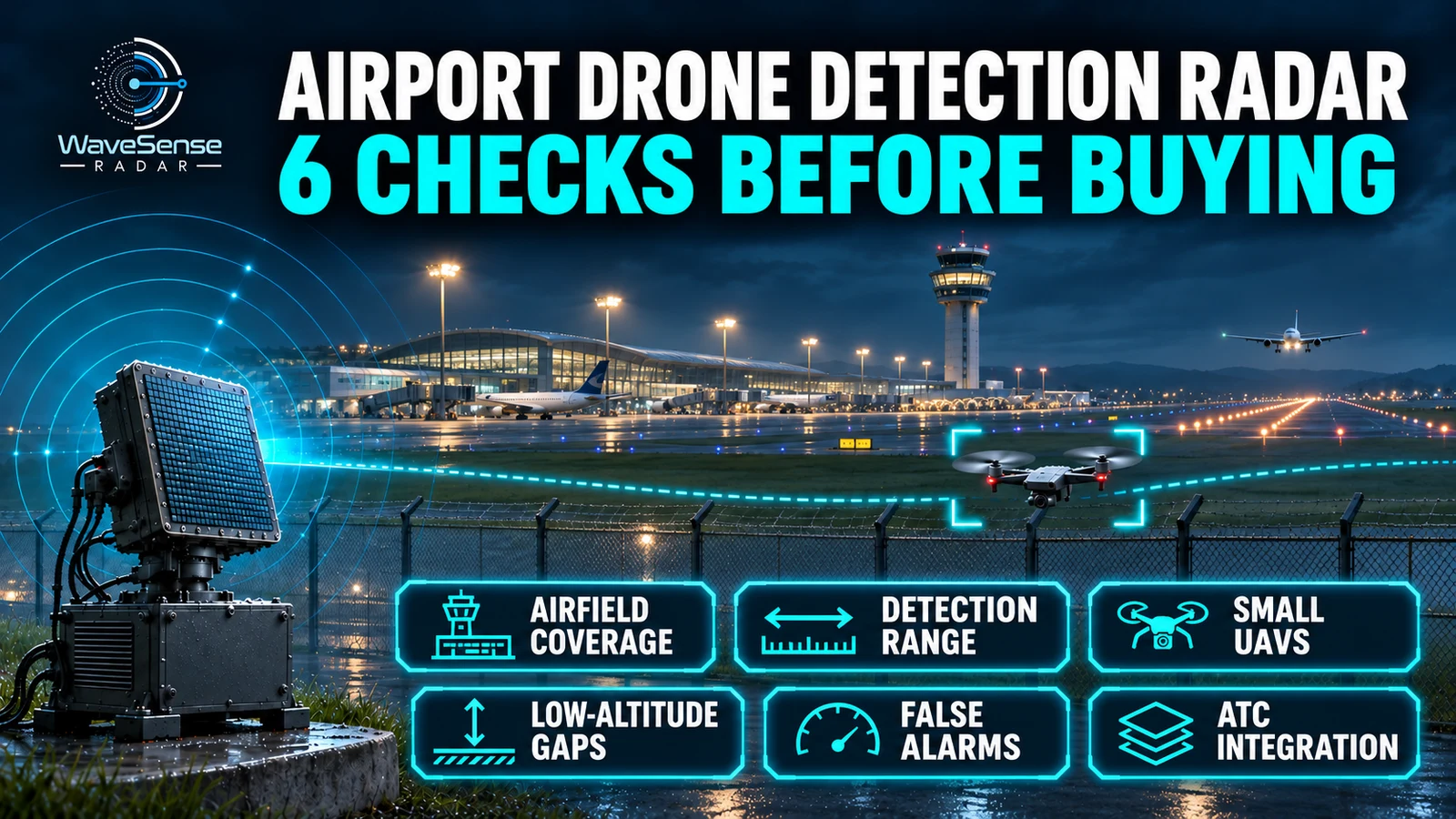
Airport Drone Detection Radar should detect small UAVs early, maintain reliable tracks, and help airport security teams distinguish drones from birds and legitimate aircraft without creating excessive false alerts.
Airports present a difficult environment for drone surveillance. They contain aircraft, birds, vehicles, buildings, and busy radio-frequency systems.
A long advertised detection range does not automatically guarantee effective airport protection.
Before selecting a radar, airport operators should verify six requirements: small-UAV detection, bird classification, tracking, coverage, false alerts, and aviation safety compatibility.
What Should Airport Drone Detection Radar Actually Detect?
An airport radar must recognize small airborne targets without relying only on their control signals.
A purpose-built Drone Detection Radar can detect physical UAV targets, including some autonomous drones that do not transmit recognizable RF signals.
However, detection depends on the drone’s size, radar cross section (RCS), altitude, distance, and surrounding clutter.
Buyers should distinguish three performance measurements:
- Detection range: When does the radar first detect the UAV?
- Tracking range: When can the radar maintain a stable target track?
- Classification range: When can the system identify the target as a probable drone?
These distances may differ.
For example, a radar might detect a small object before collecting enough information to classify it confidently.
Buying advice: Ask the manufacturer to provide detection and tracking results for a defined UAV model or RCS rather than an unspecified maximum range.
How Should Airport Drone Detection Radar Handle Birds?
Birds present one of the biggest challenges for airport drone detection.
Small birds and consumer drones can share similar speeds, altitudes, and radar signatures.
A radar may correctly detect a bird but incorrectly classify it as a UAV.
This creates unnecessary alerts for airport security teams.
The industry guidance from Airports Council International (ACI World) explains the role of radar and other sensors in airport drone detection.
A useful system should consider multiple target characteristics, including:
- Flight trajectory
- Radar cross section
- Speed and movement
- Rotor or wing motion
- Track history
No single feature guarantees correct classification.
Our Bird Vs Drone Radar Detection article explains how radar combines these features.
Why Do False Alerts Matter at Airports?
An incorrect drone alert can require operator attention, camera checks, and additional investigation.
Frequent nuisance alerts may reduce confidence in the surveillance system.
However, overly aggressive filtering can also hide real drones.
Airport operators should therefore measure two outcomes together:
Real UAV detections and unnecessary operator alerts.
For a more detailed explanation of these measurements, see Drone Detection Radar False Alarms.
Where Should Airport Drone Radar Be Installed?
Airport Drone Detection Radar needs a site-specific coverage plan because terminals, hangars, terrain, and other structures can block radar visibility.
A manufacturer may advertise 360° horizontal surveillance, but that does not guarantee complete coverage of the required airspace.
Installation planning should consider:
- Target surveillance area
- Radar mounting height
- Building obstructions
- Antenna elevation coverage
- Overlapping sensor coverage
- Access to power and communications
One long-range radar may not provide reliable coverage across a large or complex airport.
Multiple radar positions may offer better visibility when buildings or terrain create blind zones.
A peer-reviewed 2026 review of airport aerial-object surveillance technologies identifies coverage limitations, target classification, and multi-sensor integration as major challenges for airport detection systems.
Buying advice: Request a coverage assessment that shows the protected surveillance volume and identifies major limitations before choosing equipment locations.
Can Drone Radar Interfere With Airport Equipment?
Airport operators must review electromagnetic compatibility and regulatory requirements before deploying radar.
Radar transmits radio-frequency energy.
The proposed system must operate without creating unacceptable interference with aviation communication, navigation, surveillance, or other airport equipment.
The FAA guidance on UAS detection and mitigation at airports specifically identifies electromagnetic interference, legal considerations, and operational safety as important deployment issues.
For projects in the United States, airport operators should coordinate with the appropriate authorities and review the applicable FAA requirements.
Other countries have their own aviation and spectrum regulations.
A second distinction also matters:
Drone detection is not the same as drone mitigation.
Radar normally detects and tracks targets. Disrupting or disabling an aircraft involves separate capabilities, permissions, and legal restrictions.
Buyers should clearly distinguish these functions when requesting quotations.
What Are the 6 Most Important Airport Drone Radar Checks?
When comparing Airport Drone Detection Radar systems, use the following checklist.
| Check | What Buyers Should Ask |
|---|---|
| 1. Small-UAV detection | Which drone or RCS supports the range claim? |
| 2. Bird classification | How does the radar distinguish birds from drones? |
| 3. Track stability | Can it continuously track the required UAV? |
| 4. Airport coverage | Does the installation plan identify blind zones? |
| 5. False alerts | How many unnecessary operator alerts occur? |
| 6. Aviation compatibility | What interference and regulatory checks are required? |
These six questions help buyers compare real operational requirements instead of marketing features.
Should Airport Radar Work With EO/IR Cameras?
For many airports, yes.
Radar can locate and track an airborne object, while an EO/IR camera helps operators inspect it visually.
A typical workflow includes:
Radar detection → Target tracking → Camera cueing → Visual confirmation
RF detection may add information when the drone transmits a compatible signal.
However, the system should not automatically treat every unidentified airborne object as an unauthorized drone.
Our Drone Detection System: Radar Vs RF Vs EO/IR article explains these complementary sensor roles.
How Should Airport Drone Detection Radar Be Tested?
Airport Drone Detection Radar should pass an authorized, site-specific acceptance test before airport operators rely on it for routine surveillance.
A useful test should include both drone activity and normal airport background conditions.
Test 1: Representative Small UAV
Use an approved test drone and measure first detection, stable tracking, and classification performance.
Test 2: Bird Activity
Observe the system during representative bird activity where practical.
Record how often the system incorrectly identifies non-drone targets as drones.
Test 3: Coverage Verification
Evaluate the agreed surveillance area and identify gaps caused by terrain, buildings, or antenna geometry.
Test 4: Camera Integration
When the system includes EO/IR, verify that the camera can acquire the target using radar track information.
Test 5: Background Monitoring
Record unnecessary operator alerts during normal airport activity.
Test 6: Safety and Documentation
Confirm that the installation meets the applicable aviation, spectrum, and operational requirements. Document the system configuration and test conditions.
The FAA has conducted airport and off-airport UAS detection evaluations to study system effectiveness and potential effects on aviation systems.
All live-flight testing must follow an approved safety plan and applicable airspace authorizations.
Use a simple acceptance record:
| Test Metric | Result |
|---|---|
| Representative UAV / RCS | ___ |
| Stable tracking range | ___ km |
| Classification result | ___ |
| False alerts per hour | ___ |
| Surveillance coverage | ___ |
| Camera acquisition | Pass / Fail |
| Compliance review | Complete / Pending |
Buyers should compare results under consistent settings and clearly documented conditions.
What Should Buyers Ask ChinaWavesense?
Airport projects need more than a generic radar quotation.
Before selecting a product, the buyer should define:
- Required UAV target size
- Surveillance area and range
- Installation location
- Bird and clutter conditions
- Expected camera or RF integration
- Applicable aviation safety requirements
ChinaWavesense lists airport security among its application scenarios, but buyers should request product-specific evidence for their proposed system.
The company should confirm the relevant radar model, verified specifications, available test documentation, and integration requirements before the customer makes a final decision.
For a broader comparison of radar specifications, read our Counter-UAS Radar Buyer’s Guide.
To discuss an airport surveillance project, contact ChinaWavesense with the required detection range, UAV target, installation conditions, and system-integration requirements.
Conclusion
Airport Drone Detection Radar should help security teams detect small UAVs, distinguish them from normal airport activity, and provide reliable information without interfering with aviation operations.
Do not select a radar based only on its maximum detection range.
Focus on six practical requirements:
Detection + Classification + Tracking + Coverage + False Alerts + Aviation Compatibility
A suitable system should demonstrate these capabilities under representative airport conditions.
The best purchasing decision starts with a clear surveillance requirement and ends with documented performance and safety verification.
FAQ
Can Airport Drone Detection Radar Detect Small Drones?
Yes. Suitable radar systems can detect small UAVs, but detection range depends on target RCS, altitude, clutter, and radar design.
Can Airport Radar Distinguish Birds From Drones?
Advanced systems can use movement patterns, micro-Doppler, RCS, and track history to improve classification. Buyers should verify actual false-positive performance.
Can Drone Radar Operate Near Airport Navigation Equipment?
Potentially, but airport operators must verify electromagnetic compatibility, licensing, and applicable aviation requirements before installation.
Is Radar Alone Enough for Airport Drone Detection?
Not always. RF sensors and EO/IR cameras can provide additional information and visual confirmation.
What Should Airports Test Before Buying?
Test small-UAV tracking, bird classification, surveillance coverage, false alerts, sensor integration, and operational compatibility.