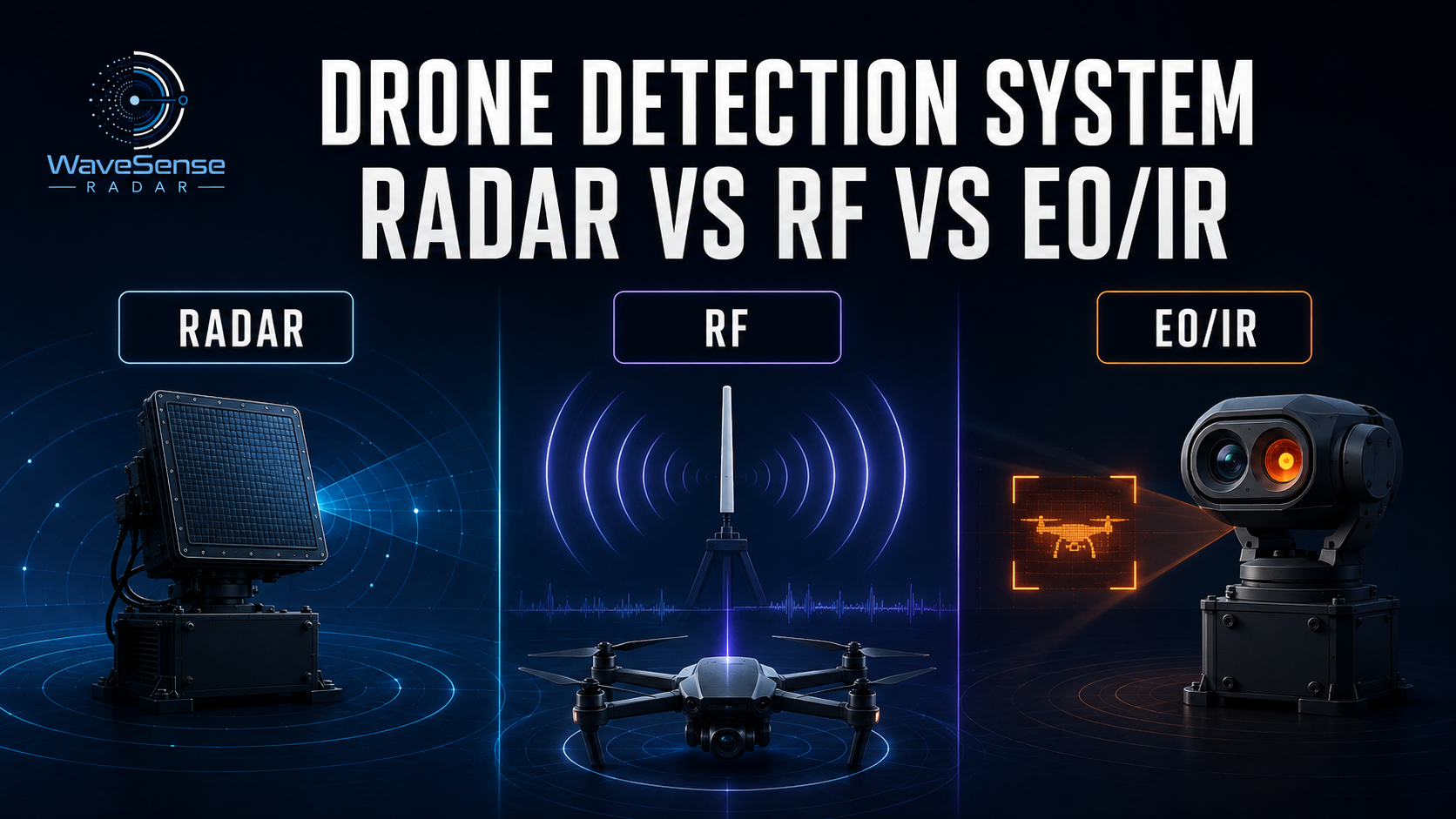
Radar Vs RF Vs EO/IR: Which Is Best For Drone Detection?
There is no universally best drone detection sensor: radar is strongest for finding physical airborne targets, RF is strongest when the drone is transmitting recognizable signals, and EO/IR is strongest for visual confirmation.
The practical question is not which sensor wins.
It is:
Which sensor should detect first, which should verify the target, and what happens when one sensor fails?
That distinction matters because an autonomous RF-silent drone, a low-RCS quadcopter, and a legitimate drone transmitting Remote ID create very different sensing problems.
The 2026 JIATF-401 C-UAS guide similarly describes radar, RF, and EO/IR as sensing different evidence rather than interchangeable technologies. Radar measures physical airborne objects, RF analyzes transmitted signals, while EO/IR helps visually confirm targets detected by other sensors.
What Does Each Drone Detection Sensor Actually See?
The easiest way to compare technologies is to stop comparing their marketing specifications and ask what physical evidence each sensor requires.
| Sensor | What It Actually Detects | Target Must Transmit? | Best Role |
|---|---|---|---|
| Radar | Reflected RF energy from a physical object | No | Wide-area detection and tracking |
| RF Detection | Drone/controller/telemetry transmissions | Usually yes | Signal detection and identity context |
| EO/IR | Visible or thermal image of target | No | Confirmation and classification |
This immediately explains why one sensor cannot replace all the others.
Radar
Radar can detect a drone even when the aircraft does not transmit a recognizable control or telemetry signal.
It also provides measurements such as:
- Range
- Azimuth
- Elevation
- Velocity
- Track history
Its main weakness is that small drones can have low radar cross section and may operate inside strong ground clutter.
For the underlying detection problem, see our Drone Detection Radar article.
RF Detection
RF sensors listen for electromagnetic emissions associated with the UAV ecosystem.
Depending on the system and signal, RF sensing may provide information about:
- Drone activity
- Communication frequency
- Signal direction
- Protocol characteristics
- Controller location
- Remote ID
Its fundamental limitation is simple:
No useful transmission means less useful RF evidence.
The 2026 U.S. counter-UAS guidance notes that RF sensors passively scan control, telemetry, and video-related signals and compare their technical characteristics with known signatures.
EO/IR
EO/IR provides something radar and RF cannot provide as effectively:
visual evidence.
Once another sensor reports a target location, a PTZ EO/IR unit can point toward it and attempt to determine whether the object is actually:
- A drone
- Bird
- Aircraft
- Balloon
- Other object
FAA technical guidance has historically treated EO/IR mainly as a validation or secondary sensor rather than the preferred primary wide-area detector.
Where Does Each Sensor Fail?
This is more useful than another “advantages and disadvantages” table.
A good Drone Detection System should be designed around sensor failure modes.
Radar Failure Mode: Weak Or Cluttered Physical Return
Radar becomes difficult when a target combines:
Small RCS + low altitude + unfavorable aspect + strong clutter.
A small UAV near:
- Buildings
- Terrain
- Trees
- Vehicles
can be harder to separate from its environment.
Radar also cannot automatically identify the operator or communication protocol.
Its output may initially be:
Physical airborne target — probable drone
rather than a specific aircraft identity.
Drone RCS is also highly dependent on orientation and frequency rather than being one fixed value. Our Radar Cross Section Of A Drone page explains why this matters.
RF Failure Mode: Nothing Useful To Listen To
RF detection becomes weaker when a drone:
- Follows a pre-programmed route
- Operates autonomously
- Uses an unsupported frequency
- Uses an unfamiliar waveform
- Minimizes transmissions
FAA technical considerations specifically recommend asking whether a system can detect fully autonomous UAS without RF capability.
This is an important procurement question because RF-only detection assumes the threat will cooperate electromagnetically.
EO/IR Failure Mode: It Cannot Find What It Cannot See
EO/IR performance depends heavily on:
- Line of sight
- Target size
- Background contrast
- Weather
- Visibility
- Camera field of view
A zoomed camera can provide excellent identification but observes only a narrow region.
That makes EO/IR much stronger when radar or RF has already supplied a location.
The camera answers:
“What is that object?”
better than:
“Search the entire airspace and find anything suspicious.”
Which Sensor Should Be The Primary Detector?
This depends on the threat model.
There is no reason to force the same architecture onto every project.
Critical Infrastructure With RF-Silent Drone Risk
Recommended primary layer: Radar
Radar should usually carry the wide-area physical detection role when the site must detect:
- Autonomous UAVs
- Unknown protocols
- RF-silent aircraft
RF can then add signal intelligence when transmissions exist.
EO/IR provides confirmation.
A practical architecture becomes:
Radar → Track → EO/IR Confirmation
with:
RF → Additional Evidence
rather than making the RF detector a single point of failure.
Site Dominated By Commercial Consumer Drones
Recommended approach: Radar + RF
If the main threat consists of common consumer drones using known radio links, RF can provide highly valuable information.
Radar adds resilience against aircraft that:
- Do not match the RF library
- Lose communication
- Operate autonomously
The two sensors answer different questions.
Radar asks:
Is a physical aircraft there?
RF asks:
Is recognizable drone-related RF activity present?
Airport
Recommended approach: Radar-led multi-sensor architecture
Airports already contain:
- Aircraft
- Birds
- Vehicles
- RF activity
- Complex infrastructure
One sensor is unlikely to provide enough information.
FAA guidance specifically recommends evaluating which sensors serve as primary detection and which serve as secondary validation, rather than assuming one sensing technology should perform every role.
Radar provides physical track information.
RF may provide complementary signal evidence.
EO/IR helps operators visually inspect suspicious tracks.
Urban Facility
The decision becomes more complicated.
Buildings can block radar line of sight.
They can also block or distort RF propagation.
EO/IR may suffer from visual obstruction.
The correct answer is often not:
“Which technology is best?”
It is:
“Where should several sensors be placed so their blind zones do not overlap?”
Sensor placement can become more important than the brand name of the sensor.
Temporary Event
A temporary event may prioritize:
- Fast installation
- Low power consumption
- Reduced infrastructure
- Rapid operator training
RF sensing can be attractive where expected drones use conventional communication links.
Radar becomes more important when physical detection of non-cooperative UAVs is part of the requirement.
The correct architecture should follow the threat, not a fixed Counter-UAS template.
Why “Radar + RF + EO/IR” Is Not Automatically A Good System
Buying three different sensors does not create sensor fusion.
It can simply create:
three independent alert systems.
Suppose:
Radar reports Target 17.
RF reports Device 4.
Camera reports Object B.
The C2 software still needs to determine whether all three observations refer to the same drone.
This is the real fusion problem.
Recent research reviewing multimodal UAV sensing similarly concludes that no single sensing modality performs reliably across every degraded environment, while fusion improves resilience only when the individual sensor limitations and deployment conditions are understood.
What Should Sensor Fusion Actually Do?
A useful fusion layer should perform four functions.
Associate
Determine whether different sensor observations belong to the same target.
Increase Or Reduce Confidence
For example:
Radar track only → Possible UAV
then:
Radar + RF correlation → Higher confidence
then:
EO/IR visual confirmation → Confirmed drone
Manage Contradictions
What if:
Radar says probable drone.
RF reports nothing.
Camera cannot acquire the target.
The system should not automatically declare:
Not a drone.
RF silence is evidence absence, not evidence that the physical target does not exist.
Preserve Degraded Operation
A good system should still function when one sensor is unavailable.
For example:
RF lost → Radar tracking continues
or:
Camera visibility poor → Radar + RF maintain awareness
This is a much stronger design principle than simply maximizing sensor count.
How Should Buyers Compare Drone Detection Systems?
Instead of asking vendors to fill in one generic comparison table, use a threat-to-sensor matrix.
| Requirement | Radar | RF | EO/IR |
| Detect RF-silent drone | Strong | Weak | Possible but difficult for search |
| Wide-area physical tracking | Strong | Limited/indirect | Limited |
| Detect known communication signals | No | Strong | No |
| Locate controller | No | Potentially strong | No |
| Visual confirmation | Limited | No | Strong |
| Night operation | Strong | Strong | Strong with suitable IR |
| Dense ground clutter | Challenging | Environment-dependent | Background-dependent |
| Exact drone visual evidence | Weak | Limited | Strong |
| Autonomous drone resilience | Strong | Weak | Moderate after acquisition |
The point is not to assign a universal winner.
The table identifies which evidence disappears when a particular technology fails.
What Should A Drone Detection System RFQ Ask?
A good RFQ should not begin with:
“We need Radar + RF + EO/IR.”
That already assumes the architecture before defining the problem.
Start with the mission.
Threat
Define:
- Consumer multirotor?
- Fixed-wing UAV?
- Autonomous?
- RF-silent?
- Multiple drones?
- Small low-RCS aircraft?
Required Warning Time
Determine how early a track must be available.
Required Evidence
Do operators need:
- Physical detection?
- Visual confirmation?
- Controller location?
- Classification?
- Recorded evidence?
Environment
Define:
- Open terrain
- Urban
- Airport
- Industrial
- Coastal
- Mountainous
Failure Requirement
Ask:
If RF does not detect anything, must the system still detect the drone?
If yes, RF cannot be the only primary sensor.
Similarly:
If camera visibility is poor, must tracking continue?
If yes, EO/IR cannot be the only tracking mechanism.
This failure-first approach is more useful than comparing sensor brochure ranges.
How Should Radar, RF And EO/IR Be Field-Tested Together?
Do not test each sensor only under its easiest scenario.
Use several target states.
| Test | What It Reveals |
| Normal controlled drone | Baseline system operation |
| Autonomous waypoint flight | RF dependency |
| Hovering UAV | Radar low-Doppler performance |
| Tangential flight | Radar geometry |
| Low-altitude flight | Ground-clutter performance |
| Night flight | EO/IR performance |
| Camera obstruction | Fusion degraded mode |
| Multiple drones | Association and tracking |
| Bird activity | Classification / false alerts |
The test should record which sensor detected first, which sensor confirmed the target, and what happened when another sensor failed.
That produces much more useful evidence than asking:
“What is your maximum detection range?”
What Does A Good Multi-Sensor Workflow Look Like?
For many high-security sites, a practical sequence is:
1. Radar detects a physical airborne target.
The system obtains position and movement.
2. RF checks for associated transmissions.
If present, the system gains additional signal context.
3. EO/IR receives the radar track.
The camera slews toward the target.
4. Fusion software combines evidence.
Classification confidence changes as evidence accumulates.
5. Operator receives one target event.
Not three unrelated alerts.
That final point is critical.
A good Drone Detection System should reduce operator uncertainty.
It should not simply increase the number of sensors displayed on the screen.
When Is Radar-Only Detection Enough?
Radar-only can be sufficient when the main requirement is:
- Physical detection
- Position
- Velocity
- Tracking
and exact visual identification is not required immediately.
It may also be appropriate as one sensor inside another integrator’s C2 architecture.
However, radar-only installations must accept limitations in:
- Visual identification
- Controller information
- Signal context
The decision depends on what the customer needs to do after detection.
When Is RF-Only Detection Enough?
RF-only can make sense when:
- Expected targets use known commercial links
- Cost and passive operation are priorities
- Physical detection of silent autonomous targets is not required
The buyer should explicitly accept the architecture’s assumption:
The relevant drone must produce a detectable signal.
If that assumption is unacceptable, RF should not be the only primary sensor.
When Is EO/IR-Only Detection Enough?
EO/IR-only solutions can work in narrow, visually controlled scenarios.
However, for broad Counter-UAS airspace surveillance, EO/IR usually becomes more valuable after another sensor has already narrowed the search region.
The 2026 U.S. C-UAS guide describes cameras specifically as tools that may visually confirm targets once radar or RF has detected them.
This is why EO/IR should often be evaluated on:
- Acquisition time after cueing
- Tracking stability
- Identification distance
rather than only its maximum optical zoom.
Which Drone Detection Architecture Should You Choose?
For most serious projects, choose the architecture according to the failure you cannot tolerate.
1.If an RF-silent UAV cannot be missed:
Radar should remain part of the primary detection layer.
2.If identifying the controller or RF protocol matters:
RF detection becomes valuable.
3.If operators require visual evidence:
EO/IR should be integrated for confirmation.
4.If the site is high-value and threats are uncertain:
Use layered sensing with proper track correlation.
The important principle is:
Do not buy three sensors because “multi-sensor” sounds more advanced. Give each sensor a defined job.
Conclusion
The best Drone Detection System is not Radar, RF, or EO/IR alone—it is the architecture that continues producing useful target information when one sensing method reaches its physical limitation.
Radar is usually the strongest layer for non-cooperative physical detection and tracking.
RF provides valuable signal and identity-related context when suitable transmissions exist.
EO/IR provides the visual confirmation operators often need before making a decision.
The engineering question should therefore move from:
“Which sensor is best?”
to:
“What evidence does my security workflow require, and which sensor is responsible for producing that evidence when the other sensors fail?”
That is the basis of a reliable Counter-UAS detection architecture.
FAQ
Can Radar Detect A Drone Without RF Signals?
Yes. Radar detects electromagnetic reflections from the physical aircraft and does not require an active drone-control link.
Can RF Detection Find Autonomous Drones?
Not reliably if the aircraft emits no relevant detectable transmission. FAA technical considerations specifically identify fully autonomous UAS without RF capability as a scenario buyers should evaluate.
Is EO/IR Good For Primary Drone Detection?
It can perform detection in suitable conditions, but EO/IR is often more effective as a confirmation and tracking sensor after radar or RF has supplied a target location.
Should A Counter-UAS System Use Radar And RF Together?
For many higher-security applications, yes. The two technologies observe different evidence and fail for different reasons.
Why Is Sensor Fusion Important?
Because radar, RF, and EO/IR may all observe the same target differently. Fusion determines whether those observations belong to one aircraft and converts them into one operational event instead of multiple disconnected alerts.