What Is The Radar Cross Section Of A Drone?
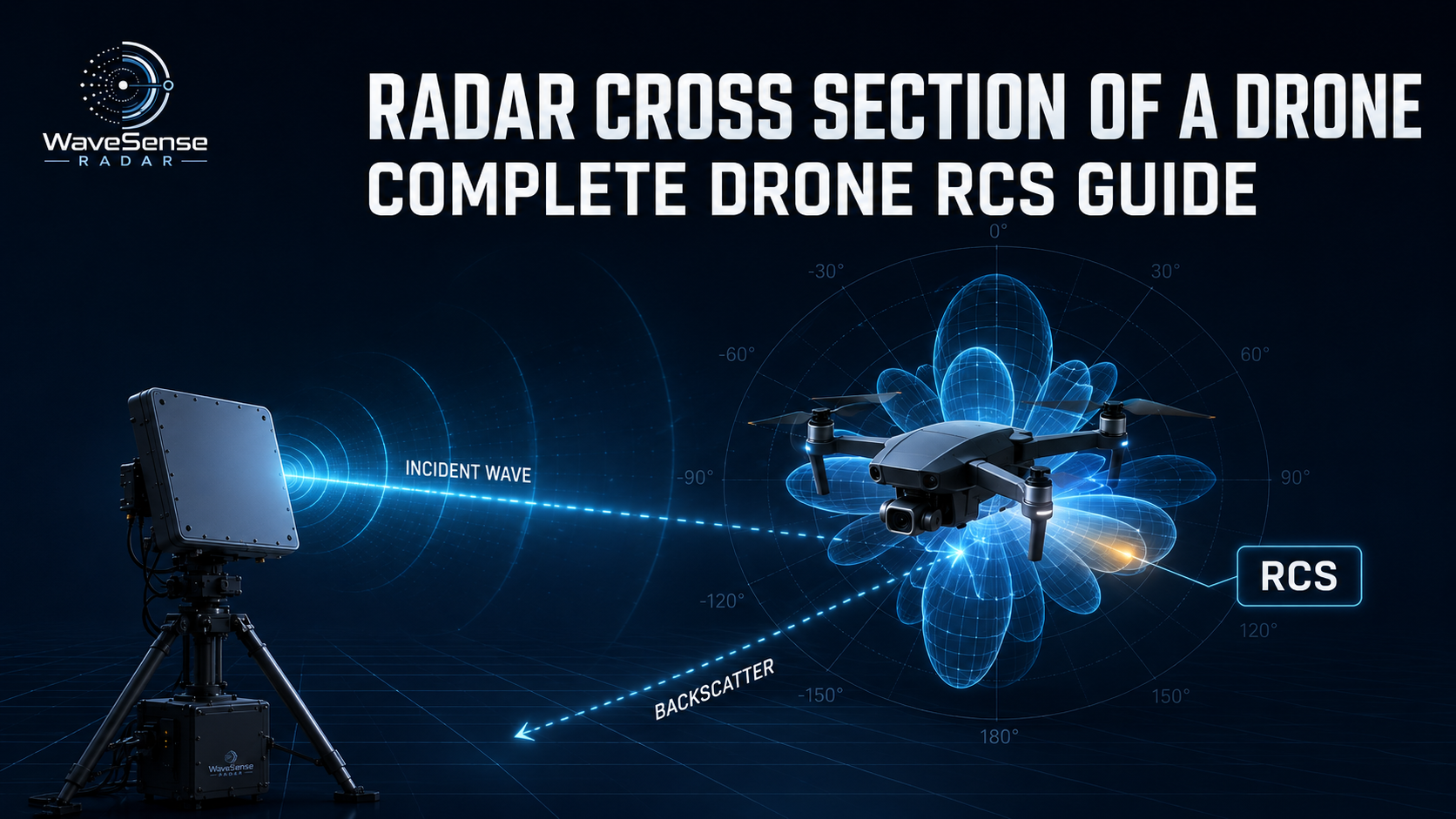
The Radar Cross Section Of A Drone is not one fixed number; it is a changing electromagnetic signature influenced by the UAV’s size, shape, material, orientation, radar frequency, polarization, payload, and measurement conditions.
This is why a statement such as “this drone has an RCS of 0.01 m²” should always be interpreted together with the test conditions.
Laboratory measurements of commercial UAVs confirm that measured RCS changes with frequency and viewing direction.
What Does RCS Mean?
Radar Cross Section, abbreviated RCS, describes how strongly a target scatters incident radar energy back toward a radar receiver.
RCS is normally expressed in square meters or logarithmically as dBsm.
A larger RCS generally makes a target easier for a given radar to detect under the same conditions.
A smaller RCS produces a weaker return and typically requires greater radar sensitivity, more processing gain, shorter range, or a combination of these factors.
Is Drone RCS The Same As Physical Size?
No.
A drone with an area of 0.5 m² does not automatically have an RCS of 0.5 m².
Radar cross section describes electromagnetic scattering rather than physical surface area.
A target’s apparent radar size depends on:
- Geometry
- Material
- Frequency
- Polarization
- Aspect angle
- Internal components
Two physically similar UAVs can therefore generate very different radar returns.
Why Do Drones Usually Have A Small Radar Cross Section?
Many commercial drones combine small dimensions with plastic, composite materials, narrow structural members, and relatively small conductive components.
These characteristics can produce weak radar echoes compared with larger aircraft.
Their low-altitude operation also places those weak echoes close to strong reflections from terrain and buildings.
This combination makes small UAV detection particularly challenging for conventional surveillance radar.
What Is A Low-RCS Drone?
A Low-RCS Drone is a UAV whose radar return is relatively weak under the radar configuration being used.
“Low RCS” should not be treated as a universal classification.
A drone may show a weak return from one direction and a significantly stronger return from another.
Its apparent RCS may also change when radar frequency or polarization changes.
What Is A Typical Drone RCS?
There is no single reliable typical drone RCS that applies to every UAV.
Published measurements cover different:
- Drone models
- Radar bands
- Aspect angles
- Polarizations
- Test environments
- Measurement methods
For example, research has measured commercial UAV signatures at 15 GHz and 25 GHz and found meaningful variation between frequencies and directions.
This is more useful than assigning every “small drone” one fixed value.
Why Is Giving One Drone RCS Number Misleading?
A single value removes the conditions under which the measurement was obtained.
Suppose a datasheet states:
Drone RCS: 0.01 m²
The buyer still does not know:
- At what frequency?
- From which aspect?
- With which polarization?
- Was the drone powered?
- Was a payload installed?
- Was this peak, mean, median, or minimum RCS?
- Was it measured in flight or in a chamber?
Without this information, meaningful radar comparison becomes difficult.
Does Drone RCS Change With Viewing Angle?
Yes.
The radar may illuminate:
- Front
- Rear
- Side
- Top
- Bottom
- Intermediate angles
Each direction exposes different scattering surfaces.
Laboratory measurements show that UAV radar signatures vary with azimuth angle, with stronger reflections occurring in particular directions.
Therefore, the same drone can become easier or harder to detect while turning.
What Is Aspect Angle?
Aspect angle describes the orientation of the target relative to the radar line of sight.
For a UAV, the aspect changes when it:
- Turns
- Banks
- Climbs
- Descends
- Changes heading
- Rotates while hovering
Because different parts of the airframe face the radar, the resulting electromagnetic scattering pattern also changes.
Aspect-dependent RCS is therefore important when modeling real drone trajectories.
Why Can A Turning Drone Suddenly Become More Visible To Radar?
A turn changes the surfaces and scattering centers facing the radar.
A battery, motor, arm, payload, landing structure, or other component may produce a stronger reflection at one orientation than another.
The radar return can therefore rise or fall even when distance remains almost unchanged.
This is one reason drone radar tracks may contain fluctuating signal strength.
Does Radar Frequency Affect Drone RCS?
Yes.
RCS depends partly on the relationship between radar wavelength and target geometry.
Measurements of small commercial UAVs at 15 GHz and 25 GHz found different average RCS values at the two frequencies, with the tested drones producing stronger average reflections at 25 GHz in that particular experiment.
That result should not be generalized into “higher frequency is always better.”
Radar design involves many additional variables.
Why Can’t RCS From One Frequency Be Used For Every Radar?
An RCS value measured at one frequency does not automatically describe how the same drone will behave at another frequency.
Changing wavelength changes electromagnetic interaction with:
- Arms
- Motors
- Battery
- Propellers
- Wiring
- Frame
- Payload
This means a UAV RCS database should specify frequency rather than listing one universal value.
Does Radar Band Matter For UAV Detection?
Yes.
Drone detection radars may operate in different bands depending on their required range, resolution, antenna size, environmental performance, and target characteristics.
Research has characterized UAV radar signatures across microwave and millimeter-wave frequencies precisely because RCS is frequency dependent.
The best operating band therefore depends on the complete radar architecture.
Does Polarization Affect Drone RCS?
Yes.
Radar polarization describes the orientation of the transmitted and received electromagnetic fields.
Common measurement configurations include:
- HH
- VV
- HV
- VH
Research using multiple commercial UAVs found that measured RCS depends partly on polarization.
For this reason, RCS test data should identify the polarization configuration.
Can Polarization Help Classify Different Drones?
Potentially.
Different UAV structures interact differently with differently polarized radar signals.
Combining polarization-dependent RCS with other information can provide additional target features.
Research into UAV recognition has used RCS measurements across different polarizations and frequencies as inputs for statistical and machine-learning classification.
However, classification performance depends on the complete dataset and operating environment.
Does Drone Material Affect RCS?
Yes.
Electromagnetic scattering depends partly on the electrical properties of target materials.
Commercial UAVs may contain combinations of:
- Plastic
- Carbon fiber
- Aluminum
- Copper
- Steel
- Batteries
- Electronic boards
Material composition therefore contributes to the overall UAV radar signature.
Does Carbon Fiber Make A Drone Invisible To Radar?
No.
Carbon-fiber construction does not make a UAV automatically invisible.
A complete drone contains many scattering elements, including:
- Motors
- Battery
- Wiring
- Electronics
- Fasteners
- Payload
- Propellers
The final RCS depends on the entire target rather than one material.
“Carbon fiber equals radar invisible” is therefore an oversimplification.
Which Drone Component Contributes Most To RCS?
The answer depends on drone design and measurement frequency.
One experimental study of several small drones found that the battery had a particularly large influence on measured RCS for the tested UAV configurations.
This is important because two versions of the same airframe may show different signatures after changing batteries, payloads, or electronic components.
Can A Payload Change Drone RCS?
Yes.
Adding a payload changes:
- Geometry
- Mass distribution
- Conductive surfaces
- Orientation
- Scattering centers
A camera, sensor, communication module, battery, or other equipment may change the overall radar signature.
A radar specification tested with an empty UAV should therefore not automatically be assumed to represent every operational payload configuration.
Do Drone Propellers Affect Radar Cross Section?
Yes.
Propellers can contribute time-varying reflections as they rotate.
Their motion also generates micro-Doppler signatures.
This means rotating blades can provide information that is not visible from a static RCS number alone.
Micro-Doppler research uses these rotational features to support UAV detection and classification.
Static RCS Vs Dynamic RCS
Static RCS measures the target under controlled orientation or limited movement.
Dynamic RCS describes how the radar signature changes as the UAV moves through realistic flight attitudes.
A flying drone continuously changes:
- Aspect angle
- Position
- Pitch
- Roll
- Yaw
- Rotor state
Dynamic measurements can therefore provide information that a single static measurement cannot represent.
Is Laboratory RCS The Same As In-Flight RCS?
Not necessarily.
Anechoic chambers provide controlled conditions that help isolate target scattering.
Real flight introduces:
- Changing attitude
- Propeller movement
- Terrain reflections
- Multipath
- Atmospheric propagation
- Background clutter
Laboratory RCS remains extremely useful, but field performance should also be validated under representative operational conditions.
Why Are Anechoic Chambers Used For RCS Measurement?
An anechoic chamber reduces unwanted electromagnetic reflections.
This allows researchers to isolate the target more effectively and measure its scattering behavior under controlled conditions.
Commercial UAV studies have used compact-range anechoic chambers to measure RCS at multiple frequencies and angles.
This creates repeatable data suitable for comparison and modeling.
What Is Compact-Range RCS Measurement?
Compact-range measurement creates conditions that approximate the plane-wave illumination expected in far-field radar operation while using a practical indoor facility.
This method is useful because accurate RCS characterization requires careful control of:
- Illumination
- Calibration
- Target position
- Reflections
- Measurement distance
A detailed example is available in the Compact-Range RCS Measurements And Modeling Of Small Drones study.
Why Does Far-Field Measurement Matter?
RCS is formally defined using far-field scattering behavior.
When a target is too close to an antenna, the electromagnetic wavefront and field distribution may differ from far-field conditions.
Accurate RCS measurement therefore requires an appropriate measurement geometry or a test range designed to reproduce suitable illumination.
How Is Drone RCS Measured?
A typical controlled measurement process includes:
- Calibrating the measurement system.
- Positioning the UAV in a controlled environment.
- Illuminating it with radar energy.
- Measuring the scattered signal.
- Changing the target angle.
- Repeating across the required frequencies or polarizations.
- Removing background contributions.
- Converting the measured response into RCS.
The exact methodology varies by test facility.
What Is RCS Calibration?
Calibration uses a reference target with known electromagnetic properties to verify the measurement system.
Without calibration, antenna response, propagation loss, equipment gain, and background reflections can distort the apparent target signature.
High-quality UAV RCS experiments therefore describe calibration procedures rather than reporting unexplained numbers.
Can Drone RCS Be Calculated With Simulation?
Yes.
Electromagnetic simulation can estimate RCS before physical testing.
Simulation may use a detailed 3D UAV model and evaluate different:
- Frequencies
- Aspect angles
- Polarizations
- Materials
A fixed-wing UAV study used numerical RCS simulation to investigate target signatures and estimate detection and classification distances.
Physical measurements remain valuable for validating simulation assumptions.
Simulation Vs Measurement: Which Is Better?
Neither should automatically replace the other.
Simulation provides:
- Repeatability
- Fast parameter changes
- Wide angle coverage
- Design-stage analysis
Measurement captures:
- Real materials
- Real components
- Manufacturing details
- Unexpected scattering behavior
The strongest UAV RCS characterization programs often compare simulated and measured results.
Can You Estimate Drone RCS From A Photograph?
Not reliably.
A photograph cannot reveal enough information about:
- Material conductivity
- Internal electronics
- Battery structure
- Hidden components
- Frequency-dependent scattering
- Polarization response
Physical dimensions may help create a preliminary model, but accurate RCS requires electromagnetic simulation or measurement.
Mean RCS Vs Peak RCS
Mean RCS summarizes radar return over a defined set of observations.
Peak RCS describes stronger reflections occurring at particular orientations or conditions.
A drone may have a modest mean RCS but occasional strong peaks.
A radar datasheet that reports only peak RCS can therefore make a target appear easier to detect than it is throughout an entire flight.
What Is Minimum RCS?
Minimum RCS represents a low-reflectivity condition within a defined dataset or orientation range.
This value can be important for radar design because detection reliability may degrade when the drone presents its weakest aspect.
However, minimum RCS should always be reported together with:
- Frequency
- Angle
- Polarization
- Measurement method
Otherwise, the value lacks sufficient context.
Mean RCS Or Minimum RCS: Which Matters More?
It depends on the design objective.
Mean RCS helps describe typical target behavior.
Minimum RCS helps evaluate difficult detection conditions.
Peak RCS shows favorable orientations.
For security radar procurement, relying on peak RCS alone is risky.
Reliable systems should be evaluated against realistic distributions and difficult target aspects.
Why Should Drone RCS Be Treated Statistically?
A UAV’s radar return fluctuates as orientation and operating conditions change.
Therefore, RCS can be represented as a statistical distribution rather than a constant.
Research on commercial UAVs found that distributions such as lognormal, gamma, and generalized extreme-value models can describe measured RCS data better than assuming a simple fixed value.
This approach is more realistic for radar performance modeling.
What Is An RCS Probability Distribution?
An RCS probability distribution describes how frequently different radar-return levels occur.
Instead of saying:
RCS = 0.01 m²
a statistical representation answers:
- How often is RCS near 0.01 m²?
- How often is it lower?
- How often does it produce strong peaks?
- How much does it fluctuate?
This gives radar engineers more useful information for probability-of-detection calculations.
What Is A Swerling Model?
Swerling models are statistical target-fluctuation models used in radar engineering.
They represent targets whose radar returns vary during observations or scans.
Real drones are complex targets with multiple scattering centers, so fluctuating-target models may be more realistic than assuming constant RCS.
The correct statistical model depends on the actual measured data.
How Does RCS Affect Radar Detection Range?
All else being equal, a target with stronger RCS can generally be detected farther away than a weaker target.
In the simplified monostatic radar range equation, maximum range depends approximately on the fourth root of target RCS.
This relationship is important.
A modest increase in detection distance can require a much larger increase in target RCS or radar-system performance.
Does 10 Times More RCS Mean 10 Times More Detection Range?
No.
Detection range does not scale linearly with RCS.
Under the simplified radar-range relationship, increasing RCS by a large factor produces a much smaller increase in maximum range.
This explains why manufacturers cannot convert one target’s detection range directly into another target’s range using simple proportional scaling.
Environmental clutter creates additional uncertainty.
Why Should Radar Detection Range Always Include Target RCS?
Consider two specifications:
Radar A: 10 km detection range
Radar B: 8 km detection range
Radar A appears better.
But suppose Radar A used a relatively large UAV while Radar B used a much smaller low-RCS target.
Without target information, the kilometer figures cannot be fairly compared.
The FAA likewise identifies target RCS as an important radar performance consideration for UAS detection. See the FAA UAS Detection Technical Considerations.
What Should A Professional Detection-Range Specification Look Like?
Instead of:
Detection Range: 10 km
a more useful specification identifies:
Target: Defined UAV or RCS
Frequency: Defined radar band
Altitude: Defined
Range: Defined
Probability Of Detection: Defined
False Alarm Criterion: Defined
Environment: Defined
This gives procurement teams enough context to judge whether performance matches their project.
Can A Radar Detect A 0.01 m² Drone?
Potentially, but RCS alone cannot determine the answer.
Detection also depends on:
- Transmit power
- Antenna gain
- Receiver sensitivity
- Waveform
- Processing gain
- Radar bandwidth
- Clutter
- Target altitude
- Required Pd
- Detection threshold
A quoted RCS therefore describes the target, not the complete radar performance.
Why Can’t Drone Detection Range Be Predicted From RCS Alone?
The theoretical radar equation assumes simplified propagation and noise conditions.
Real deployments add:
- Terrain
- Buildings
- Vegetation
- Interference
- Multipath
- Weather
- Ground clutter
- Target maneuvering
A radar capable of detecting a particular RCS in an open test range may achieve different performance at an industrial site or inside a city.
Does Altitude Change Drone RCS?
Altitude does not simply transform the physical target into a new RCS value.
However, altitude changes the radar environment around the target.
A very low drone may appear close to strong ground clutter.
A higher target may have a cleaner background and better line of sight.
Therefore, apparent detectability can change significantly even when the intrinsic target-scattering characteristics remain similar.
Does Distance Change Drone RCS?
The intrinsic RCS is a target-scattering property under defined electromagnetic conditions.
Distance primarily changes received signal strength through propagation loss.
However, measurement geometry, near-field effects, aspect, multipath, and atmospheric conditions can complicate real measurements.
This is another reason field observations should not be interpreted as a pure RCS value without calibration.
Drone RCS Vs Radar Signal Strength
These terms are related but different.
RCS describes the target’s scattering behavior.
Received signal strength depends on the complete radar link, including:
- Transmit power
- Antenna gain
- Range
- Propagation
- Target RCS
- Receiver characteristics
A weak radar return does not automatically mean the drone has one particular RCS.
Drone RCS Vs Signal-To-Noise Ratio
Signal-to-Noise Ratio, or SNR, describes how strong the received target signal is relative to noise.
RCS contributes to received signal level.
However, SNR also depends on radar hardware, bandwidth, processing, range, and environmental noise.
UAV classification research has shown that classification accuracy can change significantly as SNR changes.
Drone RCS Vs Micro-Doppler
RCS describes overall electromagnetic scattering strength.
Micro-Doppler describes small frequency modulations produced by moving target components such as rotors.
A radar can therefore use:
RCS → How strongly does the target reflect?
Micro-Doppler → What internal motion does the target contain?
Combining both features can improve drone classification.
Can RCS Identify A Drone Model?
RCS can contribute to UAV identification, but it should not be treated as a unique fingerprint under every condition.
Research has demonstrated statistical UAV recognition using measured RCS signatures across multiple commercial drones.
However, real-world classification must account for variations in:
- Orientation
- Payload
- Frequency
- SNR
- Environment
Multiple radar features generally provide stronger classification than a single RCS value.
Can AI Classify Drones Using RCS?
Yes.
Machine-learning algorithms can learn patterns from measured RCS datasets.
Research comparing statistical learning, machine learning, and deep learning has shown that RCS features can support classification among different commercial UAV types under controlled datasets.
The result does not mean every field radar will achieve the same accuracy.
Training data and operational conditions matter.
Why Is An RCS Database Useful?
An UAV RCS database can store radar signatures for different:
- Drone models
- Frequencies
- Polarizations
- Aspect angles
- Payloads
Radar processing software can compare new observations against known target distributions.
This can support:
- Classification
- Simulation
- Radar design
- Detection-performance analysis
A larger and more representative dataset generally improves engineering usefulness.
Can Birds Have Similar RCS To Drones?
Yes.
Small drones and birds can produce overlapping radar-return levels at some frequencies.
This creates a major challenge for radar systems that rely only on target strength.
Research on small-UAV RCS specifically notes the similarity between bird and drone RCS in some conditions.
Radar systems therefore often examine movement and micro-Doppler characteristics in addition to RCS.
Why Can’t Radar Classify A Target Based Only On Size?
Radar does not directly observe physical dimensions in the same way as a photograph.
It receives electromagnetic echoes.
A weak target might be:
- Small drone
- Bird
- Distant object
- Low-reflectivity aircraft
Classification therefore benefits from combining:
- RCS
- Velocity
- Trajectory
- Micro-Doppler
- Range
- Track behavior
Multirotor Drone RCS Vs Fixed-Wing UAV RCS
These UAV types have different structures and flight behaviors.
Multirotor platforms contain several:
- Arms
- Motors
- Rotors
Fixed-wing UAVs may contain:
- Wings
- Fuselage
- Tail surfaces
- Propulsion systems
Their scattering patterns therefore differ.
Fixed-wing RCS research has demonstrated strong dependence on geometry, aspect, and radar configuration.
Nano Drone RCS Vs Commercial Drone RCS
Nano drones generally present more difficult radar targets because of their smaller physical dimensions.
However, size alone should not be used to assign an exact RCS.
Frequency, materials, electronics, geometry, and orientation still matter.
Researchers have therefore performed dedicated three-dimensional RCS measurements specifically for nano-drones instead of assuming values from larger UAVs.
Does A Larger Drone Always Have Higher RCS?
Not necessarily at every angle and frequency.
Larger dimensions generally provide more potential scattering area, but electromagnetic interaction remains complex.
A smaller target may occasionally present a strong reflective orientation.
A larger composite UAV may show a weak aspect.
RCS comparison should therefore rely on measured distributions rather than physical size alone.
Can Drone RCS Change During One Flight?
Yes.
During flight, a UAV can continuously change:
- Yaw
- Pitch
- Roll
- Heading
- Payload orientation
- Propeller state
The radar consequently observes changing aspect angles and scattering centers.
Modern dynamic RCS modeling treats UAV signature as a time-varying quantity rather than a fixed constant.
Why Is In-Flight RCS Data Valuable?
In-flight data captures target behavior that static chamber measurements may not reproduce fully.
It can reveal:
- Dynamic aspect changes
- Rotor effects
- Real trajectories
- Operational attitudes
- Environmental interactions
Recent UAV research continues to develop in-flight and dynamic RCS measurement methods for more realistic target characterization.
What Does dBsm Mean?
dBsm means decibels relative to one square meter.
It provides a logarithmic way to express RCS.
Values below 1 m² appear as negative dBsm values.
Using dBsm makes it easier for radar engineers to compare targets whose RCS spans several orders of magnitude.
Datasheets should state clearly whether RCS is expressed in m² or dBsm.
Why Should Buyers Check RCS Units?
Confusing square meters and dBsm can create major interpretation errors.
For example:
0.01 m²
is not the same as:
0.01 dBsm
The first represents a small radar cross section.
The second is close to 1 m² on a logarithmic scale.
Always verify the unit before comparing UAV detection requirements.
Can RCS Be Used To Compare Two Drone Detection Radars?
Yes, if the test conditions are equivalent.
A meaningful comparison should use:
| Test Parameter | Radar A | Radar B |
|---|---|---|
| Drone Model | Defined | Defined |
| Target RCS | Defined | Defined |
| Radar Frequency | Defined | Defined |
| Polarization | Defined | Defined |
| Target Altitude | Defined | Defined |
| Aspect Profile | Defined | Defined |
| Detection Range | Defined | Defined |
| Probability Of Detection | Defined | Defined |
| False Alarm Criterion | Defined | Defined |
Without comparable target conditions, range figures can be misleading.
What RCS Should Be Used In A Radar RFQ?
Do not simply write:
“Must detect drones.”
Define the expected threat.
A stronger RFQ could state:
“The system shall demonstrate detection and stable tracking of a representative UAV or defined RCS target at the required range and altitude under specified site conditions.”
The project can then define appropriate Pd, update rate, coverage, and false-alarm requirements.
Should Buyers Request Minimum Or Average Drone RCS?
Ideally, request the complete testing definition.
Useful information includes:
- Mean RCS
- Median RCS
- Minimum representative RCS
- Aspect-dependent range
- Frequency
- Polarization
- Test methodology
A single optimistic peak value provides limited information about operational performance.
What Questions Should You Ask A Radar Manufacturer About RCS?
What RCS Was Used For The Published Detection Range?
Ask for the target model or defined RCS value.
At What Frequency Was The RCS Defined?
RCS can change with frequency.
Which Aspect Was Used?
Front, side, rear, and other orientations may produce different results.
Was The Value Mean, Peak, Or Minimum RCS?
These values should not be treated as equivalent.
Was The Drone Flying?
Static and dynamic measurements may differ.
Was A Payload Installed?
Payload configuration can change target scattering.
What Probability Of Detection Was Achieved?
Maximum occasional detection is different from reliable operational detection.
What Is Missing From Many Drone RCS Articles?
Many explanations stop after saying:
“RCS measures how visible a drone is to radar.”
A procurement engineer needs more.
The important questions are:
- Which frequency produced the value?
- How much does aspect change it?
- What polarization was used?
- Is it static or dynamic?
- Is the figure average or peak?
- How was it calibrated?
- How does it translate into Pd?
- Was ground clutter present?
These questions determine whether an RCS specification is actually useful.
How Should Drone RCS Be Reported?
A professional report should include:
Target: UAV model/configuration
Payload: Defined
Frequency: Defined
Polarization: Defined
Azimuth: Defined or full sweep
Elevation: Defined or full sweep
Measurement Method: Defined
Calibration: Defined
RCS Statistics: Mean/median/range/distribution
Environment: Defined
This format makes the measurement reproducible and easier to compare.
Does Lower RCS Automatically Mean Stealth Technology?
No.
A commercial UAV can have a small radar return simply because it is physically small or contains low-reflectivity structures.
Low RCS does not automatically imply intentional stealth design.
The term Low-RCS Target is therefore more technically useful than assuming every difficult-to-detect drone is a “stealth drone.”
Why Is Drone RCS Important For Counter-UAS Radar?
A Counter-UAS Radar must be designed around the smallest and most difficult target it is expected to detect.
RCS influences:
- Required sensitivity
- Antenna design
- Detection range
- Processing gain
- Threshold settings
- Tracking reliability
Understanding the expected target RCS helps engineers build realistic surveillance requirements.
Why Is RCS Important For Low-Altitude Airspace Surveillance?
Low-altitude airspace contains many small objects.
These can include:
- UAVs
- Birds
- Light aircraft
- Other aerial targets
RCS provides one useful feature, but it cannot solve classification alone.
Modern surveillance systems therefore combine radar signature with motion, altitude, trajectory, and other target features.
Radar Cross Section Vs Drone Detection Range
These terms should never be confused.
Drone RCS describes target reflectivity.
Drone Detection Range describes radar-system performance against that target under defined conditions.
A low-RCS drone can still be detected at useful range by a radar designed specifically for weak targets.
A high-RCS target can normally be detected farther under equivalent conditions.
Radar Cross Section Vs Drone Classification
RCS answers:
How strongly is the target reflecting radar energy?
Classification asks:
What type of target is this?
Classification can combine:
- RCS
- Micro-Doppler
- Speed
- Acceleration
- Trajectory
- Altitude
- Track history
Treating RCS as one classification feature rather than the entire decision usually creates a more robust system.
What Will Future Drone RCS Research Focus On?
Current research is moving beyond one-dimensional static RCS measurements toward:
- 3D RCS maps
- Dynamic RCS
- Polarimetric signatures
- Bistatic RCS
- In-flight measurements
- Machine-learning classification
- Multi-frequency databases
- ISAC sensing
Recent research continues to investigate RCS across angle, polarization, frequency, and realistic motion.
How Should A Buyer Use Drone RCS When Selecting Radar?
Start by defining the target rather than starting with the radar catalog.
Determine:
- Smallest expected UAV.
- Representative RCS range.
- Lowest expected altitude.
- Required warning distance.
- Site clutter conditions.
- Required probability of detection.
- Acceptable false alarm performance.
- Required tracking and classification capability.
The radar can then be evaluated against a realistic threat model.
Conclusion
The Radar Cross Section Of A Drone should be treated as a frequency-, angle-, polarization-, and configuration-dependent radar signature rather than one permanent number printed beside a UAV model.
Drone RCS changes with geometry, material, orientation, payload, radar frequency, polarization, and operating condition.
For radar procurement, asking only “what drone RCS can you detect?” is therefore insufficient.
Buyers should instead define RCS + range + altitude + aspect + frequency + probability of detection + false alarm criteria + environmental conditions.
That combination provides a much more meaningful measure of real UAV radar detectability.
FAQ
What Is The Radar Cross Section Of A Drone?
Drone radar cross section describes how strongly the UAV scatters radar energy under defined electromagnetic conditions.
It is normally expressed in m² or dBsm.
Does Every Drone Have A Fixed RCS?
No.
RCS changes with frequency, polarization, orientation, geometry, materials, and UAV configuration.
Why Are Small Drones Hard To Detect With Radar?
They can combine weak RCS with low altitude, slow speed, and strong surrounding ground clutter.
Does A Bigger Drone Always Have A Higher RCS?
Not at every orientation or frequency.
Physical size matters, but material, shape, aspect, and radar wavelength also affect RCS.
Does Drone RCS Change With Frequency?
Yes.
Experimental measurements have shown different UAV RCS characteristics at different radar frequencies.
Can Drone RCS Change During Flight?
Yes.
Yaw, pitch, roll, heading, rotor motion, and target aspect continually change the observed radar signature.
Does Carbon Fiber Make A Drone Invisible To Radar?
No.
The complete aircraft contains multiple scattering components, and radar visibility depends on the entire target and radar configuration.
Can A Payload Change UAV RCS?
Yes.
Payloads alter the drone’s geometry and electromagnetic scattering characteristics.
Is Peak RCS A Good Number For Radar Selection?
Not by itself.
Mean, minimum, aspect-dependent behavior, and statistical distribution provide more useful information.
Can RCS Tell A Bird From A Drone?
RCS can help, but birds and small UAVs can have overlapping radar-return levels.
Micro-Doppler, trajectory, velocity, and other features improve classification.
Can AI Identify Drone Types From RCS?
Research has demonstrated UAV classification using statistical and machine-learning analysis of measured RCS signatures.
How Should A Radar Manufacturer State Drone Detection Performance?
The manufacturer should define the target or RCS, distance, altitude, radar configuration, environment, detection probability, and false-alarm criteria rather than providing only a maximum kilometer value.