Thermal Camera DRI Range: What Buyers Should Know
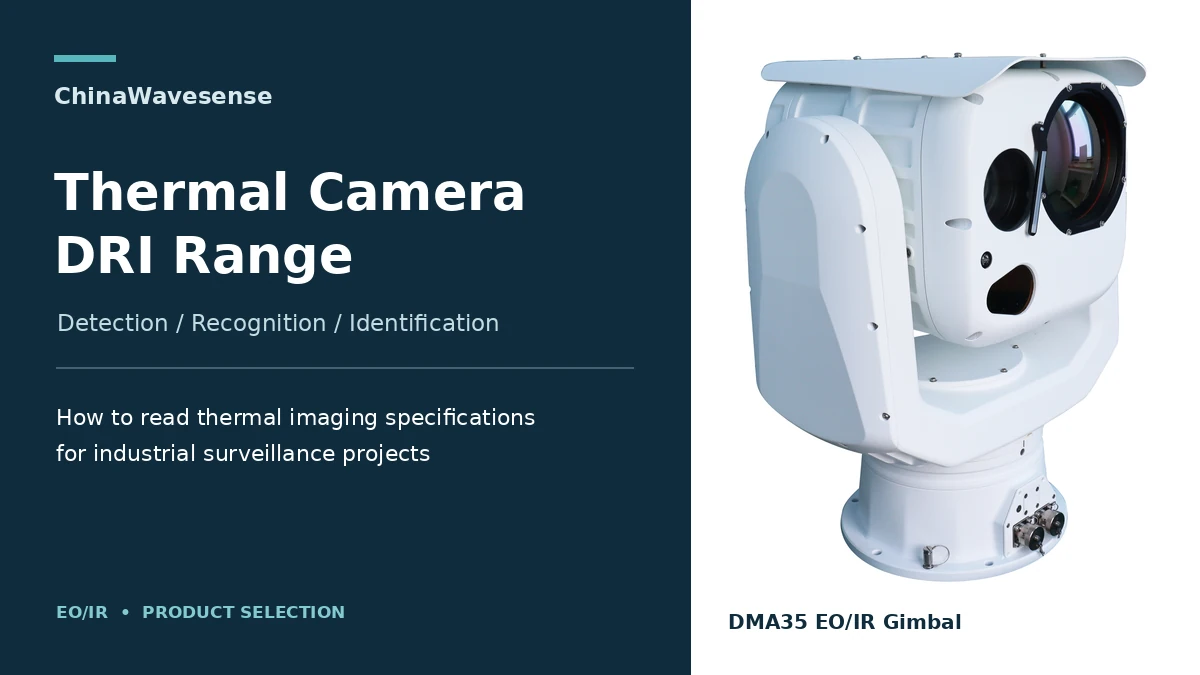
Thermal Camera DRI Range describes three different levels of imaging performance: detecting an object, recognizing its category, and identifying specific characteristics.
A thermal camera that detects a person at 3 km may not provide enough image detail to recognize or identify that person at the same distance.
This distinction matters when choosing long-range thermal cameras for industrial security, coastal surveillance, perimeter monitoring, and critical infrastructure protection.
Buyers should therefore define what they need to see before comparing camera range specifications.
What Does Thermal Camera DRI Range Mean?
DRI stands for Detection, Recognition, and Identification.
Each level requires a different amount of image detail.
| Level | What It Means | Practical Example |
|---|---|---|
| Detection | Determine whether an object exists | Notice an object near a facility |
| Recognition | Determine the object’s general category | Distinguish a person from a vehicle |
| Identification | Distinguish specific target characteristics | Identify the type or features of a vehicle |
Detection generally provides the longest range.
Recognition requires more image detail, while identification usually requires the shortest distance.
For security applications, detection may provide an initial warning. Recognition and identification help operators decide whether the detected activity requires further investigation.
Identification does not necessarily mean recognizing a person’s face or confirming their identity.
How Do Manufacturers Calculate Thermal Camera DRI Range?
Many manufacturers use the Johnson criteria or other imaging performance models to estimate DRI distances.
These methods consider how much image detail an observer needs to complete a particular visual task.
For example, Axis Communications’ thermal camera technical guide uses the following simplified Johnson criteria.
| Imaging Task | Reference Pixels Across Target |
|---|---|
| Detection | 1.5 |
| Recognition | 6 |
| Identification | 12 |
These figures represent a particular interpretation of the Johnson criteria and assume defined target characteristics and favorable imaging conditions.
They do not guarantee the same performance for every camera, target, or automatic recognition algorithm.
A manufacturer should explain the criteria behind its published distances.
Buying advice: Ask whether the DRI figures come from theoretical calculations, laboratory measurements, or actual outdoor imaging tests.
Why Does Target Size Affect Thermal Camera Range?
A large vehicle generally occupies more image pixels than a small object at the same distance.
Therefore, one thermal camera may provide significantly different DRI distances for people, vehicles, and other targets.
The following factors also influence imaging performance:
- Target dimensions
- Temperature contrast
- Detector resolution
- Thermal lens focal length
- Atmospheric visibility
- Image processing
A camera specification that only states a maximum observation distance does not provide enough information for a reliable purchasing decision.
Teledyne FLIR’s DRI range guidance explains how environmental conditions, camera sensitivity, configuration, and operator experience can affect these distances.
Buyers should always connect the published range to a defined target and observation task.
ChinaWavesense Thermal Cameras: What Do the Published Ranges Mean?
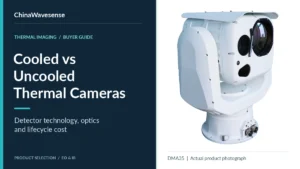
The ChinaWavesense product manual introduces several EO/IR configurations with different thermal detectors, lenses, and operating distances.
| Specification | DMS15 | DMA35 | Z50 |
|---|---|---|---|
| Thermal detector | Uncooled VOx | Uncooled VOx | Cooled MCT |
| Thermal lens | 25–75 mm or 100 mm | 31–155 mm | 90–1100 mm |
| Thermal resolution | Confirm configuration | 640×512 or 1280×1024 | 640×512 |
| Visible-light lens | 11–270 mm | 25–500 mm | 12.5–775 mm |
| Published distance | Thermal: 800 m; visible: ≥1,500 m | Tracking: ≥2,000 m | Tracking: ≥5,000 m |
These specifications describe different performance measurements. They do not represent directly comparable thermal identification distances.
For example, the Z50 catalogue lists a tracking distance of at least 5,000 m. Buyers should not interpret this figure as a guaranteed thermal identification distance of 5,000 m.
Similarly, the DMA35 catalogue provides an overall tracking distance rather than separate detection, recognition, and identification distances.
ChinaWavesense also provides multi-band electro-optical configurations such as the DMA460 Electro-Optical Gimbal.
Before selecting a configuration, request the target-specific imaging specifications that match your actual surveillance requirements.
Does a Higher Thermal Resolution Increase DRI Range?
Not necessarily.
Detector resolution determines the number of pixels available to form an image.
However, thermal sensitivity, optical design, and environmental conditions also influence image quality.
The DMA35 product manual lists an optional 1280 × 1024 uncooled detector. The Z50 uses a 640 × 512 cooled detector with a longer thermal zoom lens.
Although the DMA35 option provides more detector pixels, buyers cannot conclude that it delivers better long-distance identification in every situation.
The complete imaging system determines usable performance.
A peer-reviewed study on the measurement of long-range thermal imaging camera performance examines why manufacturers need consistent measurement methods and target conditions to support meaningful DRI comparisons.
Buying advice: Compare actual images of the same target at the required distance, not detector resolution alone.
What Reduces Thermal Camera DRI Range in Real Applications?
Outdoor conditions can reduce imaging performance even when a camera meets its published specifications.
Three factors deserve particular attention.
Weather and Visibility
Fog, rain, humidity, and atmospheric particles can reduce the infrared energy that reaches the camera.
Thermal imaging often performs better than conventional visible-light imaging in some low-visibility conditions. However, dense fog and heavy precipitation can still limit useful observation distance.
Temperature Contrast
Thermal cameras distinguish objects through differences in infrared radiation.
When the target and its surroundings produce similar thermal signatures, the image may provide less useful detail.
Camera Stability and Optical Quality
Long-range imaging requires stable camera positioning, accurate focus, and suitable optics.
Vibration and poor focus can reduce image detail, even when the thermal detector offers high resolution.
Buyers should request representative outdoor images rather than relying entirely on ideal-condition range calculations.
Is Thermal Tracking Range the Same as Identification Range?
No.
A camera can maintain automatic tracking on an object without capturing enough detail for reliable identification.
Tracking describes the system’s ability to follow the object over time.
Identification describes the amount of useful information that the image provides.
This distinction also matters in integrated surveillance systems.
Radar can provide target position information, while an EO/IR camera contributes visual or thermal observations.
Our Drone Detection System: Radar Vs RF Vs EO/IR article explains how these sensors perform different surveillance functions.
Buyers should evaluate tracking and image quality as separate requirements.
What Thermal Camera DRI Range Data Should Buyers Request?
Before requesting a quotation, provide the manufacturer with a clear observation requirement.
Use the following checklist.
| Requirement | Customer Information |
|---|---|
| Target type | Person, vehicle, vessel, or other object |
| Target dimensions | Approximate height and width |
| Detection distance | Required initial observation range |
| Recognition distance | Required target classification range |
| Identification distance | Required level of visible detail |
| Operating environment | Weather, temperature, and visibility |
| Installation | Fixed tower, building, or mobile platform |
| Imaging channel | Thermal, visible light, or both |
The supplier should then confirm the proposed detector, lens configuration, and available performance evidence.
Request separate DRI figures for each relevant imaging channel. Where possible, also request representative images or video.
This information makes different thermal camera quotations easier to compare.
Choosing the Right ChinaWavesense Thermal Camera
Thermal Camera DRI Range should match the customer’s observation requirements rather than simply provide the largest distance on a datasheet.
DMS15, DMA35, and Z50 offer different optical configurations for different surveillance requirements.
The appropriate product depends on target size, required image detail, environmental conditions, installation, and budget.
Contact ChinaWavesense with your target dimensions, required detection and identification distances, and operating environment to discuss a suitable EO/IR configuration.
FAQ
What Is Thermal Camera DRI Range?
DRI refers to the distances at which a thermal camera can detect an object, recognize its category, and identify specific characteristics.
Is Detection Range Longer Than Identification Range?
Generally, yes. Identification requires more image detail than detection.
Does a 5 km Tracking Range Mean 5 km Identification?
No. Tracking and identification describe different capabilities. Buyers should request separate identification specifications.
Does Higher Thermal Resolution Guarantee Longer Range?
No. Thermal sensitivity, lens design, atmospheric conditions, and target contrast also influence useful imaging distance.
Can Thermal Cameras Work in Complete Darkness?
Yes. Thermal cameras detect infrared radiation rather than relying on visible light. However, image quality still depends on thermal contrast and environmental conditions.
How Should Buyers Compare Thermal Camera DRI Specifications?
Use the same target dimensions, observation task, imaging channel, environmental assumptions, and evaluation criteria.