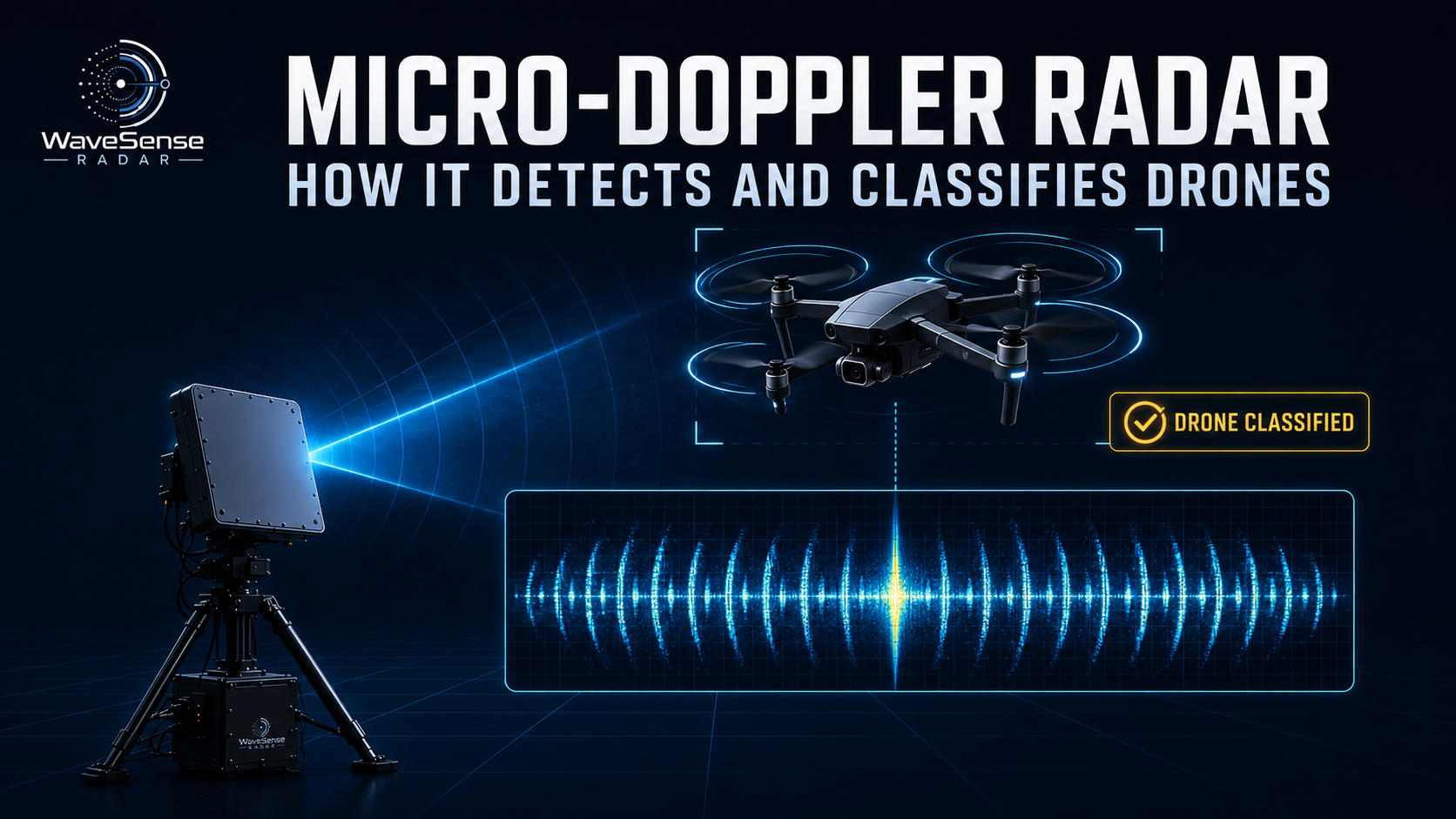
What Is Micro-Doppler Radar?
Micro-Doppler Radar detects small movements within a target, allowing radar systems to recognize rotating drone propellers, flapping bird wings, and other micro-motion that ordinary target speed measurements may not reveal.
For drone surveillance, this information is especially valuable because small UAVs and birds can have similar speed, altitude, and radar cross section.
Their internal motion, however, can be very different.
Experimental research has demonstrated clear differences between rotor-generated drone signatures and bird wingbeat signatures. See the Scientific Reports micro-Doppler study.
What Is The Micro-Doppler Effect?
The conventional Doppler effect measures frequency change caused by the overall movement of a target toward or away from radar.
The micro-Doppler effect comes from smaller movements occurring on or within that target.
For a drone, these movements may include:
- Rotating propellers
- Motor vibration
- Rotor acceleration
- Blade movement
These small motions modulate the radar return and create additional frequency components around the target’s main Doppler signal.
Doppler Vs Micro-Doppler: What Is The Difference?
Doppler primarily describes the movement of the whole object.
Micro-Doppler describes motion of individual parts of the object.
For example, a quadcopter may approach the radar at 10 m/s while its propeller tips move much faster.
The main Doppler component represents the aircraft’s translational motion.
Additional rotor-generated components form its micro-Doppler signature.
This extra information can help determine what type of target generated the radar return.
Why Is Micro-Doppler Important For Drone Detection?
Detecting a moving object is not the same as knowing what it is.
Radar may detect a small airborne target that could be:
- Drone
- Bird
- Helicopter
- Light aircraft
- Unknown object
RCS and velocity alone can overlap between target categories.
Rotor micro-motion provides another independent feature that can improve UAV classification. Reviews of radar-based drone detection identify micro-Doppler as an important feature for distinguishing small UAVs from other airborne objects.
Why Is Micro-Doppler Useful For Small Drones?
Small UAVs often have a low radar cross section.
Their main body return may therefore be weak.
However, rotating propellers generate characteristic temporal changes in the radar echo.
These patterns can provide classification information even when physical target size alone does not clearly distinguish the UAV from a bird.
For more information about why small UAV radar returns vary so strongly, see our Radar Cross Section Of A Drone guide.
What Creates A Drone Micro-Doppler Signature?
A multirotor drone contains several rapidly rotating blades.
Each blade continually changes its radial velocity relative to the radar.
As it rotates:
- The blade moves toward the radar.
- Radial velocity increases.
- It rotates through another angle.
- Radial velocity decreases.
- It may then move away from the radar.
This cycle repeats rapidly.
The resulting modulation creates a distinctive Drone Micro-Doppler Signature.
What Is A Rotor Blade Signature?
A Rotor Blade Signature is the radar pattern produced by rotating drone blades.
The signature depends on variables such as:
- Blade length
- Rotor speed
- Number of rotors
- Blade material
- Radar frequency
- Observation angle
- Sampling time
This means different UAVs can produce different patterns.
However, the signature is not always unique enough to identify every individual drone model.
What Is Blade Flash?
Blade flash refers to short, strong radar-return events that can occur when a rotating blade reaches an orientation that produces a stronger reflection toward the radar.
As the rotor continues turning, these flashes repeat.
The repetition characteristics may contain information about:
- Rotor speed
- Blade geometry
- Rotor configuration
Blade-related periodic features have been used in mini-UAV classification research.
Is Blade Flash The Same As Micro-Doppler?
No.
Blade flash is one specific phenomenon associated with rotating blades.
Micro-Doppler is the broader frequency modulation caused by target micro-motion.
A radar processor may therefore analyze:
- Blade flashes
- Doppler bandwidth
- Periodicity
- Rotor harmonics
- Time-frequency structures
together to characterize a UAV.
This richer feature set is more useful than simply checking whether a blade flash exists.
What Is A Micro-Doppler Signature?
A Micro-Doppler Signature is the characteristic time-frequency pattern produced by micro-motion.
1.For drones, the pattern can reveal information related to rotating propulsion components.
For birds, it can reflect wingbeats.
For helicopters, it may contain main-rotor and tail-rotor characteristics.
The signature therefore provides an additional layer of information beyond range and target velocity.
What Is A Micro-Doppler Spectrogram?
A micro-Doppler spectrogram visualizes how Doppler frequency changes over time.
Typically:
- Horizontal axis = time
- Vertical axis = Doppler frequency
- Signal intensity = returned radar energy
Drone rotor motion creates patterns that can become visible in the spectrogram.
These spectrograms can then be processed using conventional feature extraction or machine-learning algorithms.
Scientific studies frequently use spectrograms for drone and bird classification.
Why Does A Spectrogram Help Identify Drones?
A single radar measurement provides limited information.
A spectrogram records how motion evolves over time.
This allows algorithms to identify:
- Periodicity
- Rotor modulation
- Wingbeat patterns
- Doppler spread
- Repeated blade flashes
Instead of asking only:
“How fast is the target moving?”
the radar can also ask:
“What kind of moving components does this target contain?”
How Does Micro-Doppler Radar Detect A Hovering Drone?
A hovering drone may have almost zero translational velocity.
Its main body can therefore appear close to stationary clutter.
However, the propellers continue rotating rapidly.
Rotor movement generates micro-Doppler even when the drone remains nearly stationary.
This makes micro-motion processing particularly useful for Hovering Drone Detection. Commercial counter-UAS radars also use rotor micro-Doppler as part of their stationary-drone classification approach.
Why Are Hovering Drones Difficult For Conventional Radar?
Many conventional moving-target processing techniques use velocity to separate moving targets from stationary background clutter.
A hovering UAV has little body velocity.
Its body return may therefore lie near the clutter region.
The detection problem becomes:
Low velocity + small RCS + strong surrounding clutter.
Micro-Doppler processing gives radar another way to identify the rotating components even when translational movement is minimal.
Can Micro-Doppler Radar Detect A Completely Stationary Drone?
A multirotor UAV hovering in place is not physically motionless because its propellers are rotating.
That rotor motion can generate micro-Doppler.
A drone sitting on the ground with its motors completely stopped presents a different problem.
Without rotor movement, micro-Doppler cannot rely on propeller rotation for classification.
Another radar feature or sensor would then be required.
Can Micro-Doppler Distinguish Birds From Drones?
Yes, this is one of its most important applications.
Drone propellers typically create rapid rotational modulation.
Birds generate micro-Doppler mainly through wingbeats.
These motion mechanisms are different enough to produce useful classification features.
Controlled experiments at K-band and W-band have demonstrated characteristic differences between drone and bird signatures. Read the original study.
Why Is Micro-Doppler Better Than RCS For Bird Classification?
It is not necessarily “better” in every situation.
Instead, the two features answer different questions.
RCS: How strongly does the target reflect?
Micro-Doppler: What internal motion is generating the return?
Birds and small drones can have overlapping RCS values.
Their wing and rotor motion can provide additional separation.
The strongest classifier can therefore combine both features instead of choosing only one.
Can Micro-Doppler Always Tell A Bird From A Drone?
No.
Micro-Doppler is powerful but not perfect.
Classification can become difficult when:
- Target SNR is low
- Range is long
- Target aspect is unfavorable
- Bird wings are not actively flapping
- Rotor signatures are weak
- Clutter overlaps the target
- Observation time is too short
A professional system should therefore combine multiple radar features rather than treating micro-Doppler as a perfect identifier.
Why Does Target Angle Affect Micro-Doppler?
Radar measures the radial component of motion.
The same rotating blade can therefore produce different observed velocities depending on its orientation relative to the radar.
If target geometry produces strong radial blade motion, the micro-Doppler pattern may become clearer.
At an unfavorable aspect angle, some components may become weaker.
This means classification results should be tested across multiple approach directions rather than only one ideal orientation.
Does Drone Heading Affect The Micro-Doppler Signature?
Yes.
When a drone changes heading, the relationship between its rotors and the radar line of sight changes.
The radar may observe different:
- Doppler spreads
- Blade flashes
- Rotor contributions
- Signal strengths
A robust UAV classifier should therefore handle changing target orientation during flight.
This is one reason real-flight datasets are valuable.
Does Pitch And Roll Affect Drone Classification?
Potentially.
A drone changes pitch and roll when accelerating, turning, or compensating for wind.
These attitude changes alter rotor orientation relative to radar.
Micro-Doppler patterns may therefore vary even for the same UAV model during one flight.
A classification system should learn a range of target attitudes rather than one fixed laboratory configuration.
Does Propeller Speed Affect Micro-Doppler?
Yes.
Rotor speed directly influences blade motion.
Increasing or decreasing RPM can change the frequency spread and periodic characteristics observed by radar.
A hovering drone and an accelerating drone may therefore produce different signatures even if the aircraft model is identical.
Rotor speed is one reason micro-Doppler is a dynamic rather than fixed target feature.
Can Micro-Doppler Estimate Rotor Speed?
In suitable conditions, rotor periodicity can provide information related to rotational speed.
Researchers analyze blade flashes, harmonic structures, and time-frequency features to estimate characteristics of rotating targets.
However, practical accuracy depends on:
- SNR
- Sampling
- Radar frequency
- Target angle
- Number of rotors
- Signal-processing method
Rotor-speed estimation should therefore not automatically be assumed from every micro-Doppler radar.
Can Radar Count Drone Rotors?
Sometimes micro-Doppler patterns can contain information related to the number and configuration of rotating components.
However, several rotors may produce overlapping signatures.
Target orientation and low SNR can make separation even harder.
A system claiming to identify rotor count should therefore demonstrate the capability across multiple orientations, ranges, and UAV models rather than only controlled laboratory tests.
Can Micro-Doppler Identify A Quadrotor?
Potentially.
Quadrotors produce characteristic patterns from multiple rotating propellers.
Machine-learning systems can learn these patterns and distinguish different target classes.
Research has demonstrated multicategory mini-UAV classification using micro-Doppler features extracted from radar returns.
Model-level identification, however, is harder than simply distinguishing “drone” from “bird.”
Can Micro-Doppler Identify The Exact Drone Model?
Sometimes under controlled conditions, but this should not be guaranteed universally.
Two drones from the same product family may use similar:
- Rotor layouts
- Motors
- Propellers
- Flight behavior
Their signatures may therefore overlap.
Recent research has even explored artificially modifying rotor signatures with passive electromagnetic tags because naturally occurring micro-Doppler may not uniquely identify similar drone models.
Why Can Two Identical Drones Produce Different Signatures?
Even identical models may operate under different conditions.
Differences can come from:
- Rotor RPM
- Payload
- Flight attitude
- Range
- Heading
- Wind
- Propeller condition
- Radar observation angle
The measured signature is therefore a combination of the aircraft and its current motion.
Classification systems need enough training diversity to accommodate these changes.
Can Payload Affect Micro-Doppler?
Payload primarily changes the aircraft’s overall electromagnetic signature and flight behavior.
A heavier payload may also require different rotor speeds or flight attitudes.
This can indirectly alter observed micro-Doppler characteristics.
Payload should therefore be considered during field validation, especially if the threat model includes modified commercial drones.
What About Fixed-Wing UAVs?
Fixed-wing UAV classification may rely on different features.
If the aircraft uses a rotating propeller, that propeller can generate micro-Doppler.
However, the signature may be different from a multirotor aircraft with four, six, or eight rotors.
The classifier may need to combine:
- Propeller signature
- RCS
- Speed
- Flight trajectory
- Acceleration
rather than relying on a multirotor template.
What About Jet-Powered UAVs?
A UAV without exposed rotating propeller blades may not generate the same rotor micro-Doppler signature as a conventional quadcopter.
Radar classification must then rely more heavily on other information such as:
- RCS
- Velocity
- Acceleration
- Trajectory
- Target dimensions
- Track behavior
This is an important limitation when evaluating a system marketed simply as “micro-Doppler drone detection.”
Does Radar Frequency Affect Micro-Doppler?
Yes.
Frequency influences how electromagnetic waves interact with small target components and affects the Doppler frequency shift associated with radial motion.
Researchers have studied UAV signatures in different radar bands, including K-band and W-band, to understand these effects.
However, frequency alone does not determine classification performance.
Antenna design, waveform, bandwidth, processing, SNR, and observation time also matter.
Is Higher Frequency Always Better?
No.
Higher radar frequencies can provide advantages for observing fine target features, but they also involve different propagation, hardware, and environmental tradeoffs.
The correct frequency depends on the complete surveillance requirement.
Buyers should compare demonstrated classification performance rather than assuming:
Higher GHz = Better Drone Classification.
Can X-Band Radar Use Micro-Doppler?
Yes.
Micro-Doppler processing is not restricted to one single radar band.
For example, research has performed bird and small-drone classification using a 10 GHz continuous-wave radar system.
The ability to extract useful micro-motion depends on the radar’s waveform, signal quality, sampling, processing, and target geometry.
Can FMCW Radar Detect Micro-Doppler?
Yes.
FMCW Radar is widely used in UAV micro-Doppler research.
It can provide range and velocity information while additional signal processing extracts rotor-related features.
Researchers have developed UAV classification systems specifically using FMCW radar micro-Doppler signatures.
Why Is FMCW Useful For Drone Radar?
FMCW systems can provide useful range-Doppler information using relatively compact radar architectures.
This makes them attractive for:
- Short-range surveillance
- Small target detection
- Drone classification
- Research platforms
However, FMCW is an architecture rather than a guarantee of performance.
Detection range and classification quality still depend on the complete radar design.
What Is A Range-Doppler Map?
A Range-Doppler Map organizes radar returns according to target distance and radial velocity.
It can help separate targets at different:
- Ranges
- Speeds
Micro-Doppler adds finer time-frequency information around a target’s motion.
Modern algorithms may use range-Doppler maps, micro-Doppler spectrograms, or both for UAV detection and classification.
Range-Doppler Vs Micro-Doppler
A range-Doppler map is valuable for determining:
Where is the target and how fast is it moving?
Micro-Doppler analysis provides information about:
What smaller motions are occurring within that target?
The two methods are complementary.
A radar can first detect and locate a target before applying more detailed micro-motion processing.
What Is Dwell Time?
Dwell time is the period during which radar observes a target or particular direction.
Longer observation can collect more rotor cycles and provide richer micro-Doppler information.
Short dwell time provides faster surveillance updates but may capture fewer micro-motion details.
Research on FMCW UAV classification specifically identifies limited observation time as a challenge for extracting useful micro-Doppler signatures.
Why Does Dwell Time Matter For Classification?
Suppose one propeller produces a periodic radar pattern.
If radar observes the target for only a tiny fraction of that pattern, classification becomes harder.
A longer observation window may reveal:
- Periodicity
- Rotor harmonics
- Blade flashes
- Doppler bandwidth
However, radar still needs to scan the rest of the surveillance area.
This creates a design tradeoff between search speed and classification detail.
Can A Faster Radar Update Rate Improve Micro-Doppler?
Not automatically.
Radar update rate describes how frequently target information is refreshed.
Micro-Doppler extraction also depends on sampling, coherent processing interval, waveform, and observation time.
A system can have a fast target update rate but still use a different processing window for detailed target classification.
Buyers should therefore request both tracking and classification performance.
Why Does SNR Matter So Much?
Signal-To-Noise Ratio determines how clearly weak rotor features stand above noise.
As SNR decreases, micro-Doppler patterns can become faint or fragmented.
This is particularly important for:
- Small drones
- Long-range targets
- Low-RCS UAVs
- Cluttered environments
A 2024 CNN study specifically noted that traditional micro-Doppler approaches can degrade for small or distant drones because signal attenuation makes the signature weak.
Does Micro-Doppler Classification Range Equal Radar Detection Range?
No.
This is one of the most important purchasing questions.
A radar may detect a target when its basic return becomes visible.
Micro-Doppler classification may require stronger SNR and more detailed radar information.
Therefore:
Detection Range ≥ Tracking Range ≥ Detailed Classification Range
can occur in some system architectures, although actual relationships depend on the radar.
Manufacturers should report these distances separately.
Why Can A Radar Detect A Drone But Fail To Classify It?
Detection may require enough signal only to determine that a target exists.
Classification requires additional information.
The radar may need to see:
- Rotor modulation
- Doppler periodicity
- Track behavior
- RCS variation
At long distance, these fine features may be too weak even when the aircraft itself remains detectable.
What Is Micro-Doppler Classification Range?
Micro-Doppler Classification Range is the distance within which the radar can obtain enough micro-motion information to achieve its specified target-classification performance.
This metric can be more meaningful than simply saying:
“Micro-Doppler supported.”
Buyers should ask manufacturers to specify:
- Target
- Range
- Aspect
- Classification accuracy
- SNR
- Environment
Does Ground Clutter Hide Micro-Doppler?
It can.
Small drones often fly close to terrain, vegetation, buildings, and vehicles.
Strong background returns can mask the weak UAV signal.
Research into UAV micro-Doppler recognition identifies ground-clutter suppression as an important challenge because small UAVs often combine low flight altitude with low RCS.
How Can Radar Extract Weak Rotor Signals From Clutter?
Different systems may use combinations of:
- Doppler filtering
- Clutter maps
- CFAR
- Time-frequency analysis
- Track-before-classify processing
- Neural networks
- Feature enhancement
No single algorithm solves every environment.
The best approach depends on radar hardware, waveform, target type, and surrounding clutter.
Can Micro-Doppler Work In Urban Environments?
Yes, although cities create difficult conditions.
Urban radar can encounter:
- Multipath
- Building blockage
- Dense clutter
- NLOS propagation
- Moving vehicles
A July 2026 study demonstrated small-UAS detection using rotational micro-Doppler signatures in dense urban and indoor NLOS conditions with a 2.47 GHz multi-antenna radar and deep-learning processing.
Can Micro-Doppler Radar Detect Drones Without Line Of Sight?
Research indicates that NLOS micro-Doppler detection is possible under specific propagation conditions, but this does not mean every radar can see through buildings.
The 2026 experiment reported an overall 86.11% detection accuracy across five drone types in its specific dataset using NLOS signals.
Real performance depends on:
- Building materials
- Geometry
- Frequency
- Multipath
- SNR
- Radar design
NLOS capability should therefore be demonstrated at the actual deployment site.
Does NLOS Radar Eliminate Blind Zones?
No.
Buildings and terrain remain major sources of radar coverage loss.
NLOS techniques may exploit reflected or indirect propagation paths, but those paths are highly environment dependent.
A site should still be surveyed for:
- Physical blockage
- Terrain masking
- Near-range gaps
- Elevation coverage
- Multipath
Multiple sensors may be needed for complete coverage.
Can Micro-Doppler Work In Rain?
Rain can influence radar returns and SNR depending on radar frequency and precipitation intensity.
The effect on classification therefore depends on the complete system.
A professional acceptance test should verify micro-Doppler classification under the weather conditions expected at the deployment site rather than relying only on clear-weather laboratory data.
Can Wind Change A Drone Micro-Doppler Signature?
Yes, indirectly.
A drone fighting wind may:
- Increase rotor RPM
- Change attitude
- Tilt
- Accelerate
- Correct its position continuously
These changes affect rotor motion and observation geometry.
Training data collected only during calm weather may therefore not represent every real-world flight condition.
How Does AI Use Micro-Doppler?
AI models can learn patterns directly from radar features or spectrogram images.
Common approaches include:
- CNNs
- Deep neural networks
- Support vector machines
- Feature-based classifiers
A 2020 study reported 97.14% total classification accuracy in its specific small-drone experimental dataset after improving micro-Doppler signature extraction and using a lightweight CNN.
That number should not automatically be treated as universal field accuracy.
Why Are CNNs Used For Radar Spectrograms?
A spectrogram is an image-like representation of frequency behavior over time.
CNNs are effective at detecting spatial structures in image data.
They can learn features related to:
- Rotor patterns
- Wingbeats
- Periodicity
- Frequency spread
- Target-class differences
This reduces the need to manually define every classification rule.
Does AI Replace Radar Signal Processing?
No.
AI generally relies on data produced by the radar processing chain.
Signal quality still depends on:
- Antenna
- Waveform
- Receiver
- SNR
- Clutter suppression
- Sampling
- Calibration
A powerful neural network cannot reconstruct unlimited target information from a signal that was never captured clearly.
Can AI Overfit Drone Micro-Doppler Data?
Yes.
A model may perform extremely well on familiar datasets but poorly on new targets or environments.
Overfitting becomes more likely when training data contains too little variation.
A useful dataset should include:
- Different UAV models
- Different headings
- Different ranges
- Different altitudes
- Different weather
- Different SNR
- Different rotor speeds
Real-world generalization matters more than headline laboratory accuracy.
Why Should Unknown Drones Be Included In Testing?
Security systems cannot assume every future threat will match a training model.
Testing with previously unseen UAVs shows whether the classifier has learned general drone characteristics rather than memorizing specific aircraft.
This is especially important as new drone configurations and modified commercial platforms continue to appear.
Can Micro-Doppler Detect Drone Swarms?
It can contribute to swarm classification, but dense target environments create additional challenges.
Several drones may produce overlapping:
- Tracks
- Doppler returns
- Rotor signatures
Radar resolution becomes important.
The system must first separate individual targets before assigning detailed features reliably.
Swarm detection therefore also depends on range resolution, angular resolution, track management, and processing capacity.
What Happens When Two Drones Fly Very Close Together?
If both targets occupy the same or overlapping radar resolution cells, their returns may become difficult to separate.
Their micro-Doppler signatures can also overlap.
Whether radar can distinguish them depends on:
- Range separation
- Angular separation
- Radar bandwidth
- Antenna aperture
- Processing
“Maximum number of tracks” therefore does not automatically describe close-formation swarm performance.
Can Micro-Doppler Distinguish A Drone Swarm From A Bird Flock?
Potentially, but the problem is more difficult than classifying one target.
A system may analyze:
- Individual rotor signatures
- Wingbeat signatures
- Track coordination
- Target spacing
- Group behavior
If targets cannot be resolved individually, classification becomes harder.
Multi-feature analysis is therefore particularly important in dense aerial environments.
Can Micro-Doppler Detect RF-Silent Drones?
Yes.
Micro-Doppler radar observes physical motion from radar reflections.
It does not require the drone to transmit:
- Control signals
- Telemetry
- Remote ID
- Video links
This makes radar useful as an independent detection layer for autonomous or RF-silent UAVs.
For a broader explanation of physical UAV detection, see our Drone Detection Radar guide.
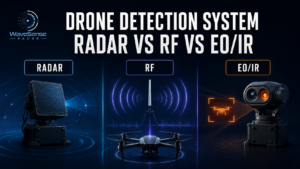
Micro-Doppler Radar Vs RF Drone Detection
The technologies observe different phenomena.
Micro-Doppler Radar
Detects physical target motion and rotor signatures.
RF Detection
Detects radio emissions associated with UAV communication.
Radar can potentially detect an autonomous aircraft without an active control link.
RF systems may provide valuable protocol or controller information when compatible signals exist.
The two technologies are complementary.
Micro-Doppler Radar Vs Camera Detection
Cameras provide visual information.
Micro-Doppler provides radar-motion information.
Camera performance can depend heavily on:
- Lighting
- Visibility
- Background
- Optical range
Radar uses radio-frequency sensing and can operate without visible light.
A combined system can use radar to detect and classify a target before cueing a camera for visual confirmation.
Micro-Doppler Radar Vs Acoustic Detection
Acoustic systems analyze sound generated by motors and propellers.
Micro-Doppler analyzes electromagnetic reflections from target motion.
Acoustic performance can be influenced by:
- Wind
- Background noise
- Distance
- Terrain
Radar and acoustic sensors therefore provide different forms of information.
They may complement each other in specialized installations.
Micro-Doppler Radar Vs RCS Classification
RCS measures target reflectivity.
Micro-Doppler measures target micro-motion.
A drone may have an RCS similar to a bird while producing a very different motion signature.
Combining:
RCS + Micro-Doppler + Velocity + Track Behavior
can therefore provide stronger classification than using one feature alone.
Can Micro-Doppler Replace Tracking?
No.
Micro-Doppler primarily contributes target-characteristic information.
Tracking answers:
- Where is the UAV?
- Where is it going?
- How fast is it moving?
A complete surveillance radar needs both.
Classification without reliable position data is of limited value for security response.
What Happens From Detection To Classification?
A practical processing chain may look like:
1. Radar Search
Scans the surveillance area.
2. Target Detection
Finds a possible airborne object.
3. Track Formation
Combines repeated observations.
4. Feature Extraction
Calculates RCS, Doppler, micro-Doppler, and trajectory features.
5. Classification
Estimates bird, drone, aircraft, or unknown.
6. Sensor Cueing
Sends coordinates to EO/IR or another system.
This explains why classification is only one part of a complete UAV surveillance architecture.
What Should A Micro-Doppler Radar Datasheet Include?
A professional datasheet should provide more than:
“AI Micro-Doppler Classification: Yes.”
Useful information includes:
- Classification range
- Tested UAV types
- Hovering performance
- Bird discrimination
- Required SNR
- Classification latency
- Confidence output
- False classification rate
- Operating frequency
- Observation conditions
These parameters make the feature much easier to evaluate.
What Is Classification Latency?
Classification latency is the time between initial target detection and delivery of a useful target class.
A system may need several observations before enough micro-Doppler information becomes available.
Longer observation may improve confidence but delay the decision.
This tradeoff matters for high-speed or short-range threats.
Why Is Classification Confidence Important?
A target does not always fit perfectly into one category.
A system may estimate:
Drone: High Confidence
or:
Bird: Medium Confidence
or:
Unknown
Confidence-based classification is more useful than forcing every radar return into a fixed category.
It allows operators and sensor-fusion software to request additional confirmation when uncertainty is high.
What Should Happen When Micro-Doppler Is Unclear?
The system should not automatically assume the target is harmless.
A practical architecture can retain the target as:
Unknown
and use:
- Track behavior
- RCS
- RF detection
- EO/IR
- Additional radar observations
to improve confidence.
An explicit unknown class reduces false certainty.
How Should Buyers Test Micro-Doppler Radar?
A field acceptance test should include more than one easy drone flight.
Recommended scenarios include:
- Hovering quadcopter
- Approaching UAV
- Crossing UAV
- Drone flying away
- Different headings
- Multiple drone models
- Different rotor sizes
- Low-altitude flight
- Birds
- Long-range targets
- Low-SNR targets
This provides a much more realistic classification assessment.
Should Testing Include Different Aspect Angles?
Yes.
Front, rear, side, and oblique views can produce different micro-Doppler characteristics.
Testing only the most favorable orientation can exaggerate real-world performance.
Drone trajectories should therefore cross the radar from several directions during acceptance testing.
Should Testing Include Hovering Targets?
Definitely.
Hovering UAV detection is one of the main reasons micro-Doppler processing is valuable.
A radar should demonstrate that it can maintain detection and classification when body velocity approaches zero while the rotors remain active.
Should Testing Include Real Birds?
Yes, when bird discrimination is an important requirement.
Recorded datasets are useful for algorithm development, but field sites may contain bird species and behaviors not represented in training data.
Real bird activity provides a practical test of false alarm performance.
What Questions Should You Ask A Radar Manufacturer?
Does Your Radar Use Micro-Doppler For Detection Or Classification?
These are different functions.
What Is The Micro-Doppler Classification Range?
Do not accept only the maximum radar detection range.
Can It Classify Hovering Drones?
Request demonstrated results.
Which Drone Types Were Tested?
Ask for multiple UAV architectures.
Was Bird Activity Included?
Bird discrimination is one of the main real-world challenges.
How Long Does Classification Take?
Ask for latency or observation time.
What Happens At Low SNR?
Request long-range or difficult-condition results.
How Does Aspect Angle Affect Performance?
Testing should include multiple target headings.
What Is The Biggest Marketing Mistake Around Micro-Doppler Radar?
The biggest mistake is treating “Micro-Doppler Supported” as a complete performance specification.
Micro-Doppler capability depends on:
- Signal quality
- Range
- Target aspect
- Radar frequency
- Observation time
- Clutter
- Feature extraction
- Classifier training
Two systems can both claim micro-Doppler while delivering very different operational performance.
What Is A Better Procurement Requirement?
Instead of:
“Radar shall support micro-Doppler classification.”
use:
“The radar shall demonstrate drone classification using rotor or micro-motion features against representative UAVs at defined ranges, target aspects, altitudes, clutter conditions, and classification-confidence requirements.”
Then define acceptable:
- Detection probability
- False drone alarms
- Classification accuracy
- Latency
This makes acceptance testing far more meaningful.
Is Micro-Doppler Radar Enough For A Complete Counter-UAS System?
Usually not by itself.
Micro-Doppler radar provides valuable:
- Detection
- Tracking support
- Drone classification
A complete security architecture may also use:
- RF sensing
- EO/IR cameras
- Command software
- Sensor fusion
- Alert management
The radar becomes one high-value sensing layer within the larger system.
Where Is Micro-Doppler Radar Most Useful?
Potential applications include:
Airports
Separating UAVs from bird activity.
Military Bases
Identifying small, low-speed airborne targets.
Critical Infrastructure
Detecting hovering or RF-silent drones.
Borders
Improving UAV classification within surveillance tracks.
Prisons
Identifying compact delivery drones.
Urban Security
Analyzing UAV targets amid complex clutter.
The exact benefit depends on site geometry and the expected threat.
What Is The Future Of Micro-Doppler Radar?
Research is moving beyond basic rotor detection toward:
- AI-assisted classification
- NLOS drone sensing
- Multi-antenna processing
- Multi-frequency signatures
- Drone model recognition
- Passive rotor tagging
- Swarm classification
- Robust low-SNR feature extraction
A 2026 study demonstrated NLOS small-UAV detection using rotational micro-Doppler signatures in dense environments, while separate research is exploring encoded rotor signatures for more specific drone identification.
Can Artificial Micro-Doppler Signatures Identify Individual Drones?
This is an emerging research direction.
Researchers have attached passive electromagnetic scatterers to drone blades to deliberately modify rotor signatures.
The goal is to create a recognizable micro-Doppler code rather than relying only on naturally occurring blade signatures.
A 2026 study reported recognition using tagged configurations and machine learning under controlled and outdoor testing.
This approach remains different from conventional counter-UAS detection of unmodified drones.
Will AI Make Micro-Doppler Classification Perfect?
No.
AI can improve feature recognition, but physics still sets limits.
If the rotor signal is too weak, blocked, unresolved, or corrupted by clutter, classification becomes harder regardless of the algorithm.
Future systems will therefore combine better sensing hardware with better algorithms rather than relying on AI alone.
Conclusion
Micro-Doppler Radar improves drone classification by analyzing rotor-generated micro-motion that conventional range, speed, and RCS measurements cannot fully describe.
Its greatest value appears when identifying hovering UAVs, separating drones from birds, and providing an additional classification feature for small low-RCS targets.
However, micro-Doppler performance depends strongly on range, SNR, aspect angle, rotor geometry, observation time, clutter, radar frequency, and classifier quality.
For procurement, buyers should therefore ask for demonstrated classification range, hovering performance, bird false-alarm results, classification latency, low-SNR performance, and multi-angle field testing rather than accepting a simple “micro-Doppler supported” claim.
FAQ
What Is Micro-Doppler Radar?
Micro-Doppler radar analyzes frequency modulation created by small moving parts of a target, such as rotating drone propellers or flapping bird wings.
How Does Micro-Doppler Detect Drones?
Rotating UAV propellers create periodic radar modulation that can be extracted and analyzed as a target signature.
Can Micro-Doppler Detect A Hovering Drone?
Yes.
Even when the drone body has nearly zero velocity, its rotating propellers can generate micro-Doppler.
Can Micro-Doppler Distinguish Birds From Drones?
It can significantly improve discrimination because bird wings and drone rotors generate different motion signatures.
What Is Blade Flash?
Blade flash is a short radar-return enhancement that can occur when a rotating blade reaches a favorable reflective orientation.
Can Micro-Doppler Identify The Exact Drone Model?
Sometimes in controlled datasets, but natural signatures may overlap between similar UAVs.
Exact model identification is more difficult than basic drone-versus-bird classification.
Does Micro-Doppler Work At Long Range?
Potentially, but performance usually becomes more difficult as SNR decreases and fine rotor features become weaker.
Does Detection Range Equal Micro-Doppler Classification Range?
No.
A radar may detect and track a UAV before receiving enough detailed rotor information for confident classification.
Does Target Angle Affect Micro-Doppler?
Yes.
The radial motion visible to radar changes with the orientation of the UAV and its rotors.
Can FMCW Radar Use Micro-Doppler?
Yes.
FMCW radar is widely used in research and practical approaches for UAV micro-Doppler extraction and classification.
Can Micro-Doppler Detect RF-Silent Drones?
Yes.
Radar detects physical target motion and does not require a radio-control transmission.
Can Micro-Doppler Work Without Line Of Sight?
Specialized research systems have demonstrated NLOS small-UAV sensing using rotational micro-Doppler, but this capability is environment dependent and should not be generalized to every radar.
Does AI Improve Micro-Doppler Classification?
Yes.
Machine-learning models can classify spectrograms and radar features, although results depend on training data, SNR, target diversity, and operating conditions.
What Should Buyers Ask About Micro-Doppler Radar?
Ask for classification range, UAV models tested, hovering performance, bird discrimination, target aspects, classification latency, false classifications, and real field-test conditions.