Why Do Drone Detection Radars Generate False Alarms?
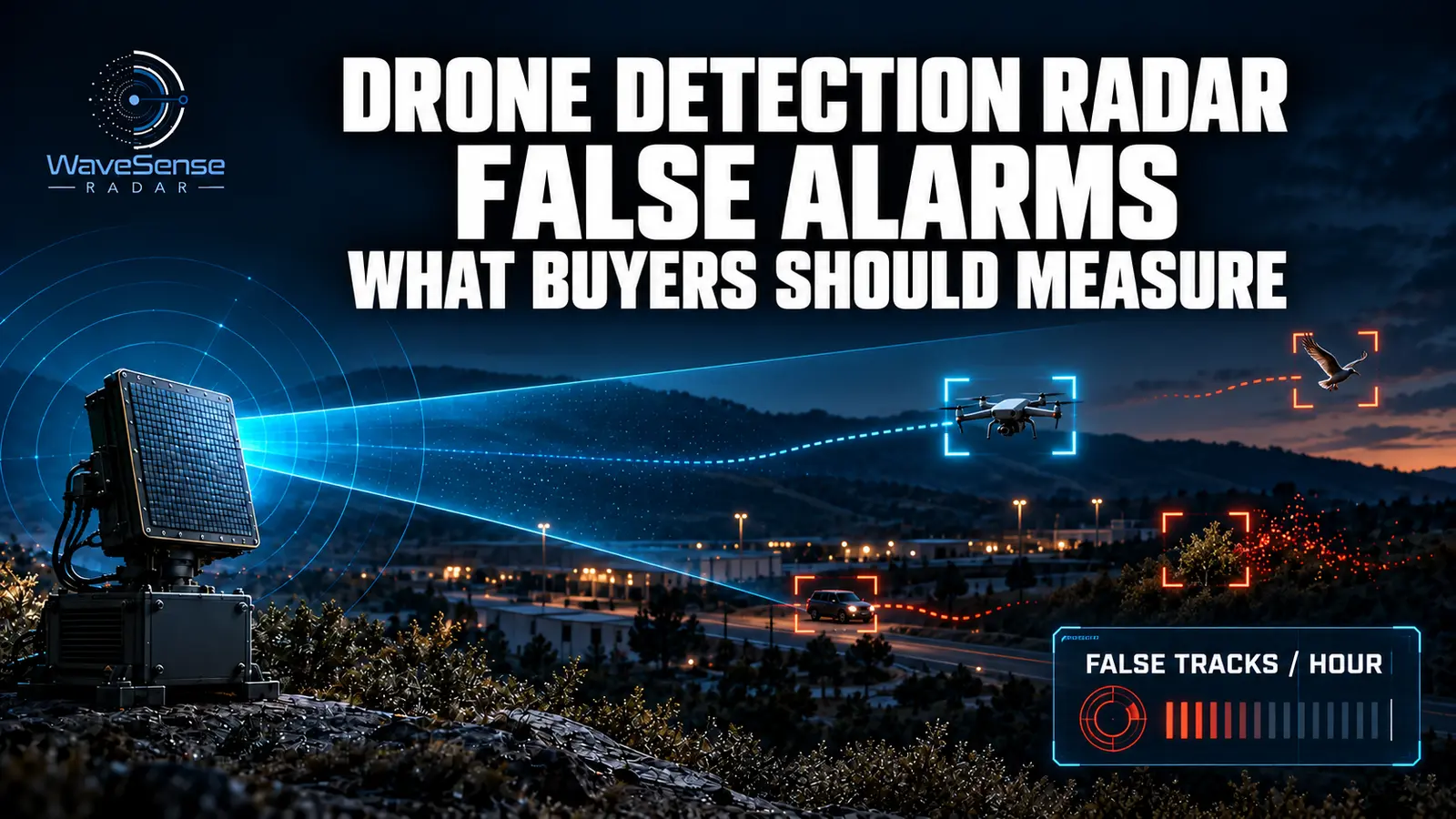
Drone Detection Radar False Alarms happen because the radar must detect very weak low-altitude UAVs without turning every bird, vehicle, moving tree, noise peak, or multipath return into a drone alert.
That creates a basic engineering tradeoff.
If the detector becomes more sensitive, it can recover weaker UAVs.
But it may also produce more unwanted detections.
If filtering becomes too aggressive, the radar display becomes cleaner—but small, slow, or hovering drones may disappear with the clutter.
The U.S. Government Accountability Office specifically identifies birds and electromagnetic interference as causes that can reduce Counter-UAS detection performance or generate false detections. GAO Counter-Drone Technologies overview
The real question is therefore not:
“Does your radar have a low false alarm rate?”
It is:
“At which stage of the detection chain are you measuring false alarms?”
One “False Alarm Rate” Number Is Not Enough
A drone radar usually processes targets through several stages:
Radar Return → Detection → Track → Classification → Operator Alert
An error can occur at every stage.
These errors should not be mixed together.
False Detection
A radar cell crosses the detector threshold even though no real target of interest exists.
False Track
Several detections are linked together and become a persistent target track even though no UAV exists.
Classification False Positive
A real object exists, but the radar incorrectly classifies it as a drone.
A bird is the classic example.
Operator False Alert
The complete system finally sends an unnecessary “Drone Detected” alert to the operator.
These four metrics describe very different system behavior.
A supplier saying:
“False alarm rate <1%”
without explaining which one it means provides very little useful procurement information.
Why Is False Track Rate More Important Than Raw False Detection Rate?
Modern radar can generate many low-level detection candidates internally.
Most never reach an operator.
Tracking software may require several consistent observations before creating a target.
For example:
Frame 1: suspicious return
Frame 2: suspicious return
Frame 3: no confirmation
Result:
No track. No operator alert.
This is normal.
The operational problem begins when random clutter survives the tracking logic and becomes a persistent target.
That is why False Track Rate can be more meaningful for a Counter-UAS buyer than raw detector Pfa.
A false track can consume:
- Operator attention
- EO/IR camera time
- C2 resources
- Classification processing
and can eventually create alert fatigue.
What Is Probability Of False Alarm?
Probability of False Alarm, or Pfa, is a detector-level radar metric.
It describes the probability that background noise or clutter exceeds a detection threshold when the desired target is absent.
Pfa is fundamental to CFAR and radar detection theory.
But a radar may process an enormous number of range, Doppler, and angle cells every second.
Even a very small cell-level Pfa can therefore produce many raw detection candidates.
This means:
Pfa ≠ operator false-alert rate.
CFAR algorithms are specifically designed to adjust thresholds according to the surrounding background rather than using one fixed threshold everywhere. MDPI overview of practical CFAR implementation
Why Can’t Two Pfa Numbers Always Be Compared?
Because the measurement conditions may be different.
For example, one radar might report:
Pfa = 10⁻⁶ per detection cell
while another supplier reports:
1 false alarm per hour.
These are not the same unit.
To compare them properly, you need to know:
- Number of processed cells
- Scan rate
- Coverage volume
- Detection logic
- Track confirmation
- Classification filtering
A per-cell probability cannot be directly compared with an operator-level alarm count.
This is one of the easiest ways radar specifications become misleading without being technically false.
Birds Create A Different Type Of False Alarm
A bird is not radar noise.
It is a real airborne target.
The radar correctly detects something.
The problem comes later:
Is it a drone or a bird?
Small birds and consumer UAVs can overlap in:
- RCS
- Speed
- Altitude
- Flight region
Research measuring drones and birds at K- and W-band explicitly identifies birds as an important source of false alarms for drone detection radar. IET study on in-flight RCS of drones and birds
Therefore, bird errors should usually be evaluated as a classification problem, not simply added to receiver noise false alarms.
Why Doesn’t RCS Filtering Solve Bird False Alarms?
Because bird and drone RCS distributions overlap.
A rule such as:
RCS below X = bird
and:
RCS above X = drone
will eventually fail.
A bird can produce a relatively strong reflection.
A small drone can produce a weak one.
Aspect angle also changes the measured radar signature.
That is why our Bird Vs Drone Radar Detection analysis focuses on combining:
- Micro-Doppler
- Trajectory
- RCS
- Velocity
- Track behavior
rather than relying on one threshold.
Does Micro-Doppler Eliminate Bird False Alarms?
No.
It can reduce them.
Drone rotors and bird wings often produce different micro-motion signatures.
That provides valuable classification information.
However, the quality of these features decreases when:
- Range increases
- SNR decreases
- Target aspect changes
- Several targets overlap
A published radar micro-Doppler CNN study reported very low bird-to-drone false classifications on its particular test dataset, but the authors also noted that real-time systems can reduce raw image-level false alarms further by requiring several consecutive classifications before generating an alert. IET drone and bird micro-Doppler classification study
That distinction is important:
Classifier False Positive ≠ Final System Alert Rate.
Ground Clutter Creates Another False-Alarm Problem
Ground clutter includes returns from:
- Buildings
- Terrain
- Vegetation
- Vehicles
- Infrastructure
Unlike birds, some clutter does not even represent an airborne target.
The detector must decide whether a weak signal is:
a small UAV
or:
part of the environment.
This becomes particularly difficult for low-RCS UAVs operating close to strong clutter.
A 2026 Scientific Reports study found that standard CA-, GO-, SO-, and OS-CFAR methods could suffer threshold breakdown in severe UAV ground-clutter scenarios, while its proposed spatial-temporal method improved sensitivity under the tested conditions. Scientific Reports study on UAV detection in severe ground clutter
The key lesson is not that one new algorithm solves every site.
It is that false-alarm performance depends heavily on the clutter environment.
Why Can Lowering The Radar Threshold Make Performance Worse?
Imagine a weak drone just below the detection threshold.
Lowering the threshold may recover it.
But now the system may also detect more:
- Trees
- Vehicles
- Noise peaks
- Multipath
- Birds
The radar’s measured maximum range may increase while its operational usability decreases.
This creates the real optimization problem:
Probability of Detection vs False Alarm Performance
A radar should not be evaluated on either number alone.
What Happens If The Threshold Is Too High?
The opposite problem occurs.
The screen becomes extremely clean.
But the radar may begin to miss:
- Small drones
- Low-RCS targets
- Slow UAVs
- Long-range targets
Therefore:
Very few false alarms do not automatically prove better radar performance.
A radar configured conservatively can appear impressive during a demonstration simply because difficult targets have already been filtered out.
The correct question is:
What Pd was maintained while achieving the claimed false-alarm performance?
Why Can False Alarms Change From Site To Site?
Radar background conditions are not universal.
Consider three sites.
Open Test Field
Few buildings.
Limited traffic.
Simple clutter.
Airport
Birds.
Aircraft.
Vehicles.
Large structures.
Industrial Port
Cranes.
Ships.
Water reflections.
Vehicles.
Metal infrastructure.
The same radar configuration can produce very different false-track behavior at each location.
This is why a factory demonstration cannot fully establish the operational false-alarm rate for the customer’s site.
Why Can False Alarms Change With Weather?
Weather changes the radar environment.
Rain can create distributed radar returns.
Wind moves:
- Trees
- Grass
- Flags
- Loose structures
Coastal environments may also contain changing sea clutter.
This means a radar tuned during calm weather may behave differently during:
- Strong wind
- Heavy rain
- Seasonal bird activity
A useful false-alarm specification should therefore state the conditions under which it was measured.
Why Is “False Alarms Per Day” Also Incomplete?
It sounds very practical, but it still needs context.
Compare:
Radar A: 1 false alert/day
monitoring a small 90° sector.
Radar B: 2 false alerts/day
monitoring 360° over a much larger volume.
Radar B may actually have better normalized performance.
The count should therefore be interpreted together with:
- Coverage volume
- Operating hours
- Radar configuration
- Target traffic
- Environment
A raw daily alarm number cannot describe the whole system.
What Should A Buyer Measure Instead?
For a practical Counter-UAS acceptance test, use several metrics rather than one “false alarm rate.”
| Metric | What It Measures |
|---|---|
| Pd | Whether real drones are detected |
| False Detections | Raw unwanted detector outputs |
| False Track Rate | Persistent fake radar tracks |
| Drone False Positive Rate | Non-drones classified as drones |
| Drone False Negative Rate | Real drones classified as something else |
| Operator False Alerts | Unnecessary alerts reaching the user |
This immediately makes supplier claims easier to interpret.
Why Is False Negative Rate Just As Important?
Suppose a classifier becomes very conservative.
It labels almost nothing as a drone.
The false-positive rate becomes excellent.
But real drones may now be classified as:
Bird
or:
Unknown.
A low false-positive number therefore means little without False Negative Rate or recall.
Recent 2026 UAV-recognition research continues to focus on this balance because frequent bird activity can simultaneously affect false UAV alarms and confidence in legitimate target recognition. 2026 research on UAV recognition confidence and bird activity
What Does A Confusion Matrix Tell You?
For drone classification, a confusion matrix is often much more useful than a headline:
Classification Accuracy: 98%.
It shows how many:
- Drones became drones
- Drones became birds
- Birds became drones
- Birds became birds
Ideally, the dataset should also include other real site confusers.
For example:
- Balloons
- Vehicles
- Insects
- Clutter
- Unknown airborne objects
This reveals where the classifier actually fails.
Why Can “98% Accuracy” Still Produce Too Many Alerts?
Consider a site with:
10 real drone events
and:
10,000 bird observations.
Even a classifier with apparently strong performance can create many more bird-related false alerts than true drone detections if the false-positive rate is not sufficiently low.
This is the class-imbalance problem.
Operational airspace usually contains many more non-threat objects than real hostile drones.
Therefore, buyers should ask for:
precision, recall, false positive rate and confusion matrix
rather than overall accuracy alone.
When Should A Target Become An Operator Alert?
Not every radar detection should generate an alarm.
A practical chain can require:
Detection → Track confirmation → Classification → Alert
For example, the system may require:
- Several consecutive detections
- Stable trajectory
- Minimum classification confidence
- Entry into a protected zone
before notifying the operator.
This can greatly reduce nuisance alerts.
But confirmation logic also introduces another tradeoff:
More confirmation → fewer false alerts
while:
More confirmation → longer alert latency.
Why Does Alert Latency Matter?
Imagine a fast UAV approaching a small protected zone.
If the system waits too long for classification confidence, false alerts may decrease—but the operator receives less warning time.
Therefore, Counter-UAS tuning must balance:
Detection confidence + False alarms + Alert latency.
A system optimized for a large airport may use different confirmation logic from one protecting a compact prison perimeter.
There is no universal best threshold.
How Should False-Alarm Performance Be Field-Tested?
A useful acceptance test should contain both drone-present and drone-absent periods.
Phase 1: Background Monitoring
Run the radar without the test UAV.
Record natural targets such as:
- Birds
- Vehicles
- Vegetation
- Weather
Measure how many false tracks and drone alerts occur.
Phase 2: Real Drone Flights
Introduce representative UAVs.
Measure whether increased filtering that reduced false alarms also reduces Pd.
Phase 3: Bird Activity
Where possible, test during realistic bird traffic.
This verifies classification rather than simply receiver detection.
Phase 4: Different Weather And Site Conditions
Repeat important measurements when environmental clutter changes.
The goal is to find a configuration that works across real operating conditions—not one perfect demonstration hour.
What Should The Test Report Actually Record?
A concise but useful report should include:
Test duration
Coverage configuration
Weather
Drone model
Drone flights
Confirmed drone tracks
Missed drone tracks
False tracks
Birds classified as drones
Unknown targets
Operator alerts
From this, the buyer can calculate meaningful system-level performance.
What Should You Ask A Radar Manufacturer?
Do not ask only:
“What is your false alarm rate?”
Ask:
- Is that Pfa, false-track rate, classification false-positive rate, or operator-alert rate?
- What environment was used to measure it?
- How long was the test?
- What coverage volume was monitored?
- What Pd was maintained at the same settings?
- Were real birds present?
- How many real UAV flights were tested?
If these questions cannot be answered, the false-alarm number is difficult to evaluate.
What Is A Better Radar Specification?
Instead of:
“Radar false alarm rate shall be less than 1%.”
write something closer to:
“The system shall demonstrate defined UAV detection probability while maintaining an agreed false-track and drone false-alert rate during representative site conditions over a defined test period.”
Then separately define:
- UAV type
- Flight profiles
- Test duration
- Coverage area
- Bird/clutter conditions
That creates an acceptance criterion rather than a marketing number.
Does Sensor Fusion Reduce Radar False Alarms?
It can reduce final system alerts, but it should not hide poor radar performance.
For example:
Radar detects target.
RF sees no transmission.
EO/IR sees a bird.
The fused system can reduce drone classification confidence.
This prevents one radar classification from automatically becoming an operator drone alert.
However, requiring RF confirmation for every radar target would create another problem:
RF-silent drones could be missed.
Sensor fusion should therefore combine evidence rather than require every sensor to agree.
When Is A Radar False Alarm Actually Useful?
Not every ambiguous target should be deleted.
Sometimes the correct output is:
Unknown Airborne Target
rather than:
Drone
or:
Ignore.
A high-security site may prefer to preserve uncertain targets for camera review.
A lower-risk site may use stricter filtering to reduce operator workload.
This means false-alarm tuning should reflect the customer’s risk tolerance, not one universal factory setting.
What Does Good False-Alarm Performance Actually Mean?
Good Drone Detection Radar False Alarm performance means the system suppresses environmental detections and non-drone targets without sacrificing the small, slow, low-RCS UAVs it was purchased to detect.
The correct measure is therefore not the cleanest screen.
It is the balance between:
Real UAV Detection
and:
Unnecessary Operator Alerts.
A professional Counter-UAS buyer should never accept a standalone:
“Low False Alarm Rate”
claim.
Ask what kind of false alarm is being measured, under what conditions, for how long, and what detection probability was preserved at the same settings.
That is the number that matters.
FAQ
What Causes Drone Radar False Alarms?
Common causes include birds, ground clutter, vehicles, vegetation, weather, multipath and receiver noise.
Is Pfa The Same As False Track Rate?
No. Pfa is usually a detector-level probability, while false-track rate measures unwanted targets that survive tracking logic.
Why Do Birds Cause Drone False Alarms?
Birds can overlap small UAVs in RCS, altitude and speed, so radar must use additional features such as micro-Doppler and trajectory for classification.
Can Lowering Radar Sensitivity Eliminate False Alarms?
It can reduce them, but it may also increase missed detections of small or distant UAVs.
Is 99% Classification Accuracy Enough?
Not by itself. Buyers should also examine class balance, false-positive rate, false-negative rate, confusion matrix and field-test conditions.
What Should Buyers Test?
Measure UAV Pd, false tracks, bird-to-drone false classifications and final operator alerts during representative site conditions.