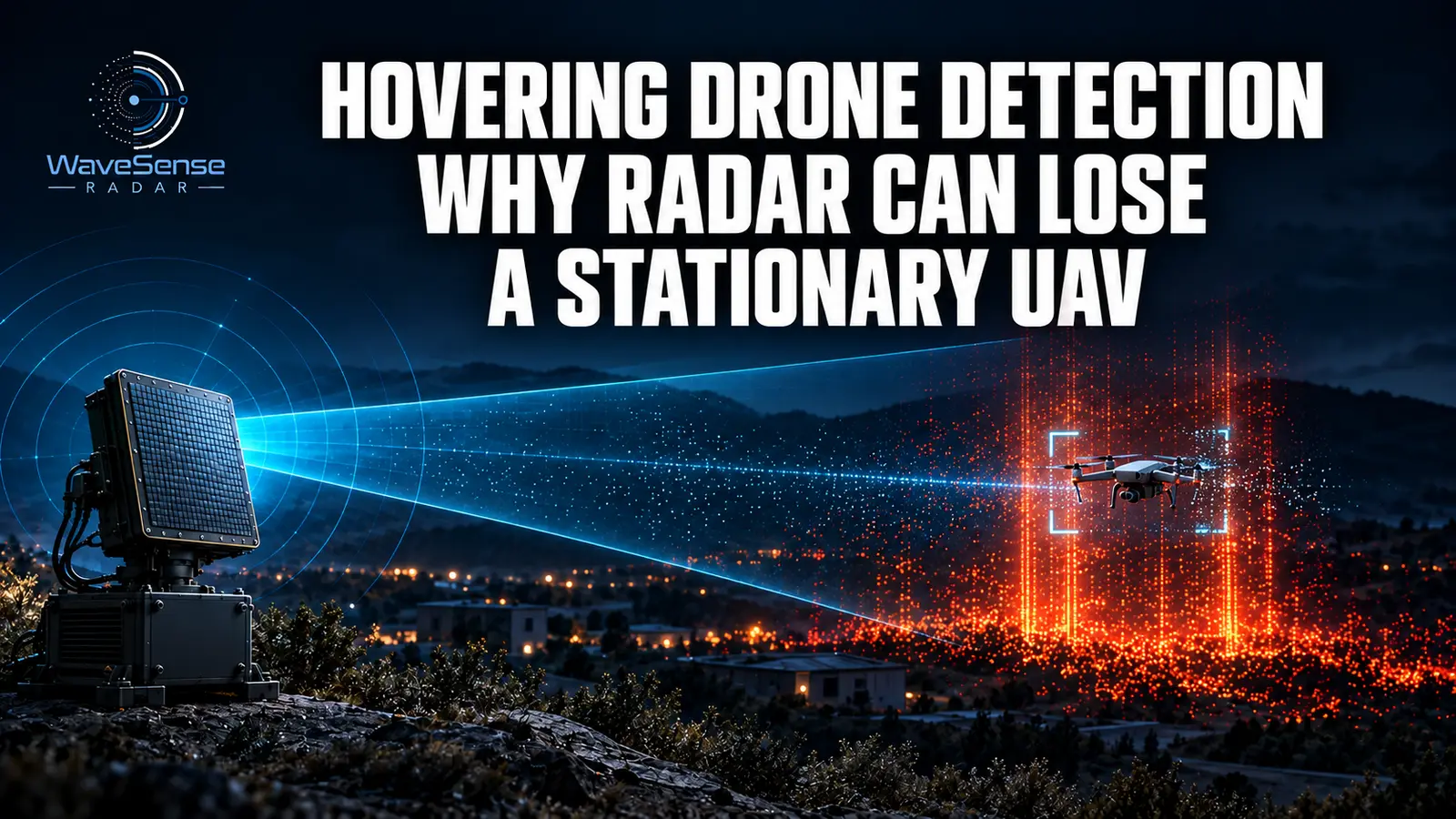
Why Are Hovering Drones Harder For Radar To Detect?
Hovering Drone Detection becomes difficult because the UAV body has almost no radial velocity, placing its main radar return close to the same zero-Doppler region as buildings, terrain, and other stationary clutter.
This creates a very different radar problem from a drone flying directly toward the sensor.
When the UAV is moving, radar can use body Doppler to help separate it from the background.
When it stops, that separation can disappear.
The target has not become physically invisible.
The problem is that the radar now has to decide whether a weak near-zero-velocity return is:
- A hovering drone
- A building edge
- Vegetation
- Ground clutter
- Another stationary reflector
That decision is where purpose-built drone radar differs from conventional moving-target processing.
What Actually Changes When A Drone Starts Hovering?
Consider the same quadcopter in two flight states.
During Approach
The drone has measurable radial velocity.
The radar sees:
Body return + translational Doppler + rotor micro-motion
The body Doppler helps move the UAV away from the strongest stationary clutter region.
During Hover
The aircraft holds nearly the same position.
The radar now sees:
Body return near zero Doppler + rotor micro-motion
The airframe return becomes much harder to distinguish from stationary surroundings.
The rotor blades are therefore much more important during hover than during a normal approach.
This is why a radar that detects a moving drone reliably does not automatically prove reliable Hovering UAV Detection.
Why Can A Clutter Filter Remove The Drone?
Radar designers face a practical problem.
The sensor may receive thousands of stationary reflections from:
- Buildings
- Ground
- Fences
- Towers
- Trees
Displaying all of them would make moving-target detection extremely difficult.
Radar therefore suppresses parts of the stationary or near-stationary background.
But a hovering UAV also sits close to that same region.
If processing is tuned too aggressively, the radar can effectively say:
“Near zero velocity = clutter.”
The result is a clean radar display—but a missing drone.
Research on low-altitude targets continues to identify this vulnerability: hovering and tangential UAVs can remain close to the clutter notch and may be weakened before stable tracking occurs.
Is A Hovering Drone Really Stationary To Radar?
Not completely.
The drone body may be nearly stationary, but its propellers are not.
Rotor blades rotate at high speed.
Different parts of each blade continually move toward and away from the radar.
That creates additional frequency modulation known as micro-Doppler.
The useful distinction is:
Airframe: almost zero Doppler.
Rotors: periodic non-zero micro-motion.
This gives the radar another source of evidence after the body motion disappears.
Our Micro-Doppler Radar article explains the rotor-signature mechanism in more detail.
Why Doesn’t Micro-Doppler Automatically Solve The Problem?
Because the rotor signal can be much weaker than the surrounding clutter.
The challenge is not merely:
“Does micro-Doppler exist?”
It is:
“Can the radar extract that feature at the required distance and clutter level?”
Signal quality can change with:
- Drone range
- Rotor size
- Viewing angle
- Radar frequency
- Ground clutter
- Signal-to-clutter ratio
A radar may therefore maintain the physical drone track at one distance but lose reliable rotor-based classification farther away.
This means buyers should separate:
Hovering detection range
from:
Hovering classification range.
They are not necessarily the same.
What Does A Hovering Drone Look Like In The Doppler Spectrum?
A simplified hovering UAV spectrum may contain a strong region around zero Doppler from:
- Ground clutter
- The nearly stationary drone body
with smaller rotor-related components around it.
Research published in 2026 describes these rotor components as periodic spectral features around the zero-frequency main return and uses their spacing, width, and stability to validate hovering UAV targets.
This matters because the radar does not need to rely on one simple rule such as:
“Anything moving is a drone.”
Instead, it can ask whether the zero-Doppler target also contains physical characteristics consistent with rotating UAV propellers.
What Happens If The Drone Hovers Near Trees?
This is a much harder test than hovering against clean sky.
Wind moves branches and leaves.
Vegetation therefore produces its own time-varying radar energy.
The radar must determine whether the observed motion comes from:
- Rotor blades
- Moving branches
- Leaves
- Other environmental clutter
This is why open-field hover demonstrations can exaggerate performance.
A 2026 IET study specifically tested micro-UAV hovering detection in tree-cluttered environments and reported detection of approximately 0.01 m² targets within 2 km for its particular Ku-band prototype. That is evidence for the tested system and algorithm—not a universal 2 km hovering-drone specification.
Why Can A Drone Hovering Near A Building Be Difficult?
Buildings create strong radar reflections.
A small UAV positioned close to a roof edge or wall may produce a much weaker return nearby.
The radar therefore needs sufficient:
- Dynamic range
- Spatial resolution
- Clutter suppression
- Track continuity
to preserve the weak target.
Multipath can make the situation even harder because reflected propagation paths may create additional target responses.
The important point for buyers is simple:
“Can detect a hovering drone” means little unless the test environment is defined.
A quadcopter hovering alone in open sky is not equivalent to a drone hovering beside industrial infrastructure.
Detection Is Not The Same As Track Retention
This is one of the most important distinctions.
Imagine the following test:
- UAV approaches the radar.
- Radar creates Track 27.
- UAV stops and hovers.
- Radar temporarily loses its body Doppler.
- UAV moves again.
Two radars may both claim they detected the drone.
But their behavior during Step 4 may be completely different.
Radar A
Keeps Track 27 throughout the hover.
Radar B
Deletes the target.
When the UAV moves again, it creates Track 48.
Radar B technically detected the drone before and after the hover.
Operationally, however, it lost target continuity.
For Counter-UAS applications, maintaining the same track can be much more valuable than simply reacquiring the aircraft later.
What Should A Good Hovering Drone Radar Maintain?
A useful system should ideally maintain enough evidence to preserve:
- Track ID
- Position
- Altitude
- Classification confidence
- Track history
during the stationary period.
The exact method can vary.
Radar may combine:
- Micro-Doppler
- Range stability
- Angle stability
- Historical tracking
- Clutter maps
- Multi-frame confirmation
The customer does not necessarily need to know the proprietary algorithm.
The customer does need to know whether the track survives.
Can Radar Detect A Drone With Exactly Zero Ground Speed?
A multirotor with operating propellers still contains moving components even when its center position remains nearly unchanged.
Therefore, radar can potentially use rotor micro-motion.
However, this does not mean every radar detects every hovering drone.
A conventional radar designed to reject slow objects may suppress the target.
A dedicated Drone Detection Radar should instead be designed around low-slow-small targets and tested specifically in low-Doppler conditions.
What About A Drone Sitting On A Roof With Its Motors Off?
That is a fundamentally different target.
If the UAV is physically stationary and its rotors are stopped:
- Body Doppler disappears.
- Rotor micro-Doppler disappears.
The radar now sees a stationary physical object among other stationary objects.
Detecting and identifying that object becomes much harder.
Therefore:
Hovering drone detection ≠ stationary parked-drone identification.
A manufacturer should not use successful hover detection to imply that radar can automatically identify an inactive drone sitting on a building.
Why Is Tangential Flight A Useful Hovering-Detection Test?
A drone does not need to stop completely to create a low-Doppler problem.
Consider a UAV flying across the radar’s field of view.
Its actual speed may be significant.
But if its movement is mostly perpendicular to the radar line of sight, its radial velocity can become small.
This creates a similar challenge:
Physical movement exists, but body Doppler is weak.
A radar that performs well against head-on approaches should therefore also be tested against:
- Crossing flight
- Slow orbit
- Hover
- Stop-and-go movement
These scenarios expose whether the detection chain depends too heavily on strong radial velocity.
How Should Hovering Drone Detection Be Tested?
A useful field test does not require dozens of scenarios.
One carefully designed sequence can reveal most of the important behavior.
Phase 1 — Approach
Fly a representative small UAV toward the radar.
Record the distance at which:
- Initial detection occurs
- Confirmed track begins
Phase 2 — Hover
Stop the UAV inside a clutter-relevant area.
Hover for at least long enough to see whether the tracker treats the target as persistent.
Record:
- Track ID
- Track drops
- Classification
- False detections
Phase 3 — Yaw
Rotate the drone while remaining approximately stationary.
This changes target aspect without adding much translational speed.
Observe whether detection or classification changes.
Phase 4 — Tangential Movement
Move sideways across the radar.
This tests the low-radial-velocity region.
Phase 5 — Resume Approach
Move again.
Check whether the system:
- Maintains the same track
- Reacquires correctly
- Creates a duplicate target
This one test tells the buyer much more than a normal high-speed flyby.
What Metrics Should The Buyer Record?
Do not record only:
Detected: Yes
Use a small set of operational metrics.
| Metric | What It Tells You |
|---|---|
| Hovering Detection Range | Where the stationary target remains detectable |
| Hovering Track Retention | Whether the target survives the hover |
| Track Drops | How often the UAV disappears |
| Track ID Continuity | Whether reacquisition creates a new target |
| Classification Confidence | Whether “drone” remains stable |
| False Tracks | Whether lower thresholds create clutter targets |
| Reacquisition Time | How quickly the target returns after loss |
These measurements turn Hovering Drone Detection from a brochure feature into something that can actually be accepted or rejected.
What Should You Ask A Radar Manufacturer?
Instead of asking:
“Can your radar detect hovering drones?”
ask:
“At what distance can you maintain a stable track on our representative UAV while it hovers near the type of clutter present at our site?”
Then ask four follow-up questions:
- Does the same Track ID remain active?
- What happens to classification confidence?
- How many false tracks appear when slow-target sensitivity is enabled?
- Is the quoted range detection range or micro-Doppler classification range?
Those four questions reveal far more than a simple Yes.
What Does Good Hovering Drone Detection Actually Mean?
It does not mean the radar detects one stationary quadcopter once.
A strong result is:
The radar detects the UAV while moving, preserves the target when body Doppler approaches the clutter region, uses additional evidence such as rotor micro-motion or track history, avoids excessive clutter false tracks, and maintains useful target continuity until the UAV moves again.
That is the real engineering requirement.
For a Counter-UAS buyer, the question should therefore move from:
“Does your radar support hovering detection?”
to:
“What happens to the track when the drone stops moving?”
That is the test that matters.
FAQ
Why Can Radar Lose A Hovering Drone?
Because the drone body’s radial velocity approaches zero and its return can overlap stationary ground clutter.
Does A Hovering Drone Produce Doppler?
Its body Doppler can be close to zero, but rotating propellers generate micro-Doppler components that suitable radar processing can use.
Can Conventional Radar Detect A Hovering UAV?
Some can, but radars designed primarily for conventional fast aircraft may suppress very slow targets as clutter. Purpose-built low-slow-small target processing is important.
Does Micro-Doppler Guarantee Hovering Drone Detection?
No. Rotor signatures still need sufficient signal quality and must be separated from clutter and noise.
Is Hovering Detection Range The Same As Normal Drone Detection Range?
Not necessarily. A moving approaching UAV can benefit from clearer body Doppler, while a hovering target presents a more difficult clutter-separation problem.
How Should I Verify Hovering Drone Detection?
Have the same UAV approach, stop, hover near representative clutter, rotate, move tangentially, and resume flight while recording track continuity, classification, false tracks, and reacquisition behavior.