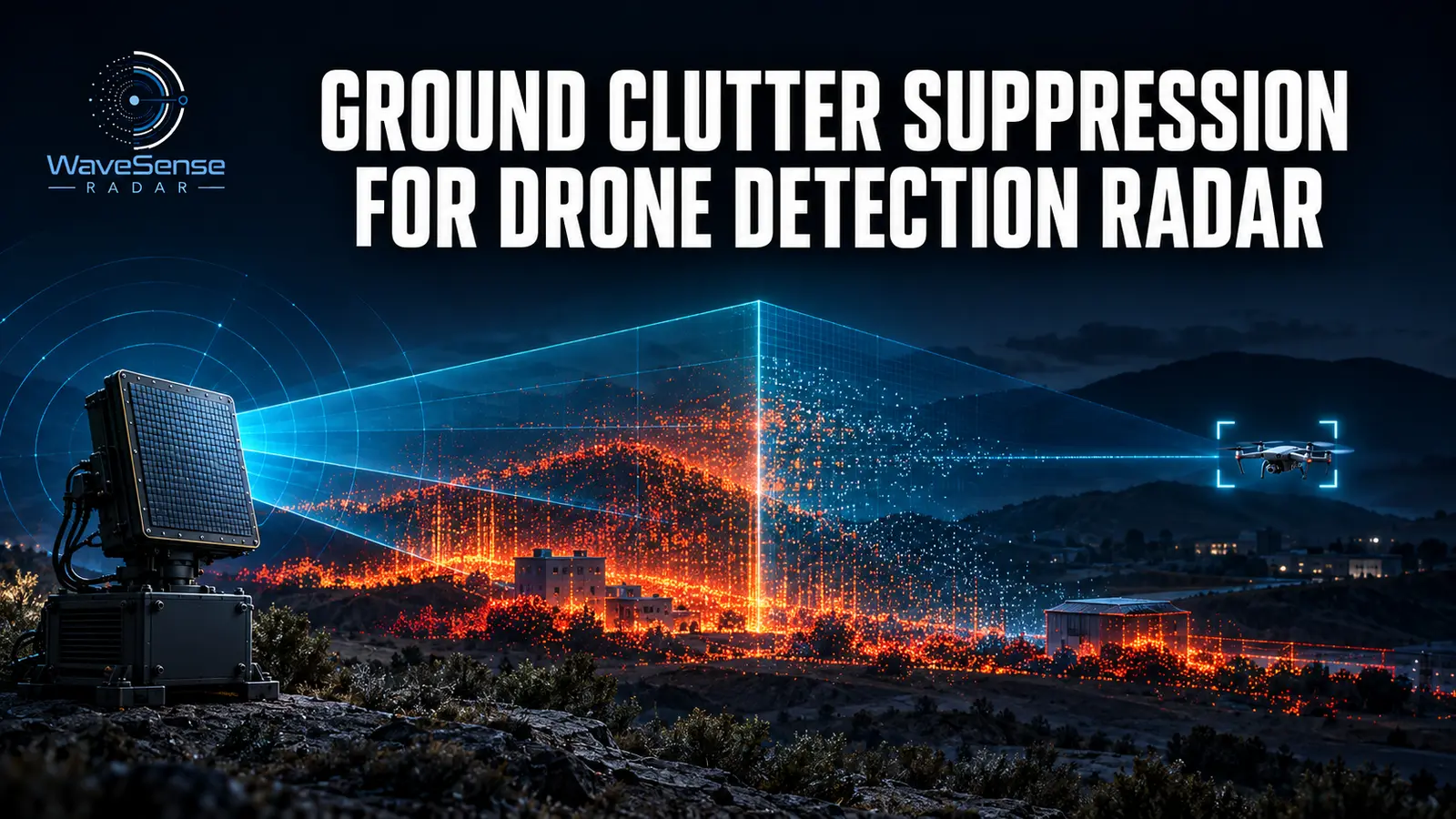
How Far Can A Drone Detection Radar Detect?
A Drone Detection Radar Range of 3 km, 5 km, 10 km, or 20 km means very little unless the manufacturer also defines the UAV, radar cross section, altitude, probability of detection, tracking criteria, and test environment.
A radar may be described as a 20 km radar while detecting a 0.01 m² small quadcopter at only 10 km.
That is not contradictory.
The two numbers describe different performance conditions.
Why Is Drone Radar Range So Easy To Misunderstand?
The word range can describe several different specifications.
A datasheet may use it for:
- Instrumented range
- Maximum processing range
- Detection range
- Tracking range
- Classification range
- Coverage radius
These numbers are not interchangeable.
Before comparing two radars, buyers should first determine what each range number actually represents.
What Does A 3 km Drone Radar Mean?
A 3 km Drone Detection Radar generally means the system is designed to provide useful UAV surveillance over a relatively compact protected area.
However, the number still requires a target definition.
A current commercial example lists approximately 3 km detection against a 0.01 m² RCS target, while another product family offers 3 km as one configuration within a wider short-to-long-range portfolio.
This makes 3 km a target-specific performance figure rather than a universal radar category.
Where Is A 3 km Drone Radar Useful?
A 3 km system can be suitable for:
- Prisons
- Warehouses
- Industrial facilities
- Small power stations
- Temporary events
- Local perimeter security
The required range depends on how much warning time the security team needs.
A compact site may gain little operational benefit from monitoring every UAV 20 km away.
Reliable short-range classification can sometimes be more useful than extreme range.
What Does A 5 km Drone Radar Mean?
A 5 km Drone Radar is commonly positioned as a medium-range C-UAS sensor.
Again, the target matters.
Current product specifications exist that explicitly state approximately 5 km against RCS = 0.01 m² rather than simply advertising “5 km range.”
This is a much better specification because the buyer knows approximately what target difficulty is associated with the distance.
Is A 5 km Radar Enough For Critical Infrastructure?
It can be.
A 5 km radius may provide several minutes of warning against many commercial UAV flight profiles.
The actual requirement depends on:
- Drone speed
- Confirmation time
- Operator response
- Site perimeter
- Terrain
- Legal response options
A radar should therefore be sized from the response timeline backward, rather than choosing the longest catalog range first.
What Does A 10 km Drone Radar Mean?
A 10 km Drone Radar becomes much more demanding when that range is specified against a genuinely small UAV.
Several current X- and Ku-band products advertise approximately 10 km against a 0.01 m² UAV target.
That is fundamentally different from a radar that reaches 10 km only against a much larger aircraft.
Always compare the target class alongside the kilometer number.
What Does A 20 km Drone Radar Mean?
This is where buyers should be especially careful.
A product may be marketed as a 20 km radar because its coverage or instrumented range reaches 20 km.
Yet the specification may say:
Small UAV, RCS 0.01 m²: ≥10 km
and:
Medium UAV, RCS 1 m²: ≥20 km.
Several current product pages use exactly this structure.
Therefore:
20 km radar does not automatically mean 20 km small-drone detection.
Why Can The Same Radar Detect One Drone At 10 km And Another At 20 km?
Different targets return different amounts of radar energy.
A larger fixed-wing UAV may have a much larger Radar Cross Section, or RCS, than a compact quadcopter.
The stronger target can therefore remain detectable at greater distance.
Other variables also matter:
- Aspect angle
- Materials
- Payload
- Frequency
- Altitude
- Clutter
For a deeper explanation, see our Radar Cross Section Of A Drone article.
What Is Radar Cross Section?
Radar Cross Section describes how strongly a target scatters radar energy back toward the radar.
RCS is measured in square meters or dBsm.
It does not equal physical drone size.
Two UAVs with similar dimensions can have different radar signatures because of:
- Geometry
- Materials
- Battery
- Motors
- Payload
- Orientation
This makes target-specific range testing essential.
How Does RCS Affect Detection Range?
Under a simplified noise-limited monostatic radar model, maximum detection range is proportional approximately to the fourth root of target RCS.
NASA technical material describes this fourth-root relationship between acquisition range and RCS.
This means changing RCS by a very large amount produces a much smaller proportional change in range.
Radar detection distance does not increase linearly with target RCS.
Does Twice The RCS Mean Twice The Range?
No.
Under the simplified fourth-root relationship, doubling target RCS increases theoretical range only by roughly 19%.
To double theoretical range, target RCS would need to increase approximately 16 times, assuming all other radar and environmental parameters remain unchanged.
Real UAV surveillance can differ because clutter, propagation, processing, and target fluctuations also affect performance.
What Happens When RCS Changes From 0.01 m² To 1 m²?
That is a 100× increase in RCS.
Under the simplified fourth-root relationship:
100^(1/4) ≈ 3.16
So a radar detecting a 0.01 m² target at 5 km might theoretically detect a 1 m² target at roughly 15.8 km under identical noise-limited conditions.
This is only an engineering illustration.
Actual field range must still be measured.
Why Does This Explain Many “20 km Radar” Specifications?
Suppose one target is around 0.01 m² and another is around 1 m².
The second target represents a dramatically stronger radar reflector.
It is therefore completely reasonable for one radar to publish:
Small UAV: ~10 km
and:
Larger UAV: ~20 km
without changing radar hardware.
Current commercial specifications demonstrate exactly this target-dependent pattern.
Is RCS = 0.01 m² A Universal Small-Drone Standard?
No.
It is widely used as a convenient reference value in product specifications, but real UAV RCS is not constant.
The radar signature changes with:
- Aspect angle
- Frequency
- Polarization
- Payload
- Rotor orientation
Therefore, 0.01 m² should be treated as a test or design reference when stated—not as the permanent RCS of every consumer drone.
Is DJI Phantom 4 Always A 0.01 m² Target?
No.
Some commercial radar datasheets use a DJI Phantom 4 together with an RCS reference of approximately 0.01 m².
That does not mean the aircraft has exactly 0.01 m² RCS from every viewing direction and radar frequency.
Drone RCS fluctuates.
A manufacturer should ideally explain whether its value is:
- Representative
- Mean
- Minimum
- Simulated
- Measured
and under what conditions.
Why Is “Small Drone” A Poor Radar Specification?
Because small is not an electromagnetic measurement.
One supplier might define small UAV as:
- DJI-class quadcopter
while another might mean:
- Larger industrial multicopter.
A useful radar datasheet should state the actual UAV model or representative RCS.
The FAA specifically recommends asking what RCS a system can detect and classify at specific distances. See the FAA UAS Detection Technical Considerations.
Instrumented Range Vs Drone Detection Range
Instrumented Range describes how far the radar processing configuration can represent or search.
Drone Detection Range describes how far away a defined UAV can actually generate sufficient information for detection.
These numbers can be very different.
A 20 km processing window does not prove 20 km performance against:
- Mini drones
- Nano UAVs
- 0.01 m² targets
Always request the target-specific number.
Coverage Range Vs Detection Range
Coverage Range may describe the physical surveillance region.
Detection Range describes target performance inside that region.
For example:
Coverage: 20 km
Small UAV detection: 10 km
can be perfectly valid.
The outer region may still be useful for larger:
- UAVs
- Helicopters
- Aircraft
while smaller targets become detectable only closer to the radar.
Detection Range Vs Tracking Range
Initial detection is only the first step.
A radar might briefly observe a weak target at its maximum detection distance.
A stable track requires repeated measurements.
Therefore:
Maximum Detection Range
may be longer than:
Reliable Tracking Range.
Buyers should ask how far away the radar can form and maintain a confirmed track—not simply where the first detection occurs.
Detection Range Vs Classification Range
Classification usually requires more information than detection.
The radar may know:
Target exists at 7 km
while still showing:
Class: Unknown.
At 5 km, stronger signal quality may allow the system to classify:
Probable Drone.
Therefore, classification range can be shorter than raw detection range.
This distinction is extremely important for AI-based radar systems.
What Is Stable Tracking Range?
Stable Tracking Range is the distance within which the radar can maintain a useful target trajectory with acceptable continuity.
A professional tracking requirement can include:
- Confirmed track formation
- Low track-drop rate
- Reliable velocity
- Reliable altitude
- Consistent track ID
For integrated security systems, stable tracking is usually more useful than occasional maximum-range detections.
Why Does EO/IR Cueing Need Tracking Range Rather Than Detection Range?
A camera needs current coordinates to find the UAV.
One isolated radar detection may not provide enough information.
The radar needs to continuously update:
- Azimuth
- Elevation
- Range
- Predicted target position
Therefore, the effective camera-cueing range depends heavily on radar track quality and angular accuracy, not only first-detection distance.
What Is Probability Of Detection?
Probability Of Detection, or Pd, describes how consistently a radar detects the defined target.
For example, a supplier might specify performance using a stated:
80% Pd
or another threshold.
One current UAV radar product explicitly publishes 80% Pd and Pfa = 10⁻⁶ alongside its target-specific range values.
That specification provides much more context than range alone.
Why Does Pd Matter More Than One Maximum Detection?
Suppose a UAV is once detected at 12 km.
That does not prove reliable 12 km coverage.
If the same target is detected consistently around 9 km but only occasionally at 12 km, then 9 km may be closer to the useful operational range.
Security systems need repeatable warning.
Maximum-range records are much less valuable than defined detection probability.
What Is Pfa?
Pfa means Probability Of False Alarm.
It describes the probability that noise or clutter crosses the target-detection threshold even when no desired target is present.
Detection threshold creates a tradeoff:
Lower threshold → more weak-target detections
but often:
Lower threshold → more false alarms.
A radar should therefore be evaluated using both Pd and false-alarm performance.
Can Manufacturers Increase Range By Lowering The Detection Threshold?
Potentially.
A more sensitive threshold may expose weaker distant returns.
However, it can also generate more:
- Clutter detections
- Bird alerts
- Noise detections
- False tracks
Therefore, maximum-range testing should specify the detection criteria.
A radar that gains 1 km while producing an unusable number of false tracks may not improve operational security.
What Is False Track Rate?
A false detection may appear once and disappear.
A false track persists through the tracking system and appears to operators as a real moving target.
False tracks can consume:
- Camera resources
- Operator attention
- C2 bandwidth
For real Counter-UAS deployments, false-track performance can be more meaningful than raw receiver false-alarm probability.
Why Does Drone Altitude Affect Detection Range?
A higher target often has a cleaner radar line of sight.
A low UAV may fly close to:
- Buildings
- Terrain
- Trees
- Vehicles
Its weak return then competes with strong ground clutter.
Therefore, the same drone can have a different practical detection range at:
30 m altitude
than:
300 m altitude.
Radar range should ideally be tested across representative flight heights.
Can A 10 km Radar Detect A Drone At 10 km When It Is Only 10 m Above The Ground?
Not necessarily.
The target may be hidden behind terrain, vegetation, or buildings.
Radar waves generally require useful propagation geometry between sensor and target.
A datasheet range measured under clear line-of-sight conditions cannot guarantee identical low-level coverage everywhere.
The FAA also notes that terrain and dense objects can screen or weaken radar targets.
Why Does Ground Clutter Reduce Detection Range?
Low-altitude radar receives strong reflections from:
- Terrain
- Buildings
- Vegetation
- Vehicles
The desired drone may be thousands or millions of times weaker than some nearby environmental returns.
The radar must separate the UAV using:
- Doppler
- CFAR
- Clutter maps
- Tracking
- Micro-Doppler
- Spatial processing
Maximum range in empty terrain can therefore differ from urban or industrial range.
Open Field Range Vs Urban Range
An open-field demonstration provides:
- Clear line of sight
- Low obstruction
- Relatively simple clutter
An urban site introduces:
- Buildings
- Multipath
- Vehicles
- RF interference
- Occlusion
Therefore, a radar rated for 5 km in open terrain should not automatically be assumed to provide identical usable coverage between high-rise structures.
Site acceptance testing is critical.
Why Can Buildings Create Radar Shadows?
A large building can physically block the direct radar path.
Targets behind it may enter a radar shadow.
Increasing transmitter power cannot always solve this because the signal still needs a suitable propagation path.
Possible solutions include:
- Higher installation
- Additional radar
- Multiple viewpoints
- Complementary sensors
This is why site geometry can matter more than another few kilometers of nominal range.
Does Installing Radar Higher Increase Range?
It can improve low-altitude line of sight over nearby obstacles.
However, the highest possible location is not automatically best.
Installation height also changes:
- Near-range coverage
- Downward geometry
- Ground clutter
- Structural requirements
A site survey should optimize radar placement for the protected airspace rather than maximizing mast height blindly.
Is Radar Horizon Important For Drone Detection?
At sufficiently long distances, Earth curvature can influence line of sight.
For many 3–10 km small-UAV applications, however, local:
- Buildings
- Trees
- Terrain
can become limiting factors much earlier.
For 20 km or longer low-altitude surveillance, both terrain and geometric horizon deserve greater attention.
The theoretical sensor range should always be compared with actual line-of-sight coverage.
Does Rain Reduce Drone Detection Range?
It can.
The effect depends on:
- Frequency
- Rain intensity
- Target RCS
- Radar architecture
- Signal processing
Small low-RCS drones provide less signal margin than large aircraft.
Weather degradation can therefore become important near the edge of detection.
The FAA recommends asking how different weather conditions affect radar performance.
Does Fog Reduce Radar Range?
Fog affects visible cameras much more directly than radar.
Radar can therefore remain useful under poor visual conditions.
However, atmospheric propagation still depends on radar frequency and environmental conditions.
A claim such as:
“All-weather radar”
should not automatically be interpreted as:
“Range never changes with weather.”
Environmental test data is more useful than marketing language.
Does Frequency Determine Drone Radar Range?
Frequency influences radar design, but it does not determine range by itself.
Drone radars can operate in:
- S-band
- C-band
- X-band
- Ku-band
- Millimeter wave
Range also depends on:
- Antenna aperture
- Transmit power
- Receiver sensitivity
- Target RCS
- Processing gain
Therefore:
Ku-band ≠ automatically longer range
and:
X-band ≠ automatically shorter range.
Does Higher Transmit Power Always Mean Longer Range?
Other conditions being equal, additional usable transmitted energy can increase detection performance.
However, practical radar range also depends on:
- Antenna gain
- Losses
- Noise
- Clutter
- Waveform
- Integration time
In a clutter-limited environment, simply increasing power can increase both target and environmental returns.
Signal processing can become just as important as transmitter power.
Why Does Antenna Size Matter?
A larger effective aperture can provide:
- Higher gain
- Narrower beams
- Better angular performance
depending on frequency and architecture.
Higher antenna gain helps concentrate energy and receive weak target echoes.
This is one reason a compact low-cost radar and a much larger surveillance radar can have very different drone ranges even when both operate in the same frequency band.
Does AESA Automatically Have Longer Range?
No.
AESA describes an active electronically scanned antenna architecture.
It provides benefits such as:
- Fast beam steering
- Flexible revisits
- Multi-target tracking
But maximum range still depends on the complete radar design.
A large mechanical radar can outperform a small AESA in raw detection range.
Architecture and performance should therefore be evaluated separately.
Does FMCW Radar Have Shorter Range?
Not automatically.
FMCW is often associated with compact short-range sensors because of automotive radar.
But FMCW architecture itself does not impose a fixed short-distance limit.
Actual range depends on:
- Transmit power
- Antenna gain
- Receiver
- Processing
- Target RCS
For a wider explanation, see the relevant FMCW technology section within our Drone Detection Radar resource.
Can Pulse-Doppler Radar Detect Farther?
Pulse-Doppler architectures can be designed for long-range surveillance and can use relatively high pulse energy.
However, they do not automatically outperform every FMCW design.
The correct comparison uses the same:
- Target
- Environment
- Pd
- Coverage
- Tracking criteria
Waveform terminology should not replace measured performance.
3 km Vs 5 km Drone Radar: Which Should You Choose?
Choose based on required warning time and site geometry.
A 3 km system may be sufficient for a compact site with rapid response.
A 5 km system may provide additional time and perimeter depth.
But if terrain blocks the outer 2 km, the longer nominal range may add little value.
The best choice is the shortest range that reliably satisfies the operational requirement with sufficient margin.
5 km Vs 10 km Drone Radar
Moving from 5 km to 10 km does more than double a number on the datasheet.
It may require:
- Larger antenna
- Greater power
- Better sensitivity
- More processing
- Different deployment
The surveillance area also grows dramatically.
A 10 km radius covers four times the theoretical circular area of a 5 km radius.
That can produce many more legitimate airborne tracks for operators to manage.
Why Does Doubling Range Increase Surveillance Area So Much?
Circular area is proportional to the square of radius.
For ideal flat coverage:
5 km radius ≈ 78.5 km²
10 km radius ≈ 314 km²
Therefore, doubling radar radius multiplies theoretical monitored area by four.
This can increase:
- Bird tracks
- Legitimate drones
- Aircraft
- Operator workload
Longer range requires stronger target management, not just stronger detection.
10 km Vs 20 km Drone Radar
The difference is particularly important because a nominal 20 km radar may not provide 20 km performance against a small UAV.
Current product specifications commonly show patterns such as:
0.01 m² small UAV: ~10 km
1 m² medium UAV: ~20 km.
Therefore, buyers comparing “10 km” and “20 km” products must verify whether both numbers refer to the same target.
Is A 20 km Radar Always More Expensive?
Usually longer-range capability increases system demands, but price does not scale simply with kilometers.
Cost can also depend on:
- AESA architecture
- 360° coverage
- Track capacity
- Environmental rating
- Classification
- Software
- C2 integration
A shorter-range 4-panel AESA can sometimes be more complex than a mechanically scanning longer-range radar.
Compare complete architecture and capability.
How Much Warning Time Does 3 km Provide?
If a drone flies directly toward the protected site at 20 m/s, 3 km corresponds theoretically to about:
150 seconds
or:
2.5 minutes.
This excludes:
- Detection confirmation
- Maneuvering
- Processing latency
The value illustrates why range should be converted into response time, not evaluated only in kilometers.
How Much Warning Time Does 5 km Provide?
At the same constant 20 m/s direct approach:
5 km ≈ 250 seconds
or approximately:
4.2 minutes.
If the operational team requires four minutes to verify the target and respond, 5 km may provide little safety margin.
This is why threat speed and response workflow should be defined before radar range.
How Much Warning Time Does 10 km Provide?
At 20 m/s:
10 km ≈ 500 seconds
or roughly:
8.3 minutes.
That provides significantly more decision time.
However, the radar must establish a stable track close to that distance.
An occasional first detection at 10 km followed by reliable tracking only at 6 km does not provide a true 8-minute operational warning.
How Much Warning Time Does 20 km Provide?
At 20 m/s:
20 km ≈ 1,000 seconds
or approximately:
16.7 minutes.
But this is relevant only if the actual threat target is reliably detectable at 20 km.
A medium fixed-wing UAV may be.
A compact 0.01 m² quadcopter may not be.
This is exactly why RCS-specific performance matters.
Warning Time At Different Radar Ranges
| Reliable Track Range | Time At 10 m/s | Time At 20 m/s | Time At 30 m/s |
|---|---|---|---|
| 3 km | 5.0 min | 2.5 min | 1.7 min |
| 5 km | 8.3 min | 4.2 min | 2.8 min |
| 10 km | 16.7 min | 8.3 min | 5.6 min |
| 20 km | 33.3 min | 16.7 min | 11.1 min |
These are simple constant-speed, direct-path calculations.
Real trajectories and operational timelines vary.
Should Radar Range Be Based On The Fastest Drone?
Often, yes.
A threat model should include the fastest relevant UAV because it produces the shortest warning time.
However, speed is not the only consideration.
Slow or hovering UAVs can be harder for Doppler processing.
A complete test matrix should therefore include:
Fast Approach + Slow Approach + Hover + Tangential Flight.
Why Is Tangential Flight Important?
A drone flying sideways relative to radar can have low radial velocity even while moving quickly.
This can reduce Doppler separation from clutter.
Therefore, a radar demonstrating 10 km range using only direct approaching flights should not automatically be assumed to provide identical performance for crossing targets.
Real-world acceptance testing should include several geometries.
Why Is Hovering Range Different From Moving-Drone Range?
A moving drone creates body Doppler that can help separate it from stationary clutter.
A hovering UAV loses much of that advantage.
Its body return can approach zero Doppler.
Rotor micro-Doppler can still assist classification.
However, the reliable hovering detection range may differ from the range achieved against a strongly approaching drone.
Buyers should request both.
What Is Approach-Aspect Range?
Radar cross section changes as the drone rotates relative to the radar.
A UAV may produce:
- Strong side aspect
- Weak front aspect
- Different rear aspect
depending on airframe and frequency.
The advertised range should therefore not automatically be assumed identical from every direction.
Multi-angle testing provides a more realistic performance picture.
Does 360° Radar Have The Same Range In Every Direction?
Not necessarily.
Mechanical systems can be affected by:
- Site obstruction
- Installation
- Antenna pattern
Fixed electronically scanned panels can experience performance changes toward sector edges.
Therefore, 360° coverage does not guarantee uniform small-drone detection distance everywhere.
Field tests should include several azimuth directions.
What Is Edge-Of-Sector Range?
For electronically steered arrays, maximum performance is often achieved closer to the preferred antenna direction.
At large steering angles, scan loss can reduce gain.
Therefore, a radar may provide:
10 km near panel boresight
but somewhat different performance near the edge of the electronic sector.
Buyers should ask whether published range is:
- Boresight range
- Minimum sector range
- Typical range
Is Classification Range More Important Than Detection Range?
For some projects, yes.
Suppose:
Detection: 10 km
Classification: 4 km
The system provides early warning, but operators may spend several kilometers of target approach without knowing whether it is a bird or drone.
If the security workflow requires automated classification before action, classification distance can become the more important performance metric.
Why Is Camera Confirmation Range Important?
Radar may detect at 10 km while the associated EO/IR camera can visually confirm the drone only at a shorter distance.
The complete system’s practical identification range can therefore be constrained by the secondary sensor.
A Counter-UAS system should be evaluated as:
Radar Detection + Radar Tracking + Camera/RF Confirmation
rather than one sensor in isolation.
Why Is Long Radar Range Wasted Without Camera Cueing Accuracy?
A narrow-FOV camera requires accurate coordinates.
If radar azimuth error is too large at long range, the predicted target region may exceed the camera’s field of view.
Therefore, long-distance sensor fusion requires:
- Good angular accuracy
- Low latency
- Track continuity
A 10 km track with poor location accuracy may be less useful than a 7 km track with precise cueing.
What Is Range Accuracy?
Range Accuracy describes how close the radar’s distance estimate is to the real target range.
It is different from:
Range Resolution, which describes separation between two nearby targets.
Current long-range UAV radar examples may publish range accuracy figures such as several meters RMS alongside 10 km small-UAV ranges.
Both values should be considered separately.
Does Better Range Resolution Increase Detection Range?
Not automatically.
Range resolution helps separate nearby targets.
Detection range depends more strongly on:
- Link budget
- RCS
- SNR
- Processing
- Clutter
A radar can have excellent high-resolution sensing at relatively short distance.
Another can detect much farther with coarser resolution.
The mission determines which capability matters more.
Why Does Track Update Rate Matter At Long Range?
A long-range detection provides early warning only if track information remains fresh.
Suppose one radar updates every:
1 second
and another every:
4 seconds.
A maneuvering UAV can move significantly between updates.
The practical impact depends on:
- Drone speed
- Camera cueing
- Track prediction
Range and update rate should therefore be evaluated together.
What Does 30 RPM Mean?
A mechanically rotating radar operating at:
30 RPM
completes one revolution roughly every two seconds.
Some current 20 km-class product specifications list approximately:
- 20 RPM = 3 s
- 30 RPM = 2 s
- 60 RPM = 1 s
as available refresh configurations.
But rotation period and final track output rate should still be verified separately.
Can Faster Rotation Reduce Detection Range?
Potentially.
Faster mechanical scanning can reduce dwell time on a target during each pass.
Less dwell can reduce available coherent integration or signal energy.
System designers compensate through:
- Antenna design
- Waveform
- Processing
- Multiple beams
Therefore, higher refresh rate can involve sensitivity tradeoffs.
Buyers should request detection performance at the actual operating scan rate.
Does Maximum Range Change With Radar Mode?
It can.
A radar may provide different modes such as:
- Long-range search
- High-update surveillance
- Classification
- Sector focus
Different modes may allocate different:
- Dwell time
- Waveforms
- Processing
Therefore, maximum range stated in one mode should not automatically be assumed while the radar operates in another configuration.
Can Sector Search Increase Drone Detection Range?
Potentially.
If radar concentrates its resources on a smaller sector, it may devote more:
- Dwell
- Energy
- Revisit time
to that region.
This can improve sensitivity or update performance depending on architecture.
The tradeoff is reduced wide-area coverage.
AESA systems can be particularly flexible in dynamically prioritizing sectors.
Does More Radar Integration Time Increase Range?
Longer coherent or non-coherent integration can improve sensitivity to weak signals.
However, increasing integration time can also:
- Increase latency
- Reduce scan speed
- Challenge maneuvering targets
A small low-RCS drone may benefit from more processing gain, but the radar still needs timely tracks.
Detection range and update rate therefore create another system tradeoff.
Why Is Maximum Range Usually Quoted Under Favorable Conditions?
Maximum specifications are often measured under controlled conditions because products need repeatable benchmarks.
Typical favorable conditions may include:
- Clear line of sight
- Defined target
- Suitable altitude
- Low obstruction
That is acceptable as long as the conditions are disclosed.
The problem begins when a laboratory or open-field maximum is interpreted as guaranteed range at every customer site.
What Is Site-Specific Effective Range?
Site-Specific Effective Range is the useful surveillance distance that remains after considering the real location.
It depends on:
- Terrain
- Buildings
- Installation height
- Clutter
- Local weather
- Target profile
This is the number a customer ultimately cares about.
It cannot always be determined accurately from a product brochure.
Why Is Site Survey Important Before Choosing Range?
Imagine buying a 10 km radar for a facility surrounded by hills that block low-altitude line of sight at 4 km.
The additional radar sensitivity provides little benefit in those directions.
A site survey can reveal:
- Terrain masks
- Building shadows
- Good sensor locations
- Required overlapping radars
This can prevent overpaying for range that the site cannot use.
When Is A 3 km Radar Better Than A 10 km Radar?
A shorter-range radar may be the better choice when it offers:
- Better site geometry
- Higher update rate
- Lower false alarms
- Better classification
- Lower cost
for a compact protected area.
The objective is not maximum technical capability.
It is sufficient operational capability at the lowest lifecycle complexity.
When Is A 5 km Radar The Best Choice?
A 5 km system can provide a useful balance for medium-sized facilities where:
- Several minutes of warning are sufficient
- Small-UAV detection is required
- Long-range airspace produces unnecessary traffic
- Installation must remain compact
This can include industrial facilities, prisons, energy sites, and other controlled perimeters.
When Is A 10 km Radar Worth The Extra Capability?
A genuine 10 km small-UAV radar becomes valuable when the site needs:
- Earlier warning
- Large-area surveillance
- Multiple protected assets
- Wide standoff distance
Potential applications include:
- Airports
- Military facilities
- Large critical infrastructure
- Borders
The 10 km figure should still be verified against the required UAV and Pd.
When Is A 20 km Radar Necessary?
20 km-class surveillance becomes more relevant when projects need to monitor:
- Larger UAVs
- Fixed-wing threats
- Large borders
- Wide military zones
- Extended approaches
For small consumer drones, buyers must verify whether the radar genuinely provides 20 km detection or whether 20 km applies only to larger RCS targets.
This distinction is critical.
Is There Such A Thing As A 20 km Small-Drone Radar?
Yes, radar systems can be engineered for very long small-target detection, but such capability is technically demanding.
The required combination may include:
- Large aperture
- High sensitivity
- Strong processing gain
- Suitable frequency
- Clean geometry
A supplier claiming 20 km against a very small RCS target should provide especially clear test conditions and demonstrated Pd.
Do not infer performance from “20 km radar” wording alone.
What Is Long Range Drone Detection Radar?
There is no universally standardized kilometer threshold for the phrase.
Different manufacturers may use Long Range Drone Detection Radar for systems reaching:
- 8 km
- 10 km
- 15 km
- 20 km+
depending on the product category.
Therefore, “long range” is primarily marketing terminology unless accompanied by:
Target + RCS + Pd + Conditions.
What Is Medium Range Drone Detection Radar?
Similarly, medium range has no universal standardized definition.
A manufacturer might classify:
- 3 km
- 5 km
- 8 km
products as medium-range depending on its portfolio.
Procurement documents should avoid relying on these labels.
Use actual performance requirements instead.
What Is Short Range Drone Detection Radar?
Short-range radar can still provide high-value Counter-UAS performance.
Such systems may prioritize:
- High refresh rate
- Fine resolution
- Compact size
- Low minimum range
- Urban deployment
instead of extreme distance.
Short-range should therefore not be treated as low-performance.
It simply reflects a different mission envelope.
Can Several 5 km Radars Be Better Than One 20 km Radar?
Yes.
Multiple sensors can provide:
- Better geometry
- Fewer blind zones
- Redundancy
- Different viewpoints
A single long-range radar may still be blocked by:
- Buildings
- Hills
- Large industrial structures
Several strategically positioned shorter-range radars can create more complete coverage.
The correct answer depends on site topology.
Does Multi-Radar Deployment Increase Detection Range?
It mainly increases coverage quality and geometry, not necessarily the intrinsic range of one sensor.
A drone blocked from Radar A may be visible to Radar B.
Different viewing angles can also improve target separation.
Networked sensors can therefore improve effective surveillance even when each radar individually has a shorter maximum range.
What Is Overlapping Radar Coverage?
Overlapping Coverage means two or more radars observe part of the same airspace.
Benefits can include:
- Redundancy
- Better continuity
- Multi-angle observation
However, the system then needs track correlation.
Otherwise, one physical UAV could appear as several independent radar tracks.
How Does Drone Swarm Detection Affect Range Requirements?
Swarm performance creates different requirements from one-drone maximum range.
At long distance, tightly spaced UAVs create small angular separation.
The radar may detect the group while failing to resolve every individual member.
Therefore, buyers should distinguish:
Swarm Detection Range
from:
Individual Swarm-Member Resolution Range.
These numbers can be different.
Is Maximum Track Count Related To Detection Range?
Indirectly.
At longer distances, the radar may detect more legitimate airspace activity because its surveillance volume is larger.
That increases processing and tracking demand.
A product rated:
500 tracks
should therefore also state:
- Update rate
- Track latency
- Target separation
under high target load.
Track capacity alone does not prove strong long-range swarm performance.
Why Does Classification Become Harder At Long Range?
Fine target characteristics become weaker as received signal decreases.
The radar might still detect a strong body return while losing enough detail for:
- Micro-Doppler
- RCS statistics
- AI classification
Therefore, a 10 km detection claim may coexist with a much shorter reliable Bird Vs Drone classification range.
This is physically reasonable and should be stated transparently.
Can AI Increase Drone Detection Range?
AI can help extract patterns that conventional processing might miss.
However, AI cannot eliminate basic radar physics.
If insufficient target information reaches the receiver, a neural network cannot create unlimited signal energy.
AI should therefore be evaluated as:
Processing Improvement
rather than:
Magic Range Multiplier.
Radar hardware, antenna, waveform, RCS, and environment remain fundamental.
Does Micro-Doppler Work At Maximum Detection Range?
Not always.
Micro-Doppler from small rotating blades can be much weaker than the overall drone-body return.
At long distance, radar may detect and track the UAV while rotor signatures are too weak for confident classification.
This is another reason to separate:
Detection Range
from:
Micro-Doppler Classification Range.
Can RF Detection Provide Longer Drone Range Than Radar?
Sometimes.
RF sensors can potentially detect drone communication signals over significant distances if:
- Signals exist
- Frequencies are supported
- Propagation is favorable
But RF detection can miss:
- Autonomous UAVs
- RF-silent drones
- Unknown protocols
Radar detects the physical aircraft.
The two technologies therefore should not be compared using range alone.
Why Is Sensor Fusion Better Than One Extreme-Range Sensor?
Different sensors have different strengths.
Radar may provide:
- Physical target track
RF may provide:
- Communication information
EO/IR may provide:
- Visual confirmation
A layered system can therefore deliver better threat understanding than maximizing one radar number alone.
Range should support the workflow rather than dominate it.
How Do You Calculate Required Drone Radar Range?
Start with:
Required Response Time × Expected Drone Speed
Then add operational margin.
For example:
Required response = 5 minutes
Threat speed = 20 m/s
Basic travel distance:
20 × 300 = 6,000 m
or:
6 km.
The project might therefore require a reliable confirmed track before approximately 6 km, plus additional margin for geometry and uncertainty.
Should You Use Detection Range Or Tracking Range In That Calculation?
Use reliable operational track range.
A maximum first-detection range may be unstable.
The response team needs sufficient time after the target becomes:
- Confirmed
- Reliably tracked
- Available to C2
If classification is required before action, then classification or multi-sensor confirmation range may become the real starting point.
What Should A Drone Radar RFQ Say?
Avoid:
“Need a 10 km radar.”
Instead write something closer to:
“The radar shall demonstrate reliable detection and stable tracking of the defined UAV or RCS target at the required distance and altitude under representative clutter, with specified Pd, false-track performance, update rate, and positional accuracy.”
This creates a measurable requirement.
Example 5 km Radar RFQ Requirement
Target: Representative 0.01 m² UAV
Required Stable Track Range: ≥5 km
Flight Altitude: Defined
Pd: Defined
False Tracks: Defined
Azimuth Coverage: Defined
Elevation Coverage: Defined
Update Rate: Defined
Environment: Defined
This specification is much harder to manipulate with marketing language than:
“5 km anti-drone radar.”
Example 10 km Radar RFQ Requirement
For longer-range projects, specify:
Small UAV/RCS: Defined
Reliable Detection: ≥10 km
Stable Track: Defined
Classification: Defined
Pd: Defined
Update Rate At 10 km: Defined
Accuracy At 10 km: Defined
Sector Edge Performance: Defined
This forces the supplier to show that the 10 km figure remains operationally useful.
What Should Be Tested During FAT?
A Factory Acceptance Test can verify:
- Radar hardware
- Interfaces
- Target simulation
- Basic tracking
- Software
- Communications
Live UAV testing may also be included where possible.
However, factory conditions cannot reproduce every customer site’s clutter and obstruction.
FAT should therefore not replace site acceptance.
What Should Be Tested During SAT?
A Site Acceptance Test should use representative UAVs at the final deployment site.
Include:
- Maximum required distance
- Low altitude
- Hovering
- Tangential flight
- Multiple headings
- Real birds
- Local clutter
- Multiple UAVs
Record objective metrics rather than relying only on visual impressions from the radar screen.
What Range Should SAT Test?
Do not test only the published maximum.
A useful range sequence might include:
- Near range
- 50% required range
- 75% required range
- Required operational range
- Beyond requirement where safe and practical
This allows the buyer to see how performance degrades as the UAV approaches the radar’s sensitivity limit.
Why Should SAT Repeat Each Flight?
One successful pass is not enough to estimate reliability.
Repeat flights allow the buyer to evaluate:
- Pd
- Track formation
- Track drops
- Classification consistency
If a 10 km requirement matters operationally, the same flight condition should be tested repeatedly.
Consistency is more valuable than a one-time record.
What Data Should A Range Test Record?
Record at least:
| Parameter | Test Data |
|---|---|
| UAV Model | Defined |
| Representative RCS | Defined if available |
| Payload | Defined |
| Altitude | Recorded |
| Heading | Recorded |
| Distance | Recorded |
| Radar Mode | Recorded |
| Weather | Recorded |
| Detection | Yes/No |
| Stable Track | Yes/No |
| Classification | Recorded |
| Track Drops | Recorded |
This creates evidence that can be compared across suppliers.
What Is The Biggest Drone Radar Range Buying Mistake?
The biggest mistake is treating:
20 km > 10 km > 5 km > 3 km
as a complete product ranking.
Those numbers are meaningful only after normalizing:
- Target RCS
- Pd
- Tracking requirement
- Environment
- Update rate
- Coverage
A genuine 5 km capability against a difficult small target can be more technically valuable than 20 km against a much larger target.
What Is The Second Biggest Range Mistake?
Confusing instrumented range with small-UAV detection range.
A radar processing data out to 20 km does not mean every relevant drone can be detected there.
Always locate the target-specific detection table.
If none is provided, ask the manufacturer directly.
What Is The Third Biggest Range Mistake?
Ignoring classification range.
A radar that detects something at 10 km but cannot distinguish drone from bird until 3 km may behave very differently from a system that provides confident classification at 7 km.
For automated C-UAS workflows, this difference can materially affect response time.
What Is The Fourth Biggest Range Mistake?
Ignoring site geometry.
A 20 km brochure specification is useless behind a 200-meter-away concrete building that blocks the target.
Radar procurement should therefore combine:
Product Testing + Site Survey + Coverage Modeling.
Range should never be evaluated as an isolated number.
What Should A Radar Manufacturer Provide?
A professional manufacturer should clearly distinguish:
- Instrumented range
- Defined-target detection range
- Stable tracking range
- Classification range
- Minimum range
It should also explain:
- Test target
- RCS reference
- Pd
- Update rate
- Coverage
- Environmental conditions
Transparent performance definitions increase buyer confidence.
How Should You Choose Between 3 km, 5 km, 10 km And 20 km?
Use this sequence:
Step 1: Define The UAV Threat
Identify the smallest relevant drone and expected RCS.
Step 2: Define Response Time
Determine how early a confirmed target is needed.
Step 3: Define Site Geometry
Map terrain, buildings, and blind zones.
Step 4: Define Tracking Requirement
Decide whether initial detection or stable track is required.
Step 5: Define Classification Requirement
Determine when the system must identify probable drone versus unknown target.
Step 6: Field Test
Verify the claimed range with representative targets.
3 km, 5 km, 10 km Or 20 km: Quick Comparison
| Range Class | Typical Project Question |
|---|---|
| 3 km | Do I need reliable local perimeter protection? |
| 5 km | Do I need several minutes of warning around a medium site? |
| 10 km | Do I need genuine long-range small-UAV surveillance? |
| 20 km | Is the 20 km figure for small drones or only larger UAVs? |
The table describes selection logic, not universal performance categories.
Which Range Is Best For Airports?
Airport requirements depend on:
- Runway geometry
- Airspace
- Bird activity
- Response procedures
- Sensor installation
Long range can provide valuable early warning.
But airports also need strong:
- Classification
- False-alarm control
- Integration
FAA guidance recommends evaluating target types, RCS, coverage, weather, and clutter rather than relying on range alone.
Which Range Is Best For A Prison?
Prisons usually protect a relatively compact perimeter.
The operational problem may involve:
- Small delivery drones
- Low altitude
- Short approach paths
- Hovering
Therefore, strong near-to-medium range detection and low false alarms can matter more than extreme long-distance surveillance.
A 3–5 km architecture may sometimes be more practical than a much longer-range system, depending on the site.
Which Range Is Best For A Power Plant?
A power plant may require:
- Early warning
- Multiple protected areas
- Large security perimeter
- High reliability
A 5–10 km small-UAV capability can provide more time for assessment.
However, large industrial structures can create severe radar shadows.
Several strategically placed sensors may be required even when one product has longer nominal range.
Which Range Is Best For A Military Base?
Military requirements can include:
- Small reconnaissance drones
- Fixed-wing UAVs
- Swarms
- Fast threats
This can justify longer-range layered surveillance.
A 10–20 km radar may provide valuable warning against larger threats.
Additional sensors may still be needed for:
- Very small targets
- Close-in coverage
- Obstructed sectors
Layering is usually more meaningful than one maximum range.
Which Range Is Best For Border Surveillance?
Border projects often need wide-area coverage and early warning.
Longer-range radars can reduce the number of sensor sites in open terrain.
However, hills and terrain masking can dominate low-altitude detection.
A 20 km theoretical radar cannot detect through a mountain.
Coverage modeling should therefore determine sensor spacing.
What Will Future Drone Radar Range Marketing Look Like?
As radar competition increases, manufacturers will likely continue advertising:
- Longer ranges
- Lower RCS
- More tracks
- Faster refresh
The most useful specifications will increasingly combine these metrics.
A mature UAV radar datasheet should evolve from:
“Range: 10 km”
toward:
“Pd against defined RCS at range, altitude, aspect, and clutter conditions.”
That is the information procurement teams actually need.
Why Will AI Search Favor This Type Of Content?
AI search systems need explicit relationships between concepts.
A page is more useful when it clearly answers:
- What does 10 km mean?
- What target was tested?
- Why does RCS change range?
- Is tracking range different?
- How much warning time does range provide?
- How should buyers test it?
Clear definitions, comparison tables, calculations, and independent sections make these answers easier to extract and cite.
Conclusion
Drone Detection Radar Range should never be compared as a standalone 3 km, 5 km, 10 km, or 20 km number; the figure becomes meaningful only when it is tied to a defined UAV or RCS, probability of detection, stable tracking criteria, altitude, clutter, update rate, and test environment.
A 20 km radar may detect a 1 m² UAV at 20 km while detecting a 0.01 m² small quadcopter at approximately 10 km.
A genuine 5 km small-UAV radar can therefore be more relevant to one project than a nominal 20 km radar.
The best purchasing question is not:
“How many kilometers?”
It is:
“At what distance can this radar reliably detect, track, and classify the exact UAV threat my site needs to defend against?”
FAQ
How Far Can Drone Detection Radar Detect?
Depending on radar architecture, target RCS, altitude, and environment, small-UAV detection can range from hundreds of meters to many kilometers.
There is no universal drone detection distance.
Is A 20 km Radar Able To Detect A Small Drone At 20 km?
Not necessarily.
Current product specifications exist where 20 km applies to approximately 1 m² medium UAVs while 0.01 m² small-UAV detection is approximately 10 km.
What Does 10 km Drone Radar Mean?
It should mean reliable UAV detection around 10 km only when the manufacturer defines the test target, RCS, altitude, Pd, and environmental conditions.
Is A 5 km Drone Radar Enough?
It can be sufficient for many medium-sized sites when several minutes of warning provide enough time for detection, confirmation, and response.
What Is Instrumented Radar Range?
Instrumented range is the maximum range interval the radar is configured to process or display.
It does not automatically equal small-drone detection range.
Why Does Drone RCS Affect Radar Range?
A larger RCS returns more radar energy.
Under a simplified radar equation, maximum range scales approximately with the fourth root of RCS.
Does 100 Times More RCS Mean 100 Times More Range?
No.
Under the simplified fourth-root relationship, 100× RCS corresponds to approximately 3.16× theoretical range under otherwise identical conditions.
Is Detection Range The Same As Tracking Range?
No.
A radar can detect a weak target before it has enough repeated measurements to establish a stable track.
Is Classification Range The Same As Detection Range?
Not necessarily.
Classification may require higher SNR or micro-Doppler information and can therefore occur at a shorter distance.
Does Drone Altitude Affect Radar Range?
Yes.
Very low targets can be hidden by terrain or surrounded by strong ground clutter, while higher targets often have clearer line of sight.
Does Rain Reduce Drone Radar Range?
It can.
The impact depends on frequency, precipitation intensity, target RCS, and radar processing.
Does Higher Radar Frequency Mean Longer Range?
No.
Frequency influences radar design, but antenna gain, power, receiver sensitivity, processing, target RCS, and propagation also determine range.
Does AESA Mean Longer Drone Detection Range?
No.
AESA improves beam-steering flexibility but does not automatically provide greater range than every mechanical or other radar architecture.
Can FMCW Radar Detect Drones At Long Range?
Yes, depending on antenna, power, receiver, target RCS, and processing.
FMCW itself does not impose one fixed maximum range.
Can Pulse-Doppler Radar Detect Farther Than FMCW?
Sometimes a particular system may, but waveform type alone does not determine the answer.
Actual radar performance must be compared under equivalent target conditions.
How Much Warning Time Does A 5 km Radar Provide?
Against a target flying directly toward the site at 20 m/s, 5 km corresponds theoretically to about 4.2 minutes before arrival.
Operational warning time may be shorter because detection, confirmation, and response take time.
How Much Warning Time Does A 10 km Radar Provide?
At 20 m/s direct approach, approximately 8.3 minutes theoretically.
Use stable-track range rather than maximum first-detection range for operational planning.
Can Several Short-Range Radars Replace One Long-Range Radar?
Sometimes.
Multiple viewpoints can reduce blind zones and improve complex-site coverage.
The best architecture depends on terrain and protected-area geometry.
What Should Buyers Ask A Drone Radar Manufacturer?
Ask for UAV model or RCS, Pd, detection range, stable tracking range, classification range, minimum range, altitude, update rate, false tracks, coverage, and real test conditions.
How Should Drone Radar Range Be Tested?
Use representative UAVs and repeat flights at different distances, altitudes, headings, hover conditions, and clutter environments.
Record detection, stable tracking, classification, and track continuity separately.