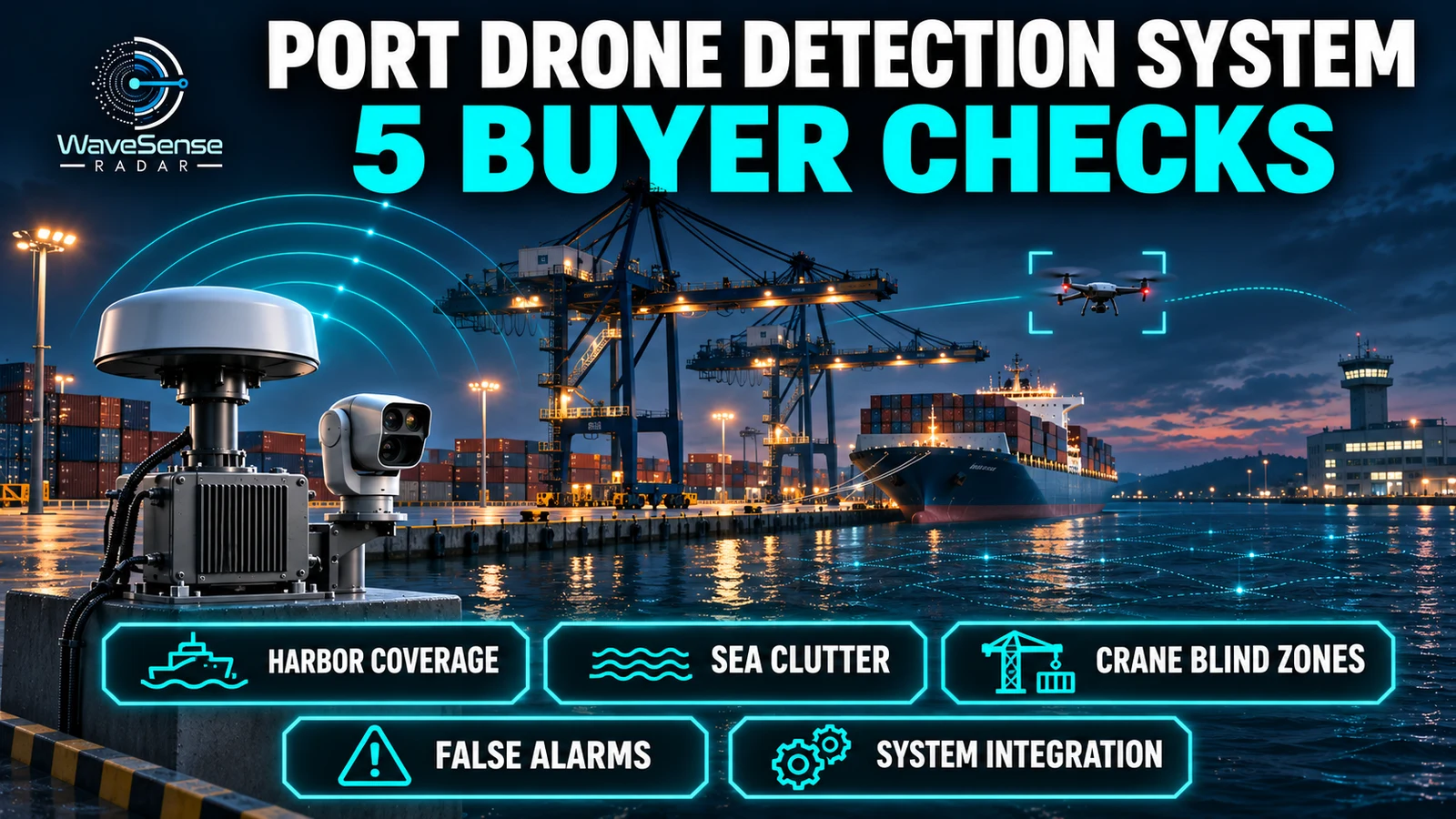
Port Drone Detection System: 5 Buyer Checks
A Port Drone Detection System helps maritime security teams detect, track and assess unauthorized UAV activity around container terminals, harbours, commercial ports and coastal infrastructure.
Unlike an open-field installation, a port contains moving ships, cranes, containers, buildings, seabirds and multiple communication systems. These conditions require buyers to consider more than maximum radar detection range.
The most important requirement is reliable low-altitude airspace surveillance without disrupting normal port operations.
Why Do Ports Need a Dedicated Drone Detection System?
Conventional maritime surveillance systems primarily monitor vessels, surface movement and perimeter activity.
However, small airborne drones require different detection capabilities.
The UK government’s guidance on countering drone threats to shipping explains that conventional maritime navigation radar may not reliably detect small UAVs because of their limited radar cross section.
A dedicated Drone Detection Radar provides an additional airspace monitoring layer for maritime security applications.
Typical applications include:
- Commercial port security
- Container terminal surveillance
- Harbour airspace monitoring
- Shipyard security
- Offshore terminal protection
- Coastal energy infrastructure
The objective is to give security personnel timely information about unauthorized aerial activity while distinguishing it from legitimate port operations.
What Makes Port Drone Detection More Difficult?
A Port Drone Detection System must operate in an environment where both land and water create complex surveillance conditions.
| Port Condition | Detection Challenge |
|---|---|
| Container stacks | Restricted visibility |
| Large cranes | Obstructions and environmental reflections |
| Moving ships | Changing surveillance background |
| Sea waves | Radar clutter |
| Seabirds | Drone classification errors |
| Marine communication systems | Potential electromagnetic interference |
| Sea fog and rain | Reduced optical visibility |
Radar reflections from water and surrounding infrastructure can make small UAV detection more challenging.
These environmental conditions also influence Drone Detection Radar False Alarms, particularly when the system must distinguish drones from seabirds and other moving objects.
Buyers should therefore request performance evidence that represents maritime environments rather than relying exclusively on open-field demonstrations.
Can Existing Marine Radar Detect Small Drones?
Some maritime radars may detect larger UAVs, but standard marine navigation radar should not automatically replace a dedicated small-drone detection radar.
The two systems serve different surveillance objectives.
| Feature | Marine Navigation Radar | Drone Detection Radar |
|---|---|---|
| Primary target | Ships and surface objects | Airborne UAVs |
| Surveillance purpose | Navigation and vessel monitoring | Low-altitude airspace security |
| Small UAV detection | Model-dependent | Purpose-specific capability |
| Altitude measurement | Often unavailable | Available on suitable 3D systems |
| Drone classification | Usually limited | Model-dependent |
A suitable port surveillance solution should complement existing vessel traffic services, AIS and CCTV systems rather than unnecessarily replace them.
Small-UAV detection performance also depends on the Radar Cross Section Of A Drone, not simply its physical dimensions.
Which Sensors Should a Port Drone Detection System Include?
Radar, RF detectors and electro-optical cameras provide different types of information.
A combined surveillance system can support more informed security decisions.
Drone Detection Radar
Radar detects physical airborne objects independently of their radio communications.
Suitable 3D surveillance radar can provide target position, altitude and movement information.
This makes radar an important component of maritime counter-UAS detection.
RF Drone Detection
RF sensors monitor recognizable drone-related radio emissions.
Depending on the system, they may provide information about drone type, communication signals or identification broadcasts.
The FAA Remote ID guidance explains how compatible drones broadcast identification and location information.
However, Remote ID and RF detection cannot independently confirm every airborne target.
EO/IR Camera Systems
Electro-optical and infrared cameras help security operators visually assess detected objects.
Thermal imaging can support nighttime surveillance, while visible-light cameras provide additional identification details when environmental conditions permit.
| Technology | Main Function |
|---|---|
| Radar | Physical UAV detection and tracking |
| RF detection | Radio signal and identification information |
| EO/IR camera | Visual confirmation and incident assessment |
| Management platform | Combined surveillance and event records |
A Port Drone Detection System should combine the sensor capabilities required by the actual project rather than include unnecessary equipment.
What Are the 5 Main Checks Before Buying a Port Drone Detection System?
Port authorities and security system integrators should focus on five practical purchasing criteria.
1. Small-UAV Detection Performance
Request detection and tracking specifications for representative small UAVs.
The supplier should explain the target type, test conditions and difference between initial detection and reliable tracking.
2. Maritime Environmental Suitability
Coastal installations may experience high humidity, salt spray, wind, rainfall and temperature changes.
Check the product documentation for:
- Operating temperature
- Environmental protection rating
- Corrosion resistance
- Salt-spray test evidence, where available
- Maintenance requirements
An outdoor enclosure rating alone does not establish resistance to long-term coastal corrosion.
3. False-Alarm Management
Ports contain seabirds, vessels and moving machinery.
The supplier should provide information about target classification and false-alarm performance.
For radar-based classification, Micro-Doppler Radar explains how motion signatures can help distinguish different airborne objects.
4. Compatibility With Existing Port Systems
A new drone detection solution should support the port’s existing security workflow.
Confirm whether the system supports the required data interfaces, event recording and associated camera integration.
Also check compatibility with existing marine radar and communication equipment.
5. Operation and Maintenance
Evaluate the complete ownership cost, not only the initial equipment price.
Consider software licensing, installation, operator training, environmental maintenance, spare parts and technical support.
A reliable Port Drone Detection System should provide useful surveillance information throughout its intended service life.
How Should Port Drone Detection Performance Be Evaluated?
Before accepting a new system, buyers should request an agreed evaluation report covering the intended operating environment.
A practical project acceptance checklist includes:
| Evaluation Item | Required Evidence |
|---|---|
| Small-UAV detection | Target details and documented results |
| Tracking performance | Confirmed tracking records |
| False alarms | Representative monitoring records |
| Environmental suitability | Product specifications and applicable test reports |
| EMC compatibility | Relevant compatibility assessment |
| System integration | Demonstrated data exchange |
| Operator workflow | Alarm verification and incident records |
All field evaluations should follow applicable aviation regulations, port safety procedures and local authorization requirements.
For additional equipment-selection criteria, see our Counter-UAS Radar buyer guide.
How to Request a Port Drone Detection Solution From ChinaWavesense
When requesting a maritime drone detection solution, provide ChinaWavesense with the main project requirements.
| Project Information | Details to Provide |
|---|---|
| Facility type | Commercial port, terminal, shipyard or coastal facility |
| Surveillance requirement | Required monitoring area |
| Target category | Representative UAV types |
| Installation environment | Fixed shore-based or maritime installation |
| Existing equipment | Radar, CCTV, RF sensors or security platform |
| Environmental requirements | Temperature, humidity and coastal exposure |
| Integration requirements | Data interfaces and management software |
These details help establish whether the project requires a dedicated radar, RF detection equipment, EO/IR cameras or an integrated surveillance solution.
Contact ChinaWavesense to discuss your port security requirements, available product specifications and system integration needs.
FAQ
What Is a Port Drone Detection System?
A Port Drone Detection System uses suitable radar, RF and optical sensors to detect, track and assess UAV activity around ports, harbours and maritime infrastructure.
Can Marine Radar Detect Small Drones?
Some marine radars can detect larger UAVs. However, reliable small-drone detection requires suitable target sensitivity, airborne tracking and classification capabilities.
Can Radar Detect Drones Over Water?
Yes, suitable drone detection radar can detect airborne targets over water. Actual performance depends on the target, environmental conditions and radar design.
Does a Port Need Both Radar and RF Detection?
Not every project requires both. Radar and RF sensors offer complementary capabilities, so selection should follow the port’s surveillance objectives.
What Environmental Ratings Should Coastal Drone Radar Have?
Buyers should check ingress protection, operating temperature, humidity tolerance, corrosion resistance and applicable environmental test documentation.
How Much Does a Port Drone Detection System Cost?
Pricing depends on the surveillance requirements, sensor configuration, installation, software integration and maintenance services. Request a project-specific quotation rather than comparing equipment prices alone.
Conclusion
A reliable Port Drone Detection System should complement existing maritime security infrastructure while providing dedicated monitoring of low-altitude UAV activity.
Small-target detection, maritime environmental suitability, false-alarm management and system compatibility are more useful purchasing criteria than maximum detection range alone.
Choose equipment based on documented product capabilities and the actual requirements of your port security project.