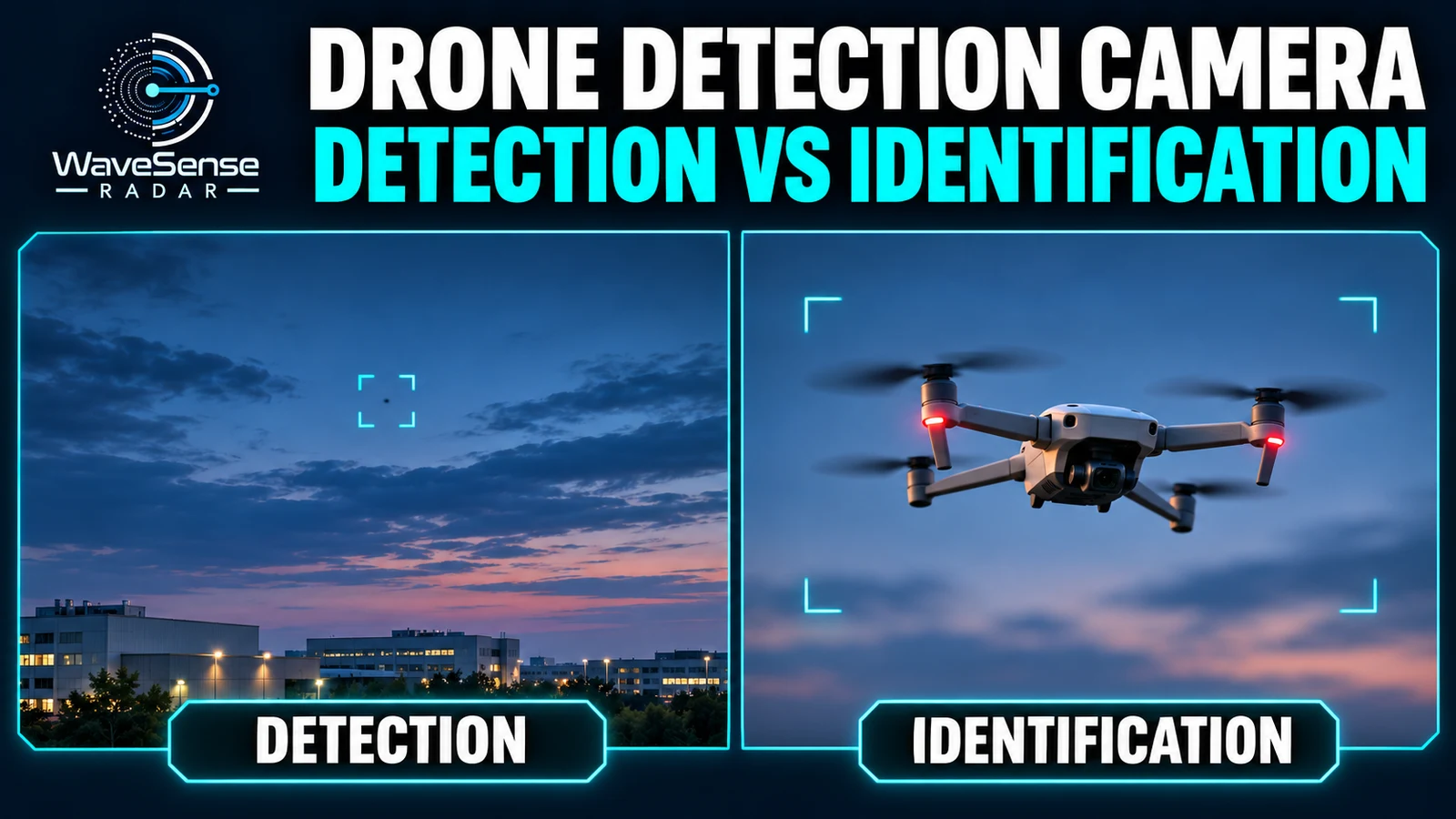
A Drone Detection Camera uses visible-light imaging, thermal imaging, or both to detect, track and visually identify unmanned aerial vehicles (UAVs). However, detecting a distant object does not necessarily mean the camera can identify it as a drone.
When selecting an electro-optical infrared (EO/IR) surveillance system, buyers should distinguish between detection distance, recognition distance, identification distance and tracking distance.
These specifications describe different capabilities.
A camera with a published tracking distance of 5 km does not automatically provide clear drone identification at 5 km.
Understanding this difference helps security system integrators select suitable optical equipment without overestimating its performance.
What Is a Drone Detection Camera?
A Drone Detection Camera is an optical surveillance device designed to observe airborne UAV targets and provide visual information for security monitoring.
Professional systems commonly combine several components:
- High-resolution visible-light cameras
- Thermal infrared imaging sensors
- Motorized optical zoom lenses
- Pan-tilt positioning systems
- Automatic target tracking software
- Interfaces for compatible security sensors
Unlike conventional CCTV cameras, professional EO/IR drone tracking systems focus on observing small and distant airborne objects.
ChinaWavesense’s DMA 460 Series Electro-Optical Gimbal incorporates multispectral monitoring, target tracking and identification functions for low-altitude airspace surveillance.
Such equipment can complement radar and RF detection technologies within a larger security system.
What Is the Difference Between Detection, Recognition and Identification?
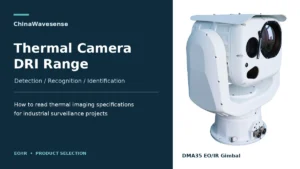
Detection, Recognition and Identification, commonly known as DRI, describe three different levels of image information.
Tracking represents an additional performance requirement.
| Performance Metric | Main Purpose | Example |
|---|---|---|
| Detection | Determine whether an object exists | An airborne object appears in the image |
| Recognition | Determine the general target category | The object appears to be a multirotor UAV |
| Identification | Determine more specific target characteristics | Recognizable aircraft type or model features |
| Tracking | Continuously follow the target | The camera maintains observation of the moving UAV |
A camera may detect a distant airborne object without producing enough image detail to recognize its shape.
Similarly, it may track an object without identifying its exact model.
The peer-reviewed study Multispectral Detection of Commercial Unmanned Aerial Vehicles demonstrates that thermal camera detection, recognition and identification distances can differ substantially, even when researchers use the same imaging equipment.
For buyers, this means that manufacturers must clearly define what their published distance represents.
Visual identification also differs from electronic identification. A camera image does not automatically provide a drone’s registration number, serial number or operator identity.
Which ChinaWavesense Drone Detection Camera Should You Choose?
ChinaWavesense provides different EO/IR configurations for day-and-night surveillance and UAV tracking.
The following comparison uses specifications from the ChinaWavesense product documentation.
| Model | Imaging Configuration | Published Distance |
|---|---|---|
| DMS15 | Uncooled thermal imaging and visible-light camera | Thermal imaging: approximately 800 m; visible light: ≥1.5 km |
| DMA35 | Uncooled VOx thermal imaging and visible-light zoom camera | Tracking distance: ≥2 km |
| Z50 | Cooled MCT thermal imaging and visible-light zoom camera | Tracking distance: ≥5 km |
Important: These figures represent different measurement categories in the product documentation. They do not establish comparable UAV identification ranges.
DMS15 EO/IR System
The DMS15 combines uncooled infrared imaging with a visible-light camera.
Its documented optical configuration supports surveillance and visual observation, including integration with compatible radar equipment.
Buyers should confirm the required target image quality before selecting this configuration.
DMA35 EO/IR Tracking System
The DMA35 uses an uncooled VOx thermal detector and a visible-light zoom camera.
The product documentation lists a tracking distance of at least 2 km.
This specification describes tracking capability rather than guaranteed recognition or identification distance.
Z50 Long-Range EO/IR System
The Z50 uses a cooled MCT infrared detector with visible-light imaging.
Its product documentation lists a tracking distance of at least 5 km.
Buyers who require long-range optical observation should request representative target imagery and confirm the imaging configuration available for their project.
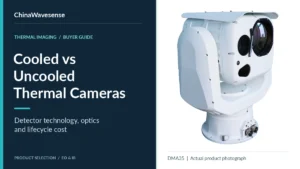
For a detailed comparison of detector technologies, read Cooled vs Uncooled Thermal Cameras: How to Choose.
Does Higher Optical Zoom Mean Better Drone Identification?
Not necessarily.
Optical zoom is important, but it does not independently determine drone identification performance.
A Drone Detection Camera also depends on image resolution, optical quality, atmospheric visibility, target contrast and positioning stability.
For example, digital zoom enlarges existing image information. It does not automatically reveal additional physical details that the original image failed to capture.
A high optical zoom ratio also provides limited information unless the manufacturer specifies the actual lens focal length and imaging configuration.
When comparing long-range surveillance cameras, buyers should request representative images or video instead of relying exclusively on zoom specifications.
Teledyne FLIR’s technical guide to thermal infrared sensor design for counter-UAS applications discusses how optical resolution, image contrast, sensor sensitivity and atmospheric conditions influence UAV imaging performance.
The complete imaging system matters more than any single specification.
Can a Drone Detection Camera Work at Night?
Yes. A suitable thermal drone detection camera can observe airborne targets at night without relying on visible-light illumination.
Visible-light and infrared cameras provide different types of information.
| Feature | Visible-Light Camera | Thermal Imaging Camera |
|---|---|---|
| Imaging principle | Reflected visible light | Infrared radiation |
| Daytime observation | Suitable | Suitable |
| Nighttime observation | Depends on available illumination | Does not require visible illumination |
| Target color information | Available | Generally unavailable |
| Image performance | Depends on lighting and visibility | Depends on thermal contrast and atmospheric conditions |
A dual-sensor EO/IR system combines both imaging technologies to support surveillance under changing lighting conditions.
However, thermal imaging does not guarantee clear identification under every environmental condition.
Dense fog, heavy rain and insufficient thermal contrast can reduce image quality.
Buyers should specify whether the required nighttime function is simple detection, continuous tracking or detailed visual identification.
These requirements may lead to different optical configurations.
Can a Drone Detection Camera Replace Radar?
A camera can independently detect airborne objects when equipped with suitable optics and image-processing software. However, radar and optical surveillance perform different functions.
Radar provides physical target measurements, while EO/IR systems provide image-based information for visual assessment.
An integrated surveillance system combines these capabilities to improve the information available to security operators.
The UAS Detection Technology Guidance for Critical Infrastructure identifies EO/IR cameras as a distinct detection technology and discusses their imaging, environmental and surveillance considerations.
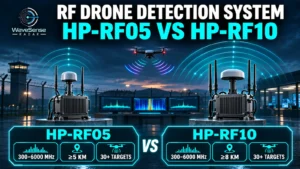
ChinaWavesense explains the differences between these technologies in its Drone Detection System: Radar vs RF vs EO/IR guide.
For system integrators, equipment selection should reflect the required surveillance information rather than assuming that a single sensor can perform every task.
What Should Buyers Check Before Purchasing a Drone Detection Camera?
The following purchasing checklist helps buyers compare professional UAV surveillance cameras.
| Purchasing Requirement | What to Confirm |
|---|---|
| Detection distance | Target type and defined detection criteria |
| Recognition distance | Target category and required image detail |
| Identification distance | Specific visual characteristics required |
| Tracking performance | Documented tracking capability |
| Night operation | Thermal imaging configuration |
| Optical specifications | Detector resolution and lens configuration |
| System compatibility | Communication interfaces and software support |
| Environmental suitability | Operating conditions and protection ratings |
Ask the manufacturer to explain which performance figures come from product specifications, physical test reports or theoretical calculations.
Request original images or representative video when available.
Suitable applications include airport security, commercial ports, industrial facilities, critical infrastructure and low-altitude airspace monitoring.
Before requesting a quotation, define the target category, required observation distance, image detail and integration requirements.
Contact ChinaWavesense to request EO/IR product specifications, available model configurations and relevant imaging evidence for your project.
FAQ
How Far Can a Drone Detection Camera See?
The observation distance depends on the camera configuration, target size, atmospheric visibility and required image detail. Detection distance generally exceeds detailed identification distance under comparable conditions.
Is Drone Tracking Distance the Same as Identification Distance?
No. A camera may continuously track an airborne object without capturing enough detail to identify its exact type or model.
Can a Thermal Camera Detect Drones at Night?
Yes. Suitable infrared cameras detect thermal radiation without visible-light illumination. Actual image quality depends on target contrast, optics and environmental conditions.
Is a Cooled Thermal Camera Better for Long-Range UAV Surveillance?
Cooled thermal detectors generally provide higher sensitivity and can support demanding long-range imaging applications. However, the complete optical configuration and required observation task determine suitability.
Can an EO/IR Camera Work With Drone Detection Radar?
Yes. Compatible EO/IR systems can exchange information with radar and integrated security platforms. Buyers should confirm hardware, communication and software compatibility.
What Is the Best Drone Detection Camera?
The best configuration depends on the required detection, tracking and identification functions. Buyers should compare documented product capabilities against their actual surveillance requirements.
Conclusion
Choosing a Drone Detection Camera requires more than comparing maximum zoom or published tracking distance.
Detection, recognition, identification and tracking describe different levels of surveillance performance.
ChinaWavesense offers multiple EO/IR configurations, including the DMS15, DMA35 and Z50, to address different observation requirements.
The most suitable product is the one that delivers the required visual information under the intended operating conditions, supported by relevant product documentation and imaging evidence.