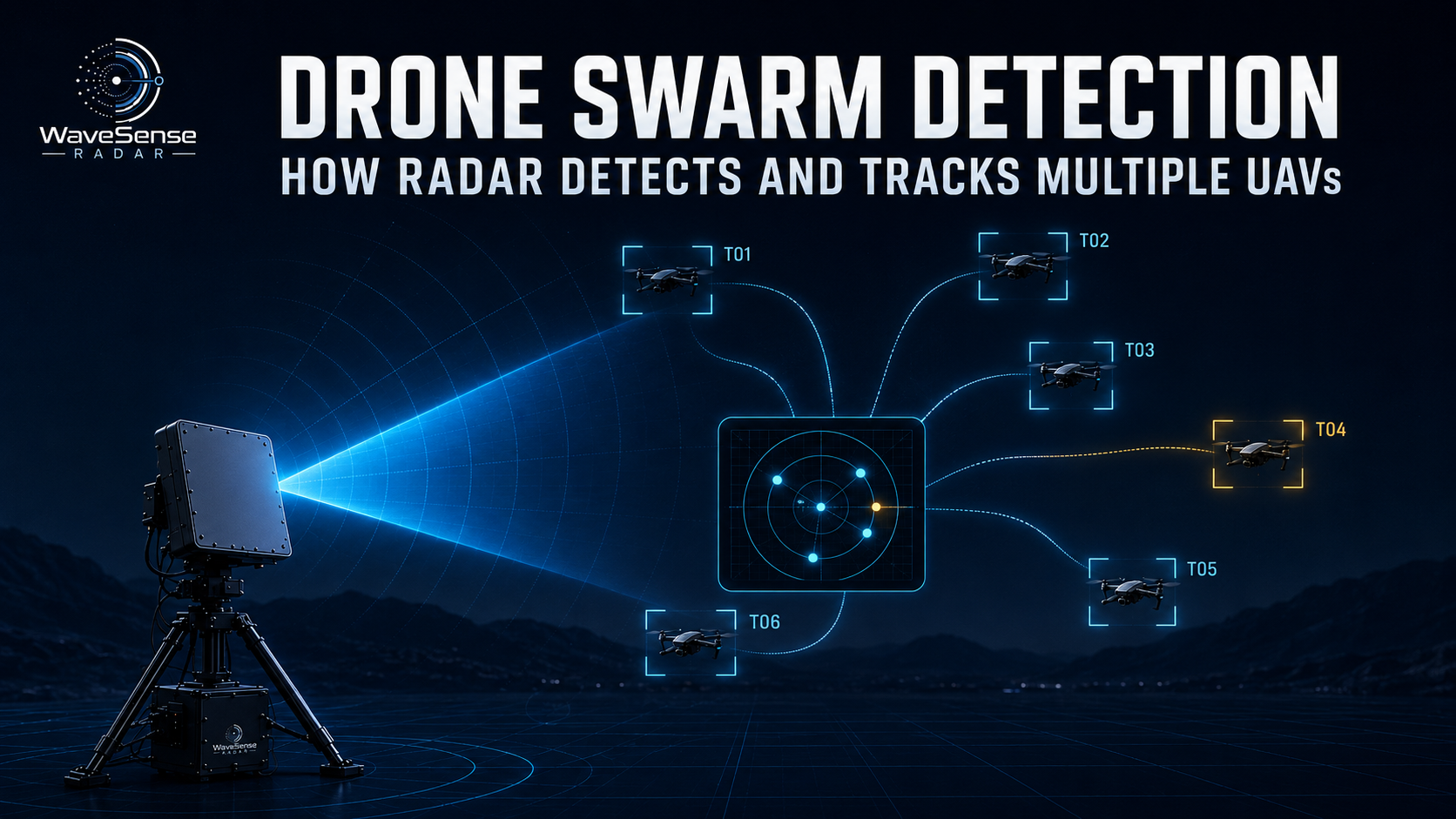
What Is Drone Swarm Detection?
Drone Swarm Detection is the process of detecting, separating, tracking, and assessing multiple UAVs operating simultaneously, and its hardest problem is not finding the swarm but maintaining reliable individual tracks when targets become closely spaced, cross paths, split, merge, or maneuver together.
A radar detecting 50 reflections does not automatically mean it can maintain 50 accurate UAV tracks.
Detection, resolution, association, tracking, and classification are separate problems.
What Is A Drone Swarm?
A drone swarm generally describes multiple UAVs operating with some degree of coordinated or collective behavior.
The aircraft may fly in formation, divide into smaller groups, approach from different directions, or react collectively.
For counter-UAS surveillance, the main difficulty is scale.
Instead of analyzing one small target, the system may need to process dozens of similar targets moving through the same airspace simultaneously.
Is Every Group Of Drones A Drone Swarm?
No.
Several drones flying in the same area do not automatically form a coordinated swarm.
There is an important difference between multiple independent UAVs and a coordinated drone swarm.
Radar can observe positions and movement, but determining coordination may require trajectory history, relative spacing, velocity correlation, RF information, or behavioral analysis.
For security systems, both situations can still create a difficult multi-target tracking problem.
Why Is Drone Swarm Detection Harder Than Single-Drone Detection?
A single drone produces one primary tracking problem.
A swarm produces many simultaneous measurement and association problems.
When UAVs fly close together, radar must determine which new measurement belongs to which existing track.
The difficulty increases when targets accelerate, turn, cross paths, separate, or regroup.
Research on highly maneuverable UAV swarms identifies complex target distribution and high mobility as major challenges for group tracking. See the UAV group-target tracking study.
Can Radar Detect Multiple Drones At The Same Time?
Yes.
Modern radar systems can detect and maintain multiple target tracks simultaneously.
However, simultaneous track capacity should not be confused with the number of closely spaced UAVs the radar can individually resolve.
A radar may technically support hundreds of tracks when targets are well separated.
Its performance can be very different when dozens of drones fly only a few meters apart.
This distinction is critical when comparing anti-swarm radar specifications.
What Does Maximum Track Capacity Mean?
Maximum Track Capacity describes how many target tracks a radar or tracking system can maintain under defined processing conditions.
For example, a datasheet might state:
Maximum Tracks: 200
That does not necessarily mean the radar can distinguish 200 UAVs packed into one compact formation.
Track capacity describes processing capability.
Target separation depends additionally on radar resolution, geometry, signal quality, antenna performance, waveform, and tracking algorithms.
Why Is “Tracks 100 Drones” An Incomplete Specification?
The number does not explain how the test was conducted.
One hundred UAVs separated across a large surveillance volume are much easier to track than 100 targets concentrated in a small angular region.
A professional specification should therefore define target spacing, range, altitude, update rate, radar resolution, maneuvering conditions, and track continuity.
Without those conditions, maximum target count is mostly a processing-capacity statement.
What Is Radar Resolution?
Radar resolution describes the system’s ability to distinguish targets that are close together.
For drone swarms, two dimensions are particularly important:
Range Resolution separates targets located at slightly different distances.
Angular Resolution separates targets appearing at slightly different directions.
If two drones fall inside the same effective resolution cell, their radar returns may become difficult to separate as individual targets.
What Is Range Resolution?
Range resolution describes how closely two targets can be positioned along the radar’s range dimension while still being distinguishable.
Imagine two drones flying almost directly behind one another.
If their distance separation is smaller than the radar’s effective range-resolution capability, their echoes may overlap.
Instead of two clean detections, the processor may receive a more complicated combined return.
This becomes increasingly important in dense UAV formations.
Does Radar Bandwidth Affect Range Resolution?
Yes.
Radar range resolution is closely related to transmitted waveform bandwidth.
Greater usable bandwidth can provide finer range resolution in many radar architectures.
However, practical performance also depends on waveform design, SNR, processing, hardware, and target characteristics.
This is why buyers should compare demonstrated multi-target separation rather than looking at bandwidth alone.
What Is Angular Resolution?
Angular resolution describes how well radar can separate two targets located in similar directions.
Consider two UAVs flying side by side at long range.
Their physical spacing may appear as only a very small angular difference from the radar.
If that difference becomes too small, separating the two tracks becomes more difficult.
Antenna aperture, wavelength, beamforming, target SNR, and processing all influence practical angular separation.
Why Does Long Range Make Swarm Separation Harder?
The same physical spacing creates a smaller angular separation as distance increases.
Two UAVs 10 meters apart may appear clearly separated nearby.
At much longer range, they may occupy nearly the same direction from the radar.
Therefore, saying a radar can detect a swarm at 15 km does not automatically tell the buyer whether it can individually resolve every member at 15 km.
Detection Range Vs Swarm Resolution Range
These are different performance metrics.
Detection Range asks:
Can the radar detect that UAV activity exists?
Swarm Resolution Range asks:
At what distance can the radar distinguish individual UAVs inside the group?
The first distance can be considerably longer than the second.
This is one of the most important questions missing from many drone-radar datasheets.
Can Radar Detect A Swarm Without Counting Every Drone?
Yes.
A radar may detect a collection of UAV returns and recognize that a group target exists even when individual members cannot all be reliably resolved.
This can still provide useful early warning.
The system might estimate the group’s:
Center position, movement direction, approximate extent, velocity, and threat trajectory.
Academic research has developed dedicated methods for UAV swarm target identification and quantification because simply detecting a combined radar return does not automatically reveal the correct number of UAVs. See the Remote Sensing study on UAV swarm quantification.
How Does Radar Count Drones In A Swarm?
Counting becomes relatively straightforward when every UAV produces a clean, separated detection.
Dense formations are harder.
Radar processing may need to analyze spatial distribution, Doppler information, target clustering, signal structure, and track history.
Researchers have developed swarm-quantification methods specifically because multiple UAV signals can become multimodal and difficult to interpret in clutter.
Therefore, “number of detections” should not automatically be interpreted as “number of drones.”
What Happens When Two Drone Returns Merge?
When UAVs move too close together in the radar measurement space, the tracker may receive what appears to be one combined detection.
This is sometimes called a merged measurement or unresolved target situation.
The tracking system must determine whether:
Two previous targets became one target, two targets remain present but unresolved, or one track disappeared.
Track history becomes essential.
A good tracker should avoid deleting valid UAV tracks merely because their measurements temporarily overlap.
What Happens When The Drones Separate Again?
When previously merged targets separate, the tracking system needs to reconstruct the individual tracks correctly.
This creates a data-association problem.
The processor must determine:
Which separated detection belongs to Drone A, and which belongs to Drone B?
If that decision is incorrect, the tracks can exchange identities.
This phenomenon is often called track swapping or an identity switch.
What Is Track Swap?
A Track Swap occurs when the tracking system incorrectly assigns the identity of one target to another.
Imagine Drone A and Drone B crossing.
Before the crossing, the radar knows both trajectories.
During the crossing, their measurements become difficult to separate.
Afterward, the software may accidentally continue Drone A’s track using Drone B’s measurements.
The radar still shows two drones, but their track identities have been exchanged.
Why Does Track Identity Matter?
For simple early warning, knowing that several UAVs exist may be enough.
For a complete counter-UAS system, identity continuity becomes much more important.
The system may need to associate a specific track with:
A camera image, RF signature, threat classification, previous behavior, or response action.
If radar identities continually swap, sensor fusion and threat assessment become less reliable.
What Is Data Association?
Data Association is the process of deciding which radar measurement belongs to which target track.
In a simple situation, the nearest measurement may clearly belong to an existing UAV.
In a swarm, several measurements may simultaneously fall near several predicted tracks.
The software then needs more advanced logic to determine the most likely assignments.
Data association is one of the central challenges of Multi-Target Tracking Radar.
Why Does Data Association Become Difficult In A Swarm?
Drone swarms create many similar objects.
The UAVs may have comparable:
RCS, velocity, altitude, size, and movement patterns.
When they fly close together, a measurement cannot always be assigned based on one characteristic.
Tracking algorithms therefore combine predicted motion and repeated observations to maintain continuity.
The problem becomes harder as target density and maneuverability increase.
What Is Track Initiation?
Track Initiation is the process of creating a new target track after radar detections indicate that a real object is present.
One isolated detection should not always create a permanent track because radar can also detect noise or clutter.
The system may require several consistent observations before confirming the UAV.
In a sudden swarm attack, track initiation must be fast enough to handle many new targets almost simultaneously without creating excessive false tracks.
What Is Track Maintenance?
Once a UAV track exists, Track Maintenance keeps updating its estimated position and motion.
The tracker must tolerate temporary problems such as weak signal, clutter, close formation, rapid turns, or missed detections.
An anti-swarm radar should maintain useful track continuity during complex movement rather than repeatedly losing and recreating UAV tracks.
What Is Track Termination?
Track termination removes a target track when the system determines that the UAV is no longer present or reliably observable.
Terminating too quickly can cause valid tracks to disappear during temporary signal loss.
Waiting too long can leave “ghost tracks” after the target has gone.
A published anti-swarm radar study specifically describes a tracking framework covering track initiation, maintenance, and termination. See the IEEE anti-swarm UAV radar research.
What Is A Ghost Track?
A Ghost Track is a displayed or maintained track that does not correspond to a real current target.
Ghost tracks may result from false detections, multipath, poor association, or tracks that persist after signal loss.
In a dense swarm, excessive ghost tracks can make operators believe more UAVs exist than are actually present.
False-track suppression is therefore an important part of swarm surveillance.
Why Is False Alarm Control Important For Drone Swarms?
A swarm already creates a large number of legitimate measurements.
If the radar simultaneously produces many false detections, the tracking problem becomes significantly harder.
The processor must separate real UAV returns from clutter while also maintaining correct associations among true targets.
Research on low-altitude radar continues to investigate spatial-temporal false-alarm suppression because clutter directly affects reliable target tracking.
Can Ground Clutter Hide Members Of A Drone Swarm?
Yes.
A low-flying swarm may operate near:
Buildings, terrain, vegetation, vehicles, towers, or other strong reflectors.
Some UAVs may have clearer radar visibility than others.
Therefore, one part of the formation may be tracked individually while other members temporarily disappear into clutter.
This means swarm track count can fluctuate even when the physical number of drones remains constant.
Does Drone RCS Matter For Swarm Detection?
Yes.
Every UAV presents its own radar scattering characteristics.
Small, low-RCS members can be more difficult to detect consistently, especially at long range.
When comparing a swarm radar, buyers should therefore ask what individual UAV or representative RCS was used during the test.
Our Radar Cross Section Of A Drone guide explains why UAV radar visibility changes with frequency, orientation, material, and configuration.
Does A Swarm Have One Combined RCS?
Not in a simple fixed sense.
The radar receives electromagnetic scattering from multiple UAVs whose relative positions and phases change continuously.
Depending on spacing and radar geometry, the combined return can fluctuate.
A swarm should therefore not be modeled simply as:
Individual Drone RCS × Number Of Drones
Real radar behavior is more complicated because the individual scattering contributions interact in time, space, range, angle, and Doppler.
Can More Drones Make A Swarm Easier To Detect?
A larger group can create more overall radar activity, making the presence of airborne targets easier to notice in some conditions.
However, detecting the existence of the group is different from separating individual members.
Increasing the number of drones can simultaneously make individual tracking more difficult because measurement density, overlap, association ambiguity, and processing load all increase.
What Is Group Target Tracking?
Group Target Tracking, or GTT, treats a collection of closely related targets partly as a group rather than insisting on perfect individual tracking at every moment.
The system may estimate properties such as:
Group center, spatial extent, movement direction, velocity, and formation evolution.
This approach can be valuable when individual UAVs become too closely spaced for stable one-by-one association.
Academic research specifically describes GTT as a promising framework for highly maneuverable UAV swarms.
Individual Tracking Vs Group Tracking
Individual tracking attempts to maintain a unique track for each UAV.
Group tracking focuses on the collective state of a formation.
Neither is universally better.
Individual tracks are useful for precise classification and response.
Group tracks can remain robust when targets merge or become difficult to resolve separately.
A sophisticated swarm-tracking architecture may transition between the two depending on target spacing.
When Should Radar Treat A Swarm As A Group?
Group tracking becomes particularly useful when UAVs are closely spaced and individual measurements cannot be associated reliably.
Instead of creating unstable or constantly swapping tracks, the system can maintain the overall swarm state.
When the UAVs separate again, individual tracks may become resolvable.
This split-and-merge behavior is important for realistic swarm tracking.
What Happens When A Swarm Splits?
A coordinated swarm may divide into two or more subgroups.
The tracking system must recognize that one group has become several groups.
It should then estimate new group centers, trajectories, and individual membership.
Failure to recognize a split can produce incorrect threat predictions.
Research into swarm tracking specifically considers target groups with changing spatial structures because UAV distributions are not always uniform or static.
What Happens When Two Drone Groups Merge?
The opposite problem occurs when separate formations converge.
The tracker must determine whether:
Two groups remain independent but overlap temporarily, or they have formed a new combined group.
The answer can affect threat assessment.
Historical trajectories and group-motion models help the system interpret these transitions.
Why Are Maneuvering Swarms Difficult?
Standard tracking models often predict where a target should appear next based on previous movement.
Highly maneuverable drones can violate those predictions quickly.
A swarm may:
Accelerate, turn, divide, converge, change altitude, or reverse direction.
The more unpredictable the movement, the harder measurement association becomes.
Modern group-tracking research therefore develops adaptive motion models for highly maneuverable UAV formations.
What Is Track Update Rate?
Track Update Rate describes how frequently the system provides updated target information.
Swarm tracking requires sufficiently frequent updates because multiple UAVs can maneuver rapidly.
If updates are too slow, predicted positions become less accurate.
That increases the chance of association errors, lost tracks, and identity swaps.
Track update rate should therefore be evaluated together with maximum target count.
Why Is Radar Scan Time Important?
A mechanically rotating radar may need time to revisit the same sector.
During that interval, fast drones can move significantly.
A phased-array radar can electronically redirect beams and may provide more flexible revisit scheduling.
The U.S. Navy’s swarm-detection program specifically highlights phased-array radar’s ability to steer narrow beams rapidly toward multiple targets and directions. See the Navy SBIR swarm detection requirement.
Why Is Phased Array Radar Useful For Drone Swarms?
Electronic beam steering allows radar resources to be allocated dynamically.
The radar can search one region and quickly revisit high-priority tracks elsewhere without physically rotating an antenna for every change.
This can improve surveillance flexibility in a multi-target environment.
However, phased array alone does not guarantee successful swarm tracking.
Processing, resolution, waveform management, track algorithms, and sensor fusion remain essential.
What Is Radar Resource Management?
Radar has limited time, energy, bandwidth, and processing resources.
Radar Resource Management determines how those resources are distributed between:
Searching for new targets, updating existing tracks, classifying suspicious UAVs, and revisiting difficult targets.
A dense swarm creates competing demands.
The radar must avoid spending so much time on existing tracks that it stops searching effectively for new arrivals.
Why Is Search Vs Track A Tradeoff?
Search mode attempts to discover new UAVs across a large area.
Track mode spends additional radar attention on known targets.
During a swarm event, the radar may need to track dozens of targets while still searching for more.
If too many resources are dedicated to detailed tracking, surveillance coverage may degrade.
Efficient radar scheduling is therefore important for high-density target environments.
What Is Track Latency?
Track Latency is the delay between target movement and updated information becoming available to the command system.
Low latency is particularly important for swarm defense.
Dozens of targets may approach from different directions while the system must continuously update their positions.
The U.S. Navy’s swarm C-UAS requirements explicitly identify low detection, identification, and tracking latency as critical when UAV numbers increase.
Why Does Latency Matter More For A Drone Swarm?
One delayed target track is problematic.
Dozens of delayed tracks can make the entire operational picture outdated.
High latency affects:
Threat prioritization, EO/IR cueing, interception planning, engagement sequencing, and operator decisions.
Therefore, “tracks 200 targets” means little if the resulting coordinates arrive too slowly for the response system.
Track Capacity Vs Processing Latency
These two specifications should always be considered together.
A system might technically maintain 300 tracks but experience increasing latency as track count rises.
A better performance question is:
What update rate and latency can the radar maintain while tracking the specified number of UAVs?
This describes operational capacity much better than maximum track count alone.
Can AI Improve Drone Swarm Tracking?
Yes.
Machine learning can help analyze complex target behavior, classify detections, correlate information, and recognize collective patterns.
However, AI does not remove the need for reliable radar measurements.
If several UAVs are unresolved physically, an algorithm cannot always reconstruct perfect individual tracks.
AI is therefore most effective when combined with strong sensing and well-designed multi-target tracking.
Can AI Recognize Coordinated Swarm Behavior?
Potentially.
A swarm may exhibit relationships in:
Relative velocity, spacing, heading, trajectory changes, or collective maneuvering.
Deep-learning methods can analyze relationships between targets rather than viewing each track independently.
The U.S. Navy has specifically identified deep-learning approaches as potentially useful for learning behavioral patterns and relationships among UAVs in swarm scenarios.
Can Radar Predict Where A Drone Swarm Is Going?
Radar tracking software can estimate future positions based on observed motion.
Short-term prediction can help determine whether a swarm is approaching:
A restricted zone, protected asset, runway, perimeter, or other sensitive area.
However, coordinated UAVs can change behavior rapidly.
Predictions should therefore include uncertainty rather than being treated as guaranteed future trajectories.
What Is Track Uncertainty?
Every radar track contains some measurement uncertainty.
Position, speed, altitude, and predicted trajectory are estimates rather than perfectly exact values.
As target density increases, overlapping uncertainty regions can create association ambiguity.
The Navy’s swarm sensor-fusion requirements specifically identify track accuracy and uncertainty as challenges when combining radar and infrared data.
Can Radar Distinguish A Drone Swarm From A Bird Flock?
Potentially, but the problem is more difficult than distinguishing one bird from one drone.
A system can analyze:
Micro-Doppler, RCS, trajectories, group behavior, speed, altitude, and target spacing.
Bird flocks and drone swarms can both create multiple moving radar tracks.
Therefore, target count alone cannot classify the group.
Detailed target signatures and behavior provide stronger evidence.
Why Can Bird Flocks Cause Swarm False Alarms?
A flock can produce many simultaneous airborne detections within a compact region.
A simplistic algorithm might interpret this as a multi-UAV event.
Bird populations can also change seasonally and geographically.
A robust system therefore needs both individual-target classification and group-level behavior analysis.
This is particularly important near airports, coastal facilities, wetlands, and other areas with high bird activity.
Can Micro-Doppler Help With Swarm Classification?
Yes, if the radar obtains sufficient signal quality for individual targets or useful combined features.
Drone rotors and bird wings can generate different micro-motion patterns.
However, dense formations can cause overlapping signatures.
Micro-Doppler therefore becomes one feature within a larger Drone Swarm Classification process rather than a complete swarm solution by itself.
Can Radar Detect RF-Silent Drone Swarms?
Yes.
Radar detects physical objects through reflected electromagnetic energy.
It does not require the UAV to transmit a radio-control signal.
This provides an important advantage against autonomous or RF-silent drones.
For the broader radar detection process, see our Drone Detection Radar guide.
Why Is RF Detection Alone Not Enough For Swarms?
RF sensors can provide valuable information when drones emit detectable communication signals.
However, some UAVs may operate autonomously, use unfamiliar protocols, or reduce radio emissions.
A swarm may also create a complicated RF environment with many simultaneous emitters.
Radar therefore provides an independent physical tracking layer.
Combining both sensors can create a stronger surveillance picture.
Why Use EO/IR Cameras For Drone Swarms?
Radar provides wide-area detection and coordinates.
EO/IR cameras provide visual or thermal information.
One camera may struggle to observe many widely separated UAVs simultaneously.
Radar can help prioritize camera cueing toward the most important tracks.
This becomes especially useful when the swarm separates across different approach directions.
Why Is Multi-Sensor Fusion Important?
No single sensor performs perfectly in every swarm scenario.
Radar provides position and motion.
EO/IR provides visual information.
RF sensing provides communication-related information when signals are available.
Sensor fusion combines these observations into a common operational picture.
The U.S. Navy is actively pursuing radar plus MWIR/LWIR fusion specifically to improve rapid UAV-swarm detection, identification, and tracking.
What Is Track Correlation?
Different sensors may detect the same UAV independently.
Track Correlation determines whether:
Radar Track 27, RF Detection 6, and Camera Target B
represent the same physical drone.
In a swarm, dozens of sensor observations may exist simultaneously.
Correct correlation prevents the command system from accidentally counting one UAV several times.
Why Can Sensor Fusion Overcount A Swarm?
Suppose radar detects ten tracks and an RF sensor detects eight emitters.
That does not mean 18 drones exist.
Some of those observations may correspond to the same UAVs.
Fusion software must correlate detections across time and space.
Without reliable correlation, a multi-sensor system can create duplicate targets instead of improving situational awareness.
What Is A Common Operating Picture?
A Common Operating Picture combines the relevant sensor tracks into one coherent view.
Instead of operators separately watching radar, camera, and RF interfaces, the fusion platform presents unified targets.
For swarm defense, the display should ideally communicate:
Individual tracks, group relationships, classification confidence, trajectory, threat priority, and sensor source.
This makes large target counts easier to understand.
What Is Threat Prioritization?
A swarm may contain more targets than operators can evaluate manually.
Threat-prioritization software ranks targets using factors such as:
Approach direction, speed, proximity, trajectory, protected-zone entry, and classification confidence.
A UAV flying away from the site may require less attention than one approaching a critical asset rapidly.
Prioritization helps turn a large track list into actionable information.
Is The Closest Drone Always The Biggest Threat?
No.
Distance is only one factor.
A farther UAV might be moving much faster or heading directly toward a high-value location.
Another nearby drone may be stationary outside the protected zone.
Threat assessment should therefore combine trajectory, speed, classification, behavior, and protected-area geometry.
What Is Swarm Saturation?
Swarm Saturation occurs when target volume exceeds the effective capacity of some part of the surveillance or response system.
The limiting component may be:
Radar measurement capacity, tracking software, communication bandwidth, cameras, operator attention, or response resources.
A counter-swarm system should therefore be evaluated end to end rather than only by radar track capacity.
Can A Swarm Overwhelm Radar?
Potentially.
Large UAV swarms can challenge conventional radar because many small targets must be detected and tracked simultaneously.
A counter-UAS review notes that large swarms can overwhelm many radar systems and that individual UAVs in the swarm can be difficult to track.
Whether saturation occurs depends on radar architecture, target density, resolution, processing capacity, and target behavior.
What Happens When Track Capacity Is Exceeded?
Different systems may behave differently.
Possible effects include:
New targets not being initiated, lower-priority tracks being dropped, update rates decreasing, latency increasing, or classification resources being reduced.
This is why procurement tests should deliberately approach the expected maximum operational target density instead of demonstrating only a few drones.
How Many Drones Should A Swarm Radar Track?
There is no universal number.
The correct requirement depends on the threat model.
A critical infrastructure facility might prioritize a smaller number of highly reliable tracks.
A military installation facing mass UAV threats may need substantially greater capacity.
The requirement should be based on expected target density plus a safety margin rather than choosing the largest number advertised by a supplier.
Why Is “Over 100 Targets” Not Enough?
Because buyers still need to know:
At what range, at what separation, with what update rate, under what clutter conditions, and with what probability of maintaining individual tracks?
A useful target-capacity test should demonstrate not just software track creation but stable track continuity under realistic swarm geometry.
What Is Track Continuity?
Track Continuity describes the ability to maintain the same logical track as the target moves through time.
A good swarm-tracking system should avoid unnecessary:
Track drops, duplicate tracks, identity swaps, and repeated reinitialization.
Continuity becomes particularly important during crossings, turns, split formations, and temporary measurement loss.
What Is Track Completeness?
Track completeness describes how much of the target’s true trajectory is successfully represented by the radar track.
A system may detect a drone during 90% of its flight but repeatedly lose it during difficult maneuvers.
Therefore, a simple “detected yes/no” metric does not fully describe multi-target tracking quality.
What Is Track Purity?
Track purity describes whether one reported track consistently corresponds to the same physical target.
A track contaminated with measurements from multiple UAVs has poor identity consistency.
This matters in a swarm where visually similar drones cross paths frequently.
Track purity and continuity are useful concepts when evaluating advanced multi-target tracking.
What Is A Track Drop?
A Track Drop occurs when the system stops maintaining a previously tracked UAV.
This may happen because of:
Weak signal, obstruction, clutter, maneuvering, unresolved targets, or processing limits.
A good system may reacquire the UAV later, but repeated drops reduce operational confidence.
What Is Reacquisition?
Reacquisition is the process of recognizing a target after its radar track has been temporarily lost.
The tracker attempts to connect the new detection with the previous trajectory.
In a dense swarm, this can be difficult because several nearby UAVs may be plausible matches.
Historical motion and classification data can help.
Can Multiple Radars Improve Drone Swarm Detection?
Yes.
Networked radars can observe the same airspace from different positions.
One radar may have a difficult geometry while another has better separation between the UAVs.
Multi-radar coverage can also reduce terrain and building blind zones.
However, networking creates an additional challenge: the system must correlate tracks correctly across sensors.
Why Can Different Radar Angles Help Separate A Swarm?
Two UAVs that appear almost perfectly aligned from one radar may look widely separated from another location.
This geometric diversity can improve observability.
Therefore, multiple radar viewpoints may help maintain individual tracks in situations where a single sensor struggles.
This is one reason distributed or netted sensing is attractive for complex multi-target surveillance.
What Is Multi-Radar Track Fusion?
Each radar may generate its own estimate of a UAV.
Fusion software combines those estimates into a unified track.
The system must consider:
Position accuracy, timing, coordinate systems, uncertainty, and duplicate detections.
Poorly designed fusion can create duplicate tracks.
Well-designed fusion can improve coverage and continuity.
Can One Long-Range Radar Replace Several Shorter-Range Radars?
Not necessarily.
One long-range radar may provide excellent early warning but still encounter blind zones, poor geometry, or limited swarm separation in particular directions.
Several correctly positioned sensors can sometimes provide better operational coverage.
System design should be based on site geometry rather than maximum advertised range alone.
Does 3D Radar Help With Drone Swarms?
Yes.
A 3D radar provides elevation information in addition to range and azimuth.
This helps separate UAVs flying at different altitudes even when their horizontal positions appear similar.
Vertical resolution can therefore improve the quality of a dense-airspace picture.
However, practical separation still depends on radar resolution and measurement accuracy.
Is 4D Radar Better For Swarm Detection?
The term 4D Radar is commonly used when radar provides range, azimuth, elevation, and radial velocity information.
Velocity adds another dimension that can help separate targets with similar positions but different motion.
However, buyers should focus on actual resolution, accuracy, update rate, and multi-target performance rather than relying on the “4D” label alone.
Can Doppler Separate Two Close Drones?
Sometimes.
Two UAVs occupying similar range and angle may still have different radial velocities.
Doppler processing can help distinguish them.
However, drones flying in formation may have almost identical velocities.
In that case, Doppler separation becomes less useful.
Dense formation tracking therefore requires multiple dimensions of information.
Can Formation Flying Hide Individual Drones?
Close formation can make individual radar separation more difficult when the drones have similar:
Range, angle, velocity, and altitude.
Their radar measurements may partially overlap.
This does not necessarily make the swarm invisible.
It means the radar may detect the group more easily than it can resolve every member individually.
Can A Swarm Deliberately Challenge Radar Tracking?
Coordinated movement can create difficult radar geometries.
Targets may cross, converge, separate, or maintain tight formation.
From a defensive engineering perspective, the important requirement is therefore not simply multi-target detection but robust tracking under target interaction and changing group structure.
Modern research into swarm situation awareness explicitly addresses formation changes and interaction between targets.
Does Weather Affect Drone Swarm Detection?
Weather can affect radar signal quality, visibility for EO/IR sensors, and UAV flight behavior.
For swarm surveillance, degraded detection of even a portion of the targets can complicate the complete group picture.
Therefore, environmental testing should examine whether track count, continuity, and classification performance change under representative weather conditions.
Can Drone Swarm Radar Work In Urban Areas?
Yes, but urban environments create additional complexity.
Buildings can cause:
Physical blockage, multipath, clutter, limited lines of sight, and abrupt target disappearance.
A swarm can also divide around structures and reappear in different sectors.
Urban deployment therefore requires both strong radar processing and careful sensor placement.
Why Are Blind Zones More Dangerous During A Swarm Event?
A single UAV entering a blind zone creates one lost target.
A swarm can exploit or unintentionally occupy several coverage gaps simultaneously.
Some tracks may disappear while others remain visible.
The command system then has an incomplete understanding of group size and formation.
Overlapping sensor coverage can reduce this risk.
Can Drone Swarm Detection Work At Night?
Radar does not require visible light.
It can therefore continue detecting physical UAV targets at night.
EO cameras may require infrared capability for visual confirmation.
This is another reason radar often forms the wide-area detection layer in multi-sensor counter-UAS architectures.
How Should Buyers Test A Drone Swarm Radar?
A useful acceptance test should involve realistic multi-target geometry rather than simply launching several drones far apart.
The test should include dense spacing, crossing trajectories, formation changes, altitude differences, split-and-merge behavior, simultaneous arrivals, low-altitude flight, and temporary obstruction.
The objective is to measure track quality under complexity rather than prove that the processor can display many target icons.
What Should Be Measured In A Swarm Radar Test?
A professional evaluation should compare the following:
| Metric | What It Reveals |
|---|---|
| Number Of Physical UAVs | Ground truth |
| Detected Target Count | Initial detection performance |
| Stable Track Count | Real tracking capacity |
| Minimum Target Separation | Resolution capability |
| Track Update Rate | Information freshness |
| Track Latency | Response delay |
| Track Continuity | Resistance to target loss |
| Identity Switches | Data-association quality |
| False Tracks | Clutter/processing performance |
| Classification Accuracy | Target understanding |
| Split/Merge Performance | Group-tracking capability |
These values provide far more information than maximum track count alone.
What Questions Should You Ask A Drone Swarm Radar Manufacturer?
A buyer should ask what “maximum targets” actually means: whether those are detections or confirmed tracks, what minimum target spacing was tested, whether drones crossed or flew in formation, how many identity switches occurred, what update rate remained at maximum load, how latency changed as target count increased, whether the system handled swarm splits and merges, and what RCS targets were used.
Those questions expose the difference between a laboratory processing number and usable Drone Swarm Detection capability.
What Is A Better Procurement Specification?
Instead of writing:
“Radar must track at least 100 drones.”
a stronger requirement would define:
“The system shall maintain stable tracks on the specified number of representative UAV targets under defined range, altitude, spacing, maneuver, clutter, update-rate, latency, and track-continuity conditions.”
The project can then define acceptable identity-switch, track-drop, and false-track limits.
This creates a measurable acceptance requirement.
Why Should Swarm Testing Use Ground Truth?
The evaluator needs to know exactly where every physical UAV was during the test.
Without ground truth, it is difficult to determine whether:
A radar track was accurate, one UAV produced duplicate tracks, two UAVs were merged, or a target was lost.
Ground-truth positioning therefore makes swarm radar testing much more rigorous.
Is Simulation Useful For Drone Swarm Testing?
Yes.
Real flight testing with dozens or hundreds of drones can be expensive and difficult.
Simulation allows engineers to test large target counts, different formations, and repeatable scenarios.
However, simulation cannot reproduce every real radar effect perfectly.
The strongest validation strategy combines controlled simulation with representative physical flight tests.
The U.S. Navy’s swarm program explicitly includes simulated-data requirements while still focusing on operational sensor-fusion performance.
Simulation Vs Live Swarm Testing
Simulation is excellent for scale and repeatability.
Live testing provides real:
RCS fluctuation, clutter, RF conditions, wind, multipath, sensor noise, and aircraft behavior.
A radar that performs well in simulation should therefore still be validated with physical UAVs.
The two methods answer different engineering questions.
What Is The Biggest Mistake When Choosing A Drone Swarm Radar?
The biggest mistake is comparing maximum track count without comparing minimum separable target spacing, track continuity, update rate, latency, and identity stability.
A radar advertising 500 tracks is not automatically superior to one advertising 100.
The more important question is how many realistic UAVs it can track reliably under the geometry and response requirements of the actual site.
Is Longer Detection Range More Important Than Swarm Capacity?
It depends on the mission.
Long range provides more warning time.
High swarm capacity provides better performance under mass-target conditions.
A system protecting a wide military area may need both.
A compact critical-infrastructure site may prioritize reliable short-range multi-target separation over extremely long detection distance.
The threat model should determine the balance.
Drone Swarm Detection Vs Drone Detection Radar
A Drone Detection Radar may be optimized for finding and tracking individual small UAVs.
Drone Swarm Detection places additional emphasis on dense multi-target processing.
The radar must handle target interactions, high track counts, resolution limits, data association, and group behavior.
Therefore, good single-drone performance does not automatically prove strong swarm performance.
Drone Swarm Detection Vs Counter-UAS
Drone swarm detection is the sensing and tracking problem.
Counter-UAS is the broader system problem.
A complete counter-UAS architecture may include detection, identification, threat assessment, command-and-control integration, and authorized response capabilities.
Radar provides the air picture needed for those downstream decisions.
What Will Future Drone Swarm Detection Focus On?
Future development is moving toward higher-density tracking, distributed radar networks, AI-assisted target association, group-behavior recognition, multi-sensor fusion, lower latency, and more advanced radar imaging.
A July 2026 study on multi-target ISAR imaging specifically addresses the problem of overlapping echoes from closely spaced UAV swarm targets, illustrating that separating dense swarm returns remains an active research challenge.
Why Will Sensor Fusion Become More Important?
As swarm size grows, one sensor has more opportunities to experience temporary uncertainty.
Radar may have difficult geometry.
A camera may lose visibility.
An RF sensor may not observe every aircraft.
Fusion allows information from different modalities to compensate for some individual weaknesses.
This is exactly why current U.S. Navy research requirements combine phased-array radar with MWIR/LWIR sensors for rapid swarm detection and tracking.
Conclusion
Drone Swarm Detection is not simply the ability to display many radar tracks; true anti-swarm performance depends on detecting, resolving, associating, maintaining, and classifying multiple UAVs while targets cross, merge, split, maneuver, and compete for radar resources.
The most important procurement parameters therefore include minimum target separation, stable track capacity, update rate, latency, track continuity, identity-switch rate, false tracks, group-tracking capability, and multi-sensor fusion performance.
For real projects, buyers should test the radar using representative UAVs in realistic dense formations instead of accepting a maximum target-count figure from a datasheet.
FAQ
Can Radar Detect A Drone Swarm?
Yes. Modern multi-target radar can detect and track multiple UAVs simultaneously, although performance depends on target spacing, RCS, resolution, range, and processing capacity.
Can Radar Track 100 Drones At Once?
Some systems may support high track counts, but the number is meaningful only when test conditions, target spacing, update rate, and track quality are defined.
Why Are Closely Spaced Drones Hard To Track?
Their radar returns can overlap in range, angle, velocity, or other measurement dimensions, making individual separation and data association more difficult.
What Happens When Two Drone Tracks Cross?
The tracker must associate each new measurement with the correct existing UAV. Incorrect association can cause a track identity swap.
What Is Group Target Tracking?
Group Target Tracking estimates the collective state and structure of several related targets and can remain useful when perfect individual tracking becomes difficult.
Can Radar Count Every Drone In A Swarm?
Not always. Dense formations can produce unresolved or overlapping returns, so accurate swarm quantification can require specialized signal processing.
Can Radar Distinguish A Drone Swarm From A Bird Flock?
Potentially, by combining individual target signatures, micro-Doppler, trajectory, RCS, spacing, and group behavior. Target count alone is insufficient.
Can Radar Detect An RF-Silent Drone Swarm?
Yes. Radar detects physical targets and does not depend on UAV control transmissions.
Is Phased Array Radar Good For Drone Swarms?
It can be highly suitable because electronic beam steering supports flexible target revisits and multi-direction sensing. Radar architecture and tracking algorithms still determine actual performance.
Does Maximum Track Count Equal Maximum Swarm Size?
No. Software track capacity and the physical ability to resolve closely spaced UAVs are different specifications.
What Is The Most Important Swarm Radar Specification?
There is no single one. Minimum target separation, stable track count, track continuity, latency, update rate, false tracks, and target RCS should be evaluated together.
Should Several Radars Be Used For Swarm Detection?
Complex sites can benefit from multiple viewpoints because different radar geometries reduce blind zones and can improve target separation.