What Is Pulse Doppler Radar?
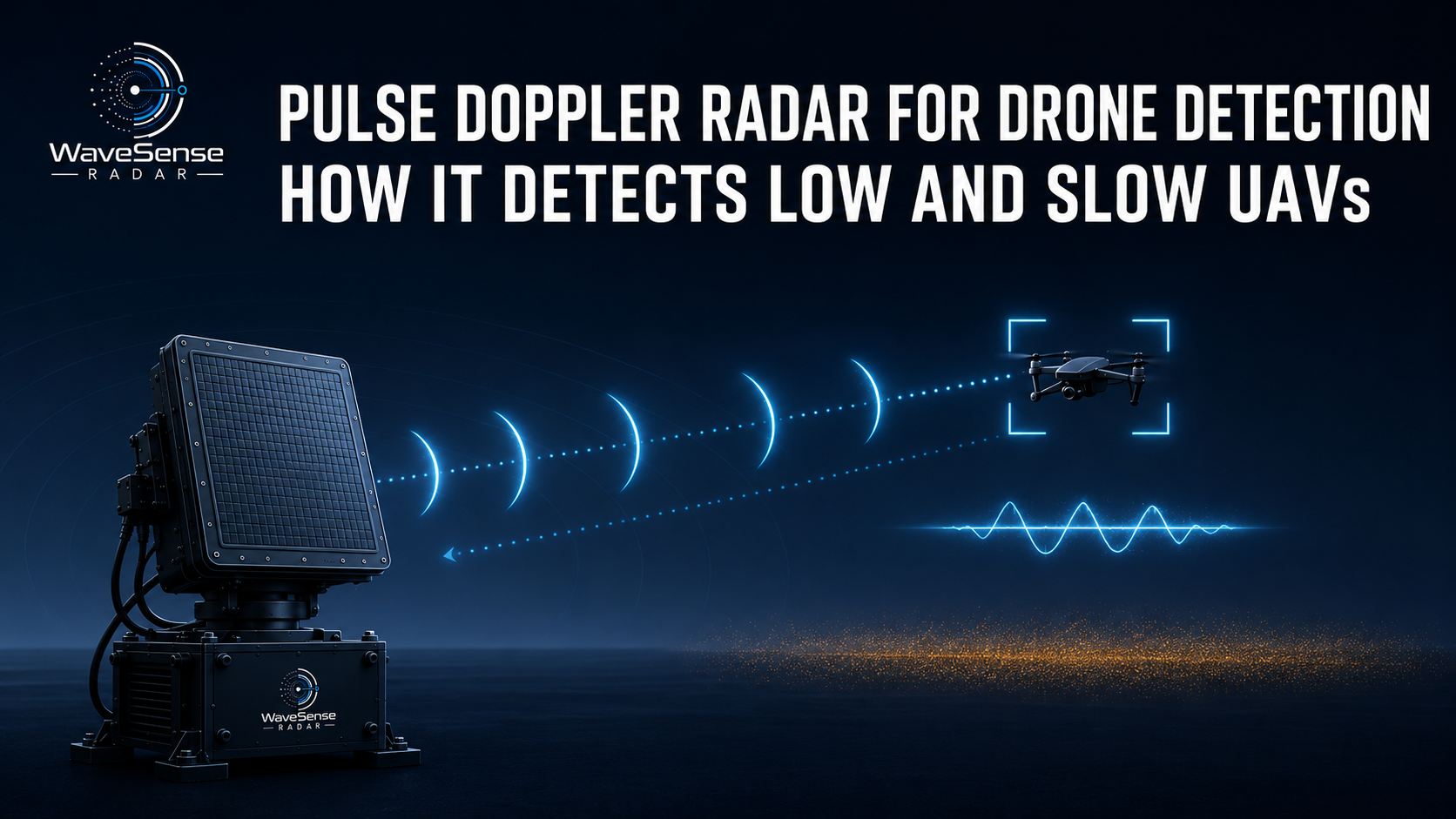
Pulse Doppler Radar transmits coherent radar pulses and analyzes pulse-to-pulse phase or frequency changes to measure radial velocity, suppress stationary clutter, and detect moving targets such as low-altitude UAVs.
This makes the architecture particularly valuable when a weak drone return appears near much stronger reflections from terrain, buildings, vegetation, or infrastructure.
The real challenge is not simply detecting motion.
It is detecting low, slow, and small targets without filtering them out together with clutter.
Why Is Pulse Doppler Radar Used For Drone Detection?
Small drones often operate exactly where conventional radar has the greatest difficulty.
They may combine:
- Low radar cross section
- Low flight altitude
- Slow radial velocity
- Hovering
- Rapid maneuvering
- Strong surrounding clutter
Pulse-Doppler processing separates radar echoes according to Doppler frequency.
This allows moving targets to be separated from many stationary reflections.
MIT Lincoln Laboratory describes pulse-Doppler processing as a method for rejecting radar clutter while measuring target radial velocity. See MIT Lincoln Laboratory’s Radar Course.
How Does Pulse Doppler Radar Work?
The radar transmits a sequence of coherent pulses.
Each pulse reflects from:
- Ground
- Buildings
- Birds
- Aircraft
- Drones
- Other objects
A moving target changes the phase of successive echoes.
The processor compares measurements across multiple pulses and estimates Doppler frequency.
That frequency is related to the target’s radial velocity.
Stationary objects concentrate near zero Doppler, while moving targets appear at different Doppler frequencies.
What Does “Coherent Radar” Mean?
A coherent radar maintains a known phase relationship between transmitted pulses.
This phase stability allows the receiver to compare echoes from one pulse with echoes from later pulses.
A target moving slightly between pulses creates a measurable phase change.
Without sufficient coherence, accurate Doppler processing becomes much more difficult.
For small UAVs, phase stability is particularly valuable because weak targets may require integration across many pulses.
What Is The Doppler Effect In Radar?
The Doppler effect describes a frequency shift caused by relative motion between radar and target.
When a drone approaches radar, the reflected frequency shifts in one direction.
When it moves away, the shift changes in the opposite direction.
The approximate radar Doppler frequency depends on:
Target Radial Velocity + Radar Wavelength
Therefore, radar can estimate how quickly a UAV is moving toward or away from the sensor.
What Is Radial Velocity?
Radial velocity is only the component of target velocity along the radar line of sight.
A drone flying directly toward radar may show strong Doppler velocity.
A drone flying perpendicular to the radar may have very low radial velocity even if its actual ground speed is high.
This creates an important limitation:
Fast drone ≠ always high Doppler.
Target geometry matters.
Can A Fast Drone Have Almost Zero Doppler?
Yes.
Imagine a UAV moving quickly from left to right across the radar.
Its distance from the sensor may change only slightly.
The radar therefore measures a small radial velocity.
This is sometimes called a Doppler geometry problem.
A radar relying too strongly on Doppler filtering can therefore find crossing or tangential targets more difficult than approaching targets.
Tracking, angle measurements, and repeated range observations help compensate.
Why Is Low-Speed Drone Detection Difficult?
Pulse-Doppler radar often suppresses signals near zero velocity because stationary clutter is concentrated there.
Unfortunately, slow UAVs can also appear close to zero Doppler.
If clutter rejection is too aggressive, the radar may suppress:
- Slow drones
- Hovering drones
- Tangential targets
along with terrain.
This creates one of the most important design tradeoffs in Low Slow Small Target Detection.
What Is Low Slow Small Target Detection?
Low Slow Small, often abbreviated LSS, describes targets with three difficult characteristics:
Low — flying close to terrain.
Slow — moving with relatively low radial velocity.
Small — producing weak radar reflections.
Commercial multicopters often exhibit all three.
This is why a radar designed for conventional aircraft does not automatically provide good drone detection.
Purpose-built processing is required.
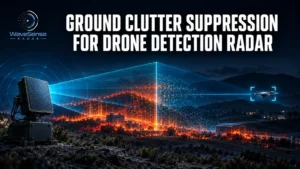
What Is Ground Clutter?
Ground clutter consists of unwanted radar returns from stationary or slowly moving environmental objects.
Examples include:
- Terrain
- Buildings
- Fences
- Towers
- Vehicles
- Trees
- Industrial equipment
A small drone may produce a much weaker echo than these objects.
Doppler processing helps distinguish targets by motion, but vegetation and other moving clutter can also generate non-zero Doppler.
Why Are Trees A Problem For Pulse Doppler Radar?
Trees are physically stationary but their leaves and branches move.
Wind therefore spreads vegetation energy across a range of Doppler frequencies.
Instead of producing one narrow zero-velocity clutter peak, vegetation can occupy a wider Doppler region.
A very slow UAV may then overlap that clutter.
This is why real low-altitude surveillance requires adaptive processing rather than simply deleting everything close to zero velocity.
What Is A Clutter Notch?
A Clutter Notch is a Doppler region that radar suppresses to reduce returns from stationary or slowly moving clutter.
Targets inside that velocity region may also be attenuated.
This creates a tradeoff:
Wider clutter notch → fewer false alarms
but potentially:
Wider clutter notch → more slow UAVs suppressed.
Therefore, buyers should ask what minimum radial velocity the radar can reliably detect under realistic clutter.
Can A Drone Fall Inside The Clutter Notch?
Yes.
This is especially possible when the UAV:
- Hovers
- Moves slowly
- Flies tangentially
- Is pushed by wind
- Changes direction
Its body Doppler can approach the clutter region.
The radar then needs additional information such as:
- Track history
- Range movement
- Angle movement
- Rotor micro-Doppler
- Adaptive clutter processing
to maintain detection.
Can Pulse Doppler Radar Detect A Hovering Drone?
Yes, but hovering is a harder case than a strongly moving target.
A hovering drone has nearly zero body radial velocity.
Its main body return can therefore overlap stationary clutter.
However, rotating propellers continue to produce micro-motion.
Purpose-built drone radar can combine conventional Doppler with rotor characteristics and tracking information.
A modern Pulse Doppler Radar should therefore be tested specifically against hovering UAVs.
Why Does A Hovering Drone Still Produce Doppler?
The airframe may remain nearly stationary, but the propellers rotate rapidly.
Different sections of each blade move toward and away from radar during every rotation.
These movements generate micro-Doppler components.
Thus the return contains:
Body Doppler ≈ near zero
plus:
Rotor Micro-Doppler ≠ zero
This information can help distinguish a hovering UAV from an ordinary stationary object.
MTI Vs Pulse Doppler Radar: What Is The Difference?
MTI, or Moving Target Indicator radar, is an older and broader moving-target processing concept.
/ MTI commonly compares successive pulses to suppress stationary targets.
Pulse-Doppler radar performs more detailed Doppler-frequency processing across a sequence of coherent pulses.
MIT Lincoln Laboratory distinguishes MTI from pulse-Doppler processing: MTI rejects stationary clutter, while pulse-Doppler processing provides radial-velocity measurement and stronger Doppler filtering.
What Is MTI Radar?
Moving Target Indicator Radar emphasizes separating moving targets from stationary clutter.
A basic MTI canceller compares returns from consecutive pulse periods.
If an object remains unchanged, much of its signal cancels.
A moving object produces a phase difference and remains visible.
This principle is useful but creates blind-speed limitations.
Modern digital radar typically uses more sophisticated Doppler filter banks and tracking algorithms.
What Is MTD Radar?
MTD means Moving Target Detection.
Instead of relying on a simple two-pulse or three-pulse canceller, MTD processing divides received signals into multiple Doppler filters.
Each filter represents a velocity region.
This provides more detailed separation between:
- Stationary clutter
- Slow targets
- Fast targets
- Weather
- Other moving objects
MIT describes Moving Target Detector processing as an example of Doppler filtering combined with adaptive detection thresholds.
MTI Vs MTD: Which Is Better For Drone Detection?
Modern MTD-style processing generally provides richer Doppler information than basic MTI cancellation.
A drone radar benefits from knowing whether a target lies at:
- 1 m/s
- 5 m/s
- 20 m/s
rather than simply deciding whether it moved.
However, sophisticated Doppler filtering also requires:
- Coherent processing
- More computation
- Careful thresholding
- Good clutter models
Real performance depends on the complete radar architecture.
What Is A Doppler Filter Bank?
A Doppler Filter Bank separates received radar energy into different Doppler-frequency regions.
Imagine the radar creating many velocity channels.
One channel may contain stationary clutter.
Other channels may contain:
- Slow drones
- Birds
- Vehicles
- Fast aircraft
Digital implementations commonly use FFT processing across repeated pulses.
This allows radar to create a Range-Doppler Map showing where targets appear in both distance and velocity.
What Is A Range-Doppler Map?
A Range-Doppler Map organizes radar energy according to:
Range → where the target is
and:
Doppler → how fast it moves radially
A small UAV may appear as a localized return at a specific range and Doppler frequency.
Machine-learning algorithms can also process these maps to find UAVs that conventional CFAR algorithms may miss in complicated backgrounds.
A 2024 study specifically examined fast UAV detection using the complete pulse-Doppler range-Doppler map.
Why Can CFAR Miss Small UAVs?
CFAR, or Constant False Alarm Rate processing, adapts target thresholds according to surrounding noise or clutter.
It works well when the statistical background behaves as expected.
Small drones become more difficult when:
- Clutter is non-uniform
- Target SNR is low
- Nearby strong objects exist
- Multiple targets interact
Research on pulse-Doppler UAV detection notes that conventional CFAR can experience missed detections for low-slow-small UAVs in non-uniform backgrounds.
Can AI Improve Pulse Doppler Drone Detection?
Yes.
AI models can analyze complete radar data structures rather than relying only on traditional thresholds.
Possible inputs include:
- Range-Doppler maps
- Micro-Doppler spectrograms
- Tracks
- RCS sequences
A 2024 IEEE study proposed a fully convolutional network operating on pulse-Doppler range-Doppler maps and reported much faster processing than sliding-window deep-learning approaches in its experiment.
AI still depends on high-quality radar measurements.
What Is PRF?
PRF means Pulse Repetition Frequency.
It describes how many radar pulses are transmitted per second.
For example:
PRF = 10 kHz
means approximately 10,000 pulses are transmitted every second.
PRF influences several important radar properties, including:
- Unambiguous range
- Unambiguous velocity
- Doppler sampling
- Blind speeds
- Processing interval
It is therefore one of the most important pulse-radar waveform parameters.
Why Does PRF Matter For Drone Detection?
PRF determines how frequently radar samples target motion.
Higher PRF can provide better Doppler sampling for faster targets.
However, transmitting pulses more frequently reduces the time available before echoes from one pulse can overlap later pulse intervals.
This creates the fundamental range-versus-velocity ambiguity tradeoff.
There is no single PRF that simultaneously gives unlimited unambiguous range and velocity.
MIT’s radar course explicitly separates low-, medium-, and high-PRF systems according to these tradeoffs.
What Is Low PRF Radar?
A Low PRF Radar waits relatively longer between pulses.
This provides a large unambiguous range because echoes usually return before the next pulse.
The disadvantage is poorer unambiguous Doppler-velocity coverage.
MIT summarizes low PRF as:
- Range relatively unambiguous
- Velocity highly ambiguous
This can be useful when accurate long-range measurement is important, but Doppler processing must address velocity ambiguities.
What Is Medium PRF Radar?
Medium PRF creates ambiguity in both range and velocity.
At first, that sounds undesirable.
However, transmitting several bursts using different PRFs allows the processor to resolve the ambiguities mathematically.
Pulse-Doppler systems frequently use this approach because it provides a practical balance for moving-target detection.
The true range and velocity can be reconstructed by comparing measurements across several PRFs.
What Is High PRF Radar?
A High PRF Radar sends pulses very frequently.
This provides stronger unambiguous Doppler-velocity capability.
However, several pulses may be in flight simultaneously.
The receiver may not initially know which transmitted pulse generated a returned echo.
Range therefore becomes highly ambiguous.
High PRF can be useful for Doppler-focused applications, but range ambiguity resolution becomes essential.
Why Can’t Radar Have Unlimited Range And Velocity At The Same Time?
Radar is sampling both delay and Doppler.
Increasing the time between pulses helps identify which pulse generated an echo and therefore improves unambiguous range.
But longer spacing lowers the sampling rate for Doppler.
Increasing PRF improves Doppler sampling but allows echoes from multiple pulses to overlap.
This creates a fundamental waveform-design tradeoff rather than a software limitation.
What Is Range Ambiguity?
Range Ambiguity occurs when radar cannot immediately determine which transmitted pulse produced a received echo.
Suppose several pulses have already been transmitted before a distant echo returns.
The receiver sees the echo but may associate it with the wrong pulse.
The resulting measured range becomes folded.
Using multiple PRFs allows modern pulse-Doppler radar to resolve many of these ambiguities.
What Is Velocity Ambiguity?
Velocity Ambiguity occurs when target Doppler frequency exceeds the unambiguous sampling region created by the pulse sequence.
The measured Doppler then folds into another frequency interval.
A high-speed UAV may therefore appear to have a different radial velocity unless the ambiguity is resolved.
Multiple PRFs and tracking can help determine the actual target velocity.
What Is Doppler Folding?
Doppler Folding is similar to aliasing in digital signal processing.
When Doppler frequency exceeds the unambiguous frequency interval, it appears at another location inside the measured spectrum.
The radar processor must identify the correct unfolded velocity.
This problem becomes particularly important when one radar must monitor both:
- Slow hovering drones
- Faster fixed-wing UAVs
over the same surveillance area.
What Is Blind Speed?
A Blind Speed is a target radial velocity that causes an MTI or Doppler processing system to respond poorly because the target’s phase change aligns unfavorably with the pulse repetition interval.
In classic MTI systems, some moving targets can therefore be suppressed almost like stationary clutter.
MIT notes that changing PRF between pulse groups can reduce the blind-speed problem.
Can A Drone Become Invisible At A Blind Speed?
A simplistic single-PRF MTI processor can significantly attenuate targets near particular blind velocities.
Modern radar normally reduces this problem using:
- Staggered PRFs
- Multiple PRFs
- Doppler filter banks
- Track history
Therefore, a drone does not simply become permanently invisible because its speed reaches one exact number.
The system architecture determines how effectively blind speeds are mitigated.
What Is Staggered PRF?
Staggered PRF means changing the pulse repetition timing between pulse groups.
A target that falls into a blind or ambiguous region under one PRF may appear normally under another.
Combining the results reduces blind zones in Doppler space.
This technique is widely used because one fixed PRF cannot optimize every range and velocity simultaneously.
Why Use Multiple PRFs?
Multiple PRFs allow the radar to compare ambiguous observations.
For example:
A PRF → one possible target range
B PRF → another folded result
C PRF C= → another result
Only one real range/velocity combination may satisfy all three measurements.
This allows ambiguity-resolution algorithms to estimate the true target state.
Pulse-Doppler radar commonly relies on this multi-PRF approach.
Does Higher PRF Mean Faster Radar Update Rate?
Not necessarily.
PRF describes pulse transmission frequency.
Track update rate describes how often the system outputs an updated target track.
A radar may transmit thousands of pulses while integrating them into one coherent processing interval.
Scanning, antenna movement, beam scheduling, processing, and tracking software also affect the final update rate.
PRF and data rate should therefore never be treated as the same specification.
What Is Coherent Processing Interval?
A Coherent Processing Interval, or CPI, is a period during which a group of coherent pulses is processed together.
More pulses can provide:
- Better Doppler resolution
- More processing gain
- Improved weak-target detection
But a longer CPI also means the target has more time to maneuver.
Drone radar must balance sensitivity with track responsiveness.
Does A Longer CPI Detect Smaller Drones?
It can improve sensitivity because the radar integrates information across more coherent observations.
Weak target energy can accumulate while random noise averages differently.
However, there are limits.
During a long CPI, a maneuvering UAV may change:
- Range
- Velocity
- Angle
- Acceleration
This can spread target energy across processing cells.
Longer integration is therefore not automatically better.
What Is Doppler Resolution?
Doppler Resolution determines how well radar can distinguish targets with similar radial velocities.
Longer coherent observation generally provides finer Doppler resolution.
This is useful when distinguishing:
- Slow drone from clutter
- Two UAVs with different speeds
- Bird from UAV movement
However, extremely fine velocity resolution may require longer observation time.
That creates a tradeoff with update rate.
Can Pulse Doppler Separate Two Drones At The Same Range?
Potentially.
If two UAVs have different radial velocities, they can appear in different Doppler bins despite having similar range.
This is one advantage of Range-Doppler processing.
If they also have the same radial velocity, radar may need:
- Angular resolution
- Elevation separation
- Track history
to distinguish them.
Dense drone swarms therefore require more than Doppler resolution alone.
Can Two Drones At The Same Speed Be Separated?
Yes, if they differ sufficiently in another measurement dimension.
The radar can potentially separate them using:
- Range
- Azimuth
- Elevation
A modern 3D radar combines these measurements with Doppler.
If targets become nearly identical in range, angle, and radial velocity, individual resolution becomes substantially harder.
What Is Pulse Compression?
Pulse Compression allows radar to transmit a relatively long, energy-rich pulse while recovering range resolution closer to that of a much shorter pulse.
The transmitted pulse is internally modulated.
After reception, matched filtering compresses the energy into a narrow response.
MIT describes this as a method for obtaining the energy benefit of a long pulse together with the resolution associated with a wide-bandwidth short pulse. See MIT Radar Course material.
Why Does Pulse Doppler Radar Use Pulse Compression?
Small drones return very little energy.
Longer pulses can transmit more energy toward the target.
Unfortunately, an ordinary long pulse produces poor range resolution.
Pulse compression solves much of this tradeoff by modulating the pulse before transmission and compressing it during reception.
This allows radar designers to combine:
Higher pulse energy + finer range resolution.
That is particularly valuable for weak, small-RCS targets.
What Is LFM Pulse Compression?
LFM means Linear Frequency Modulation.
During one transmitted pulse, radar frequency changes approximately linearly.
This creates a chirped pulse.
Matched filtering at the receiver compresses the long chirped waveform into a much narrower response.
Many solid-state surveillance radars use LFM pulse-compression techniques.
Commercial low-altitude UAV radars also commonly describe LFM pulse-Doppler architectures.
Is LFM Pulse Radar The Same As FMCW Radar?
No.
Both can use frequency chirps, but the operating concepts differ.
LFM Pulse-Doppler Radar
Transmits distinct modulated pulses with listening intervals or pulse processing.
FMCW Radar
Transmits continuously while frequency changes.
Therefore:
Chirp ≠ automatically FMCW.
This distinction is important because many buyers see “linear frequency modulation” and assume the radar uses FMCW.
Pulse Compression Vs FMCW
Both architectures can achieve fine range resolution using waveform bandwidth.
However, they manage transmission and reception differently.
Pulse compression uses coded or modulated transmitted pulses.
FMCW continuously compares transmitted and delayed frequency sweeps.
Their engineering tradeoffs differ in:
- Peak power
- Leakage
- Minimum range
- Dynamic range
- Duty cycle
- Signal processing
Neither architecture is universally superior for every drone-detection mission.
Does Pulse Compression Increase Range?
It can improve radar sensitivity by allowing more energy to be transmitted without sacrificing the range resolution associated with the compressed waveform.
However:
Pulse compression does not magically create unlimited detection range.
Actual range still depends on:
- Antenna gain
- Transmitter power
- Target RCS
- Receiver sensitivity
- Processing
- Clutter
Pulse compression is one part of the complete radar link budget.
Does Pulse Compression Create A Blind Zone?
A long transmitted pulse can create near-range limitations because the radar may still be transmitting while echoes from very close targets return.
MIT Lincoln Laboratory specifically notes that long pulse-compression waveforms can produce a near-range blind zone in transmitting channels.
Therefore, higher pulse energy creates a practical tradeoff:
Longer pulse → more energy
but potentially:
Longer pulse → larger near-range challenge.
Why Does Near-Range Blind Zone Matter For Counter-UAS?
A radar may be optimized to detect small drones several kilometers away.
But a security site also needs to know what happens close to the radar.
If pulse architecture creates a significant near-range coverage gap, additional measures may be required:
- Short-pulse waveform
- Separate radar mode
- Additional sensor
- Overlapping radar coverage
Maximum detection range and minimum detection range should therefore be evaluated together.
Can One Radar Use Long And Short Pulses?
Yes.
Radar designers can use different waveforms for different range regions.
For example:
Short pulse
can improve near-range coverage.
Long compressed pulse
can provide more energy for distant weak targets.
Waveform scheduling can combine the benefits.
However, every additional waveform consumes radar time and processing resources.
What Are Range Sidelobes?
After pulse compression, a target does not always produce one perfectly isolated peak.
Smaller responses can appear around the main compressed pulse.
These are called range sidelobes.
A strong target’s sidelobes can mask a much weaker nearby target.
MIT has specifically studied pulse-compression sidelobes and near/far interference in surveillance radar.
Why Are Range Sidelobes Important For Drone Detection?
Imagine:
Large aircraft → strong radar return
and:
Small drone nearby → very weak return.
If the strong target produces large pulse-compression sidelobes, the small UAV can become difficult to detect.
This is sometimes called a near/far target problem.
Good waveform design and sidelobe weighting are therefore important when the surveillance environment contains targets with very different RCS values.
What Is Matched Filtering?
A Matched Filter is designed to maximize the response to a known transmitted radar waveform in noise.
For pulse compression, the receiver correlates the reflected signal with the expected waveform.
The energy of a long coded pulse becomes concentrated into a shorter output response.
This improves range discrimination while retaining transmitted energy.
Matched filtering is a fundamental element of many modern pulse radar systems.
What Is Windowing In Pulse Doppler Radar?
FFT processing can produce spectral sidelobes around strong Doppler targets.
Windowing modifies pulse samples before Fourier processing to reduce those sidelobes.
Common windows trade:
Lower sidelobes
against:
Wider main response.
This matters because a strong clutter or moving target return can otherwise obscure a weak nearby UAV in Doppler space.
Can Pulse Doppler Detect Very Slow Drones?
Yes, provided the processing is designed to retain slow targets close to the clutter spectrum.
Useful approaches may include:
- Narrow adaptive clutter suppression
- MTD
- Track processing
- Micro-Doppler
- Spatial filtering
- Classification
The difficult question is not whether the architecture can theoretically detect slow motion.
It is how close to zero radial velocity the radar remains reliable in real clutter.
What Minimum Drone Speed Can Pulse Doppler Radar Detect?
There is no universal minimum.
A datasheet may specify something such as:
Minimum detectable radial velocity: 0.5 m/s
but the real threshold can depend on:
- Clutter
- PRF
- Doppler filter design
- Target RCS
- Aspect angle
- Weather
- Processing
A more useful test uses a representative UAV at the actual deployment site.
Can Pulse Doppler Detect A Drone Flying Perpendicular To Radar?
Yes, but the radial Doppler may become very small.
The system may still observe changes in:
- Range
- Angle
- Track position
- Rotor micro-Doppler
This scenario should be included in field testing.
Testing only drones flying directly toward radar can make Doppler performance appear easier than it will be during real operations.
Does Pulse Doppler Detect RF-Silent Drones?
Yes.
Radar detects reflected electromagnetic energy from the physical aircraft.
It does not require the UAV to transmit:
- Control signals
- Telemetry
- Remote ID
- Video
This allows radar to detect autonomous or RF-silent platforms when they produce sufficient radar returns.
For a broader overview, see our Drone Detection Radar article.
Why Does Drone RCS Matter?
Doppler processing separates targets according to motion, but it cannot compensate for an arbitrarily weak return.
The processor must first receive enough usable signal.
Drone RCS depends on:
- Size
- Material
- Frequency
- Orientation
- Payload
A small UAV may therefore be detectable at one aspect and harder at another.
See our Radar Cross Section Of A Drone analysis for the detailed relationship.
Pulse Doppler Radar Vs FMCW Radar
Both architectures can detect and track UAVs.
Pulse Doppler Radar is often attractive when high-energy pulsed surveillance and long-range detection are important.
FMCW Radar can be attractive for continuous-wave, compact, high-resolution sensing.
The real comparison should evaluate:
- Target RCS
- Range
- Minimum range
- Resolution
- Update rate
- Clutter performance
- Power
- Antenna
- Classification
The waveform name alone does not determine the winner.
Does Pulse Doppler Have Better Range Than FMCW?
Not automatically.
Pulse architectures can support high peak transmit power, making them attractive for long-range surveillance.
But FMCW systems can also achieve substantial range with sufficient:
- Antenna gain
- Average power
- Receiver performance
- Processing gain
The correct comparison must use actual radar systems against the same target and environmental conditions.
Does FMCW Have Better Minimum Range?
It can avoid certain transmit/receive switching limitations found in pulsed radar.
However, FMCW suffers from:
- Tx-Rx leakage
- Antenna coupling
- Strong near-field clutter
Pulse-Doppler radar can use dedicated short-range waveforms to improve nearby coverage.
Therefore, neither architecture should be declared automatically superior without examining the complete design.
Pulse Doppler Radar Vs CW Doppler Radar
A simple Continuous-Wave Doppler radar can measure target motion but normally lacks direct range information.
Pulse-Doppler adds transmitted timing.
This allows radar to determine:
- Range
- Velocity
and place targets inside spatial range cells.
For security surveillance, knowing that “a moving object exists” is not enough.
Operators need to know where the UAV is located.
Pulse Doppler Radar Vs MTI Radar
Traditional MTI emphasizes clutter cancellation.
Pulse-Doppler provides a richer Doppler spectrum.
This allows the system to estimate target radial velocity and divide moving returns among multiple velocity filters.
For modern UAV surveillance, pulse-Doppler/MTD-style processing generally provides more information than a simple moving-target indicator.
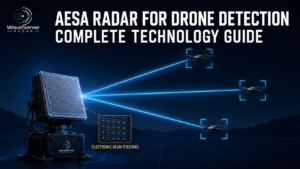
Pulse Doppler Radar Vs AESA Radar
These terms describe different parts of the system.
Pulse Doppler
describes waveform and signal-processing principles.
AESA
describes an active electronically scanned antenna architecture.
A radar can therefore be:
AESA + Pulse Doppler
at the same time.
Many modern low-altitude surveillance systems combine coherent pulse-Doppler processing with phased-array antenna technology.
Can Pulse Doppler Radar Use Phased Array Antennas?
Yes.
The radar waveform and antenna-scanning architecture are independent design choices.
A system might combine:
- Pulse-Doppler waveform
- AESA antenna
- Digital beamforming
- MTD processing
- AI classification
Each component solves a different problem.
Buyers should therefore avoid treating radar buzzwords as mutually exclusive product categories.
Can Pulse Doppler Radar Detect Drone Swarms?
Yes, provided the system has sufficient:
- Resolution
- Track capacity
- Update rate
- Processing
Doppler separation can help when swarm members have different radial velocities.
However, close-formation UAVs may have nearly identical:
- Range
- Angle
- Velocity
Individual separation can then become much harder.
Maximum track count alone does not prove swarm capability.
Why Is Doppler Useful For Multi-Target Tracking?
Two UAVs at similar distances may move at different radial speeds.
Doppler creates an additional separation dimension.
Instead of analyzing only:
Range
the tracker can use:
Range + Velocity + Angle.
This reduces ambiguity in many multi-target situations.
However, targets can still cross or occupy similar measurement cells, so advanced data association remains necessary.
Can Pulse Doppler Distinguish Birds From Drones?
It can contribute to the classification process.
Useful information includes:
- Radial velocity
- RCS
- Trajectory
- Doppler spread
- Micro-Doppler
Bird wingbeats and drone rotors can produce different time-frequency behavior.
However, basic pulse-Doppler velocity measurement alone cannot reliably distinguish every bird from every UAV.
Classification requires additional features.
Does Weather Affect Pulse Doppler Radar?
Yes.
Rain and weather can produce radar returns with their own Doppler characteristics.
Wind-driven precipitation is not necessarily stationary.
This means weather clutter can occupy Doppler frequencies where real targets also exist.
MIT notes that MTI has limited ability to suppress moving rain clutter, while pulse-Doppler processing provides stronger clutter rejection capabilities.
Environmental testing remains essential.
Can Rain Look Like A Moving Target?
Yes.
Raindrops move.
Weather systems can therefore produce Doppler returns.
The radar needs to distinguish:
- Distributed precipitation echoes
- Localized airborne targets
using spatial, Doppler, amplitude, track, and statistical characteristics.
Weather rejection is especially important for radars expected to operate continuously around airports, borders, and critical infrastructure.
Does Wind Affect Pulse Doppler Drone Detection?
Wind affects both environmental clutter and drone behavior.
Vegetation moves more strongly.
Bird flight changes.
A hovering UAV may increase rotor activity and tilt to maintain position.
These effects alter radar Doppler signatures.
Therefore, a radar tested only under calm clear weather may not represent real field performance.
What Is Clutter-To-Signal Ratio?
A drone can be weak not because its return is below receiver noise, but because nearby clutter is much stronger.
Clutter-To-Signal Ratio describes this challenge.
Low-altitude UAV detection can therefore be clutter limited rather than purely noise limited.
Increasing transmit power helps both target and clutter returns.
Better processing, geometry, and antenna design may be more important than power alone.
Why Doesn’t More Transmit Power Solve Ground Clutter?
If radar sends more energy toward the environment:
The drone reflects more energy.
But terrain and buildings also reflect more energy.
If clutter dominates the target return, simply increasing power may not improve separation enough.
The radar needs:
- Doppler filtering
- Spatial filtering
- Clutter maps
- Adaptive thresholds
- Tracking
This is why LSS detection is primarily a system-engineering problem.
What Is A Clutter Map?
A Clutter Map records expected radar returns from a surveillance area.
The processor learns where persistent environmental reflections normally occur.
New or changing signals can then receive additional attention.
A clutter map can be useful around:
- Buildings
- Terrain
- Towers
- Industrial equipment
However, the environment changes with weather, vegetation, vehicles, and construction.
Maps therefore need adaptation.
Can Pulse Doppler Radar Work In Cities?
Yes, but urban environments create difficult radar scenes.
Cities contain:
- Strong buildings
- Moving vehicles
- Multipath
- Narrow sight lines
- Trees
- Infrastructure
The target may also disappear behind structures.
Pulse-Doppler processing helps separate moving objects, but no signal-processing method can guarantee complete coverage behind every physical obstruction.
Site geometry remains essential.
What Is Multipath?
Multipath occurs when radar energy reaches the target or receiver through multiple reflected paths.
Buildings and large metal structures can create strong multipath.
The radar may observe:
- False positions
- Ghost detections
- Distorted amplitude
- Additional Doppler components
Urban Counter-UAS systems therefore need both robust processing and careful installation.
Can Pulse Doppler Radar See Through Buildings?
Not in the general way implied by that statement.
Pulse-Doppler describes how motion information is extracted.
It does not automatically allow radar signals to penetrate or bypass every obstacle.
Some RF energy may propagate through or around certain structures depending on frequency and material, but reliable surveillance should not assume building penetration.
Multiple sensor positions are usually a safer coverage strategy.
What Is A Radar Blind Zone?
A Radar Blind Zone is an area where target detection is unavailable or degraded.
It can result from:
- Buildings
- Terrain
- Antenna geometry
- Minimum range
- Elevation limits
- Pulse timing
Pulse-Doppler processing solves motion discrimination problems.
It does not eliminate geometric blind zones.
Site surveys remain necessary.
Why Is Antenna Height Important?
Higher installation can improve line of sight over nearby obstacles.
However, mounting the radar higher can also change:
- Near-range geometry
- Ground illumination
- Multipath
- Maintenance requirements
A radar should therefore be positioned according to the protected volume rather than using the highest available structure automatically.
Is Pulse Doppler Radar 2D Or 3D?
Pulse-Doppler does not determine whether radar is 2D or 3D.
A Pulse-Doppler radar can provide:
2D: range + azimuth.
or:
3D: range + azimuth + elevation.
Three-dimensional UAV surveillance usually requires elevation measurement through:
- Phased array
- Multiple beams
- Digital beamforming
- Other antenna techniques
Velocity is then added through Doppler processing.
Can Pulse Doppler Radar Track Hundreds Of Targets?
Yes, some modern systems advertise hundreds of simultaneous tracks.
But buyers should separate:
Processing Track Capacity
from:
Physical Target Resolution.
A radar may maintain hundreds of widely separated tracks while struggling to separate a dense swarm of UAVs occupying the same range-angle region.
Track update rate and latency should also be tested at full load.
What Is Track While Scan?
Track While Scan, or TWS, allows radar to continue searching for new objects while maintaining tracks on existing targets.
Pulse-Doppler measurements provide range and velocity information that helps predict where each target will appear next.
Modern UAV surveillance radars frequently combine pulse-Doppler processing with TWS tracking.
Why Is Track Update Rate Important?
A drone can change speed and direction quickly.
If radar output updates too slowly, predicted position may diverge from actual position.
This can affect:
- EO/IR camera cueing
- Airspace alerts
- Sensor fusion
- Threat analysis
A radar claiming long detection range should therefore also publish usable data or track update rate.
Is PRF The Same As Track Update Rate?
No.
This is worth repeating because the numbers can differ by several orders of magnitude.
A radar may transmit:
10,000 pulses per second
but output track coordinates only:
Once per second
or at another system-defined rate.
Pulse transmission, coherent integration, antenna scanning, and track publishing are different stages.
What Is Track Latency?
Track Latency is the delay between actual target movement and delivery of updated information.
A fast update rate with large processing delay can still provide stale target information.
For Counter-UAS systems, buyers should ask for:
- Update interval
- Processing latency
- End-to-end sensor output delay
especially when radar must cue narrow-field-of-view cameras.
Why Does Camera Cueing Need Accurate Pulse Doppler Tracks?
A long-range EO/IR camera may use a narrow zoom field of view.
Radar must provide accurate:
- Range
- Azimuth
- Elevation
so the camera can point toward the target.
Velocity estimates also help predict where the UAV will be when the camera arrives.
This makes stable tracking more useful than simple one-time detection.
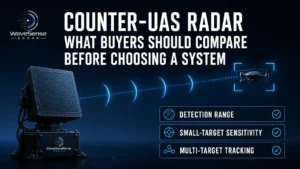
How Should Buyers Compare Pulse Doppler Radars?
Compare measurable operational parameters:
| Parameter | Why It Matters |
|---|---|
| Target RCS | Defines target difficulty |
| Detection Range | Early warning |
| Tracking Range | Usable coverage |
| Minimum Radial Velocity | Slow-target performance |
| Hovering Detection | Zero-Doppler challenge |
| Range Resolution | Target separation |
| Doppler Resolution | Velocity separation |
| Minimum Range | Near-field protection |
| PRF Strategy | Range/velocity ambiguity |
| Update Rate | Track responsiveness |
| Track Capacity | Multi-target operation |
| False Alarm Rate | Operator workload |
| Weather Performance | Real deployment |
A statement such as “Pulse Doppler technology” is not enough.
What Should Buyers Ask About Minimum Velocity?
Ask:
What minimum radial velocity can the radar detect under actual ground clutter?
Do not accept a laboratory velocity number without environmental conditions.
Also test:
- Hovering
- Slow approach
- Tangential crossing
- Stop-and-go movement
These scenarios expose whether clutter filters remove important UAV targets.
What Should Buyers Ask About PRF?
Ask whether the radar uses:
- Fixed PRF
- Staggered PRF
- Multiple PRF sets
- Adaptive waveform scheduling
Then ask how it handles:
- Range ambiguity
- Velocity ambiguity
- Blind speeds
The manufacturer does not need to disclose sensitive implementation details, but it should demonstrate that the system maintains reliable UAV tracks across its stated operating envelope.
What Should Buyers Ask About Pulse Compression?
Useful questions include:
- Is LFM or another coding method used?
- What is the range resolution?
- What is the compressed sidelobe level?
- What is the minimum detection range?
- Are short and long pulses combined?
- How are strong nearby targets handled?
These questions reveal practical performance that the phrase Pulse Compression Radar does not describe by itself.
What Should Buyers Ask About Hovering UAV Detection?
Request an actual demonstration.
The test drone should:
- Approach the radar.
- Stop.
- Hover for a defined period.
- Change heading.
- Move tangentially.
- Resume flight.
Monitor whether the radar:
- Keeps the same track
- Changes classification
- Drops the UAV
- Creates a new track
This reveals far more than a normal flyby demonstration.
Why Should Crossing Targets Be Tested?
A UAV flying directly toward radar generates favorable radial Doppler.
A crossing target may produce much lower radial velocity.
Testing both trajectories shows whether the radar depends too heavily on high Doppler.
This is particularly important for perimeter systems where drones can approach from arbitrary directions.
Why Should Strong Clutter Be Included In Testing?
Open-field demonstrations can make almost any well-designed radar look good.
Real sites may contain:
- Buildings
- Trees
- Vehicles
- Towers
- Machinery
A professional acceptance test should place UAVs in the radar environment the system was purchased to protect.
The goal is not to prove maximum laboratory range.
The goal is to demonstrate operational reliability.
How Should Detection Range Be Reported?
Instead of:
“Drone Detection Range: 10 km.”
a useful specification should state:
Target: Defined UAV/RCS
Altitude: Defined
Aspect: Defined
Range: Defined
Probability Of Detection: Defined
Clutter: Defined
Weather: Defined
Update Rate: Defined
This allows buyers to compare radar systems fairly.
Why Is A DJI Model Name Better Than “Small Drone”?
Using an actual UAV model provides more information than simply saying:
Small UAV
because “small” has no universal radar definition.
However, even one model name is insufficient without understanding its radar signature.
Orientation and frequency can change the RCS significantly.
Our Drone RCS guide explains why target definition matters.
What Is The Biggest Pulse Doppler Radar Procurement Mistake?
The biggest mistake is assuming:
Pulse Doppler = automatically excellent low-speed UAV detection.
Pulse-Doppler provides powerful clutter-separation tools.
But those same filters can suppress targets near zero velocity.
The real test is how the radar performs against:
Small RCS + Low Altitude + Low Radial Velocity + Real Clutter.
That combination should define the acceptance scenario.
Pulse Doppler Radar For Airports
Airport environments contain:
- Birds
- Aircraft
- Vehicles
- Buildings
- Weather
- Unauthorized UAVs
Doppler processing helps separate moving targets from ground clutter.
However, bird discrimination and low-speed drone detection remain important.
Radar therefore usually works best as part of a wider surveillance architecture including tracking, classification, and visual confirmation.
Pulse Doppler Radar For Critical Infrastructure
Power stations, refineries, ports, and industrial facilities can contain extremely strong clutter.
Large structures may create:
- Reflections
- Multipath
- Obstruction
Pulse-Doppler processing helps extract moving targets.
Site-specific clutter mapping and sensor placement remain equally important.
A radar selected from an open-field test alone may not represent industrial-site performance.
Pulse Doppler Radar For Border Surveillance
Border applications may require:
- Longer detection range
- Wide-area coverage
- Multiple targets
- Low-altitude tracking
Pulse-Doppler radar can provide range and radial velocity for UAVs and other moving objects.
Terrain often becomes the major challenge.
Several radar positions may be required where hills or structures block direct line of sight.
Pulse Doppler Radar For Drone Swarms
Swarm surveillance adds pressure on:
- Range resolution
- Doppler resolution
- Angular resolution
- Track capacity
- Data association
Doppler provides one useful separation dimension.
However, drones flying in coordinated formation may share similar velocities.
Swarm detection therefore requires multi-dimensional radar measurements and strong tracking rather than relying on Doppler alone.
What Are The Main Advantages Of Pulse Doppler Radar?
Important advantages include:
- Strong moving-target discrimination
- Radial velocity measurement
- Clutter rejection
- Long-range architecture compatibility
- Pulse compression support
- Multi-target processing
- Phased-array compatibility
These characteristics make pulse-Doppler attractive for professional air-surveillance and Counter-UAS systems.
What Are The Main Limitations?
Important challenges include:
- Range/velocity ambiguity
- Blind speeds
- Low-Doppler targets
- Hovering UAVs
- Weather clutter
- Pulse-compression sidelobes
- Near-range blind zones
- Processing complexity
These are not reasons to avoid pulse-Doppler.
They are parameters engineers must design and test correctly.
Is Pulse Doppler Radar Better Than FMCW For Counter-UAS?
There is no universal answer.
Pulse-Doppler can be highly effective for longer-range surveillance and strong clutter rejection.
FMCW can provide attractive continuous-wave and high-resolution capabilities in compact architectures.
The best technology depends on:
- Threat RCS
- Required range
- Site size
- Update rate
- Near-range requirement
- Power
- Antenna
- Environment
Compare measured performance rather than waveform labels.
What Is A Better Procurement Requirement?
Instead of:
“The radar shall use Pulse Doppler technology.”
write:
“The radar shall reliably detect and maintain tracks on representative low-RCS UAVs at the required range, altitude, radial velocity, and clutter conditions, including hovering and low-Doppler flight profiles.”
Then specify acceptable:
- Pd
- False alarm rate
- Update rate
- Minimum range
- Tracking continuity
Technology can then be evaluated against mission performance.
Future Of Pulse Doppler Drone Detection
Future systems are combining classical Doppler physics with:
- AESA beamforming
- Adaptive clutter processing
- AI detection
- Micro-Doppler classification
- Multi-PRF waveform management
- Sensor fusion
- Networked radars
Recent UAV research also applies deep learning directly to pulse-Doppler Range-Doppler data rather than treating AI only as a final classification layer.
The direction is toward adaptive radar processing rather than one fixed threshold or waveform.
Will AI Replace MTI And Doppler Processing?
No.
MTI, Doppler filtering, matched filtering, pulse compression, and ambiguity resolution are based on radar physics.
AI can improve decisions made from those measurements.
Future systems will therefore combine:
Radar Physics → Signal Processing → Tracking → AI Classification
instead of replacing radar fundamentals with a neural network.
Conclusion
Pulse Doppler Radar is highly effective for drone surveillance because coherent pulse processing can separate moving UAVs from strong stationary clutter while providing range and radial-velocity measurements, but its hardest targets are precisely the low-speed and hovering drones that approach the zero-Doppler clutter region.
Real performance therefore depends on much more than the words “Pulse Doppler.”
Buyers should evaluate minimum radial velocity, hovering detection, PRF strategy, blind-speed mitigation, Doppler resolution, pulse compression, minimum range, clutter rejection, target RCS, track update rate, and false-alarm performance.
A radar that detects a fast approaching drone at long range should not automatically be assumed to provide equally reliable performance against a small UAV hovering above a cluttered industrial site.
FAQ
What Is Pulse Doppler Radar?
Pulse Doppler radar transmits coherent pulses and analyzes Doppler changes between echoes to measure radial velocity and separate moving targets from clutter.
Why Is Pulse Doppler Radar Good For Drone Detection?
It combines target ranging with Doppler-based moving-target discrimination, which helps detect UAVs operating near strong ground clutter.
Can Pulse Doppler Radar Detect Small Drones?
Yes.
Performance depends on UAV RCS, radar sensitivity, range, altitude, clutter, antenna, waveform, and processing.
Can Pulse Doppler Radar Detect Hovering Drones?
Yes, but hovering UAVs are more challenging because body Doppler approaches stationary clutter.
Rotor micro-Doppler and other features can assist.
What Is MTI Radar?
MTI means Moving Target Indicator radar and uses pulse-to-pulse changes to suppress stationary clutter.
What Is MTD Radar?
MTD means Moving Target Detection and commonly uses a bank of Doppler filters to separate moving targets according to velocity.
What Is PRF?
PRF means Pulse Repetition Frequency: the number of radar pulses transmitted per second.
Does Higher PRF Mean Longer Range?
No.
Increasing PRF can improve Doppler sampling but reduces unambiguous range.
What Is Range Ambiguity?
Range ambiguity occurs when radar cannot initially determine which transmitted pulse produced a received echo.
What Is Velocity Ambiguity?
Velocity ambiguity occurs when target Doppler exceeds the unambiguous velocity interval created by the radar’s sampling.
What Is Blind Speed?
A blind speed is a target radial velocity at which certain MTI processing configurations strongly attenuate the target.
Multiple PRFs can reduce this problem.
What Is Pulse Compression?
Pulse compression transmits a modulated long pulse and processes the echo to achieve the energy benefit of a long pulse with finer range resolution.
Is LFM Pulse Radar The Same As FMCW?
No.
LFM pulse radar transmits frequency-modulated pulses, while FMCW transmits continuously modulated frequency sweeps.
Does Pulse Compression Have A Minimum Range Problem?
Long transmitted pulses can create practical near-range blind zones, so radar systems may use multiple waveform lengths or other techniques.
Is Pulse Doppler Better Than FMCW?
Neither is universally better.
The correct architecture depends on range, target RCS, coverage, resolution, update rate, environment, and deployment requirements.
Can Pulse Doppler Radar Detect RF-Silent Drones?
Yes.
Radar detects the physical aircraft and does not require an active radio-control transmission.
Can Pulse Doppler Detect Drone Swarms?
Yes, suitable systems can track multiple UAVs, but dense swarm performance depends on range, Doppler, angular resolution, and track capacity.
Does Pulse Doppler Radar Work In Rain?
Yes, but moving precipitation produces Doppler clutter and can affect detection performance.
What Should Buyers Ask A Pulse Doppler Radar Manufacturer?
Ask for target-specific range, minimum radial velocity, hovering performance, PRF/ambiguity handling, minimum range, pulse-compression characteristics, update rate, target capacity, Pd, false alarms, and field-test conditions.