What Is AESA Radar?
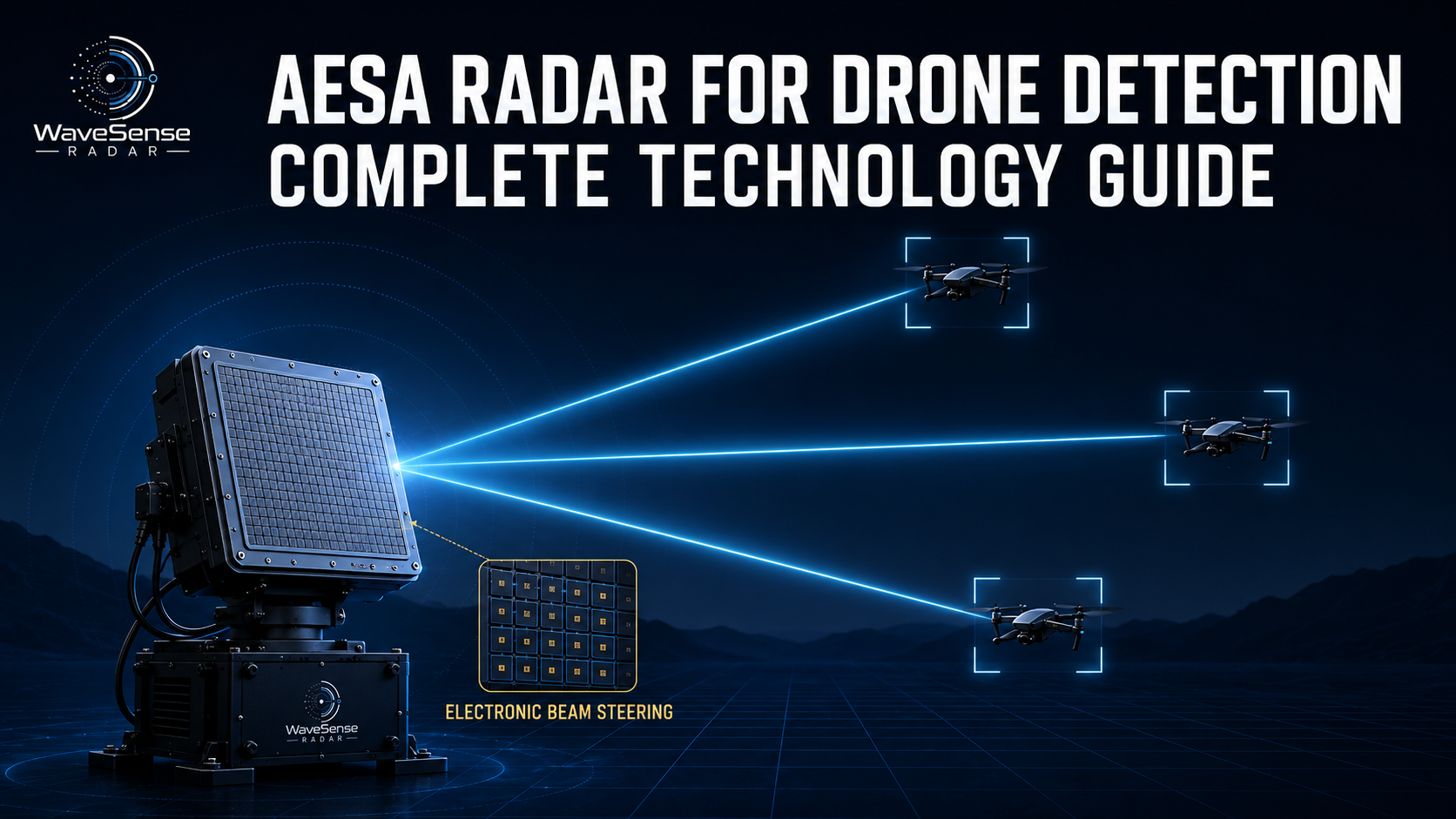
AESA Radar uses many active transmit/receive elements to electronically steer radar energy, allowing rapid beam movement, flexible target revisits, and multi-target surveillance without mechanically pointing the antenna for every measurement.
AESA means Active Electronically Scanned Array.
Its biggest advantage for drone surveillance is not simply “faster scanning.”
AESA architecture allows the radar to dynamically allocate sensing resources between searching, tracking, classification, and priority sectors.
What Does AESA Stand For?
AESA stands for Active Electronically Scanned Array.
The word “active” refers to an antenna architecture containing distributed active transmit/receive electronics rather than relying on one centralized high-power transmitter feeding a passive array.
The word “electronically scanned” means beam direction can change electronically.
The physical antenna does not need to rotate toward every new target.
Northrop Grumman describes AESA systems as supporting multi-target detection and tracking across several radar applications. See its AESA radar overview.
How Does AESA Radar Work?
An AESA antenna contains many radiating elements arranged into an array.
The radar controls the relative phase and amplitude of signals across those elements.
When the signals combine in space, they reinforce one another in a desired direction and create a focused radar beam.
Changing the electronic control values moves that beam.
MathWorks provides a useful technical explanation of how phased arrays steer beams by controlling the phase of array elements. See its Electronically Steered Array Radar guide.
What Is Electronic Beam Steering?
Electronic Beam Steering changes radar beam direction by controlling signals across an antenna array rather than physically turning the entire antenna.
The beam can therefore move from one direction to another very quickly.
For drone surveillance, this allows radar to:
- Search large sectors
- Revisit suspicious targets
- Maintain multiple tracks
- Cue cameras
- Increase attention on priority areas
Electronic steering is one of the fundamental advantages of phased-array technology.
Mechanical Scanning Vs Electronic Scanning
A mechanically scanned radar changes observation direction by physically rotating or moving an antenna.
An electronically scanned array changes the beam direction electrically.
Mechanical systems can still provide effective surveillance.
However, physical movement limits how quickly the antenna can jump repeatedly between widely separated targets.
Electronic arrays can redirect radar attention much faster because they do not need to move the entire antenna structure for every beam change.
Does AESA Radar Have No Moving Parts?
The AESA antenna itself can steer beams electronically without mechanically pointing the array.
However, an AESA radar system does not necessarily contain zero moving parts.
Some systems mount AESA panels on rotating platforms to combine:
Electronic scanning + mechanical 360° rotation.
Others use several fixed AESA panels around a mast.
Therefore:
AESA ≠ automatically fixed radar
and:
AESA ≠ automatically 360° coverage.
The complete antenna configuration determines coverage.
Is AESA The Same As Phased Array Radar?
Not exactly.
Phased Array Radar is the broader technology family.
AESA is one type of phased-array architecture.
Another important type is PESA, or Passive Electronically Scanned Array.
Therefore:
All AESA radars are phased-array radars, but not all phased-array radars are AESA radars.
This distinction is frequently lost in commercial radar marketing.
What Is PESA Radar?
PESA means Passive Electronically Scanned Array.
A PESA radar electronically steers its beam across a phased-array antenna but traditionally relies more heavily on a centralized transmitter architecture.
The antenna elements modify the signal phase to control beam direction.
PESA can therefore provide electronic scanning without using the same distributed active T/R architecture associated with AESA.
AESA Vs PESA: What Is The Main Difference?
The main architectural difference is how RF transmission and reception are distributed through the antenna.
A traditional PESA uses a centralized RF source feeding the array.
An AESA distributes active transmit/receive electronics across many array elements or subarrays.
This distributed architecture provides greater flexibility in beam control and can improve reliability because the antenna does not depend on one single high-power transmitter path.
What Is A T/R Module?
A T/R Module, or Transmit/Receive Module, is a fundamental building block in many AESA antennas.
A module can contain functions such as:
- Power amplification
- Low-noise receiving
- Phase control
- Gain control
- Switching
- Signal conditioning
An AESA antenna may contain hundreds or thousands of these active channels depending on aperture size, frequency, architecture, and mission.
MIT Lincoln Laboratory documents active phased-array architectures using large numbers of solid-state T/R modules.
Does Every Antenna Element Have Its Own T/R Module?
Not always.
Some AESA architectures use one active channel for each antenna element.
Others organize antenna elements into subarrays that share portions of the RF or digital chain.
Therefore, buyers should not assume:
Number of antenna elements = Number of independent digital channels.
The underlying architecture determines how much independent control is available.
This becomes particularly important when manufacturers advertise digital beamforming or multiple simultaneous beams.
Why Are T/R Modules Important?
Distributed T/R modules allow radar energy and receiving functions to be controlled across the antenna aperture.
This supports capabilities such as:
- Electronic beam steering
- Beam shaping
- Adaptive power distribution
- Sidelobe control
- Flexible target revisits
The resulting radar performance still depends on module quality, antenna design, calibration, processing, and thermal management.
Simply having many T/R modules does not guarantee better UAV detection.
Does More T/R Modules Mean Better Radar?
Not automatically.
Increasing the number of elements can support a larger or more capable aperture, but performance depends on the complete design.
Important variables include:
- Element spacing
- Antenna aperture
- Operating frequency
- Module output
- Receiver noise
- Beamforming
- Calibration
- Waveform
- Signal processing
Two radars with the same module count can therefore deliver very different detection and tracking performance.
What Is Beamforming?
Beamforming combines signals from multiple antenna elements so that radar energy is concentrated toward selected directions.
On receive, beamforming can also improve sensitivity to signals arriving from desired directions while reducing sensitivity to other directions.
Beamforming influences:
- Antenna gain
- Angular coverage
- Direction finding
- Target separation
- Interference suppression
It is one of the core technologies behind electronically scanned radar.
What Is Digital Beamforming?
Digital Beamforming, or DBF, processes signals from multiple receiving or transmitting channels digitally.
Compared with simpler analog beamforming, a digital architecture can provide greater flexibility over:
- Beam direction
- Beam shape
- Multiple beams
- Adaptive processing
MathWorks explains that digital beamforming uses multiple RF chains, giving greater independent control over phase, gain, and signal processing. See its Digital Beamforming explanation.
Is Every AESA Radar A Digital Beamforming Radar?
No.
This is an important distinction.
AESA describes the active electronically scanned antenna architecture.
Digital Beamforming describes how signals from antenna channels are processed.
An AESA system may use:
- Analog beamforming
- Digital beamforming
- Hybrid beamforming
- Subarray architectures
Therefore, “AESA” and “fully digital radar” should not be used as interchangeable terms.
What Is Hybrid Beamforming?
Hybrid beamforming combines analog or RF-domain beam control with digital processing.
Several antenna elements may be combined into a subarray before signals reach digital processing channels.
This reduces the number of converters and processing channels compared with a fully digital array.
The tradeoff is reduced independent control compared with digitizing every element individually.
Hybrid architectures are therefore used when designers need to balance capability, power, cost, and processing complexity.
Can AESA Radar Generate Multiple Beams?
Some AESA architectures can support multiple beams, particularly when sufficient independent receive or digital channels are available.
However:
AESA does not automatically mean unlimited simultaneous beams.
The number of practical beams depends on:
- RF architecture
- Digital channels
- Processing capacity
- Bandwidth
- Power
- Radar resource management
Digital beamforming can provide particularly flexible multibeam capability.
Why Are Multiple Radar Beams Useful?
Multiple beams can allow the radar to observe different directions or perform different processing tasks.
Possible uses include:
- Wide-area surveillance
- Target tracking
- Height estimation
- Interference monitoring
- Target classification
For UAV surveillance, flexible beam control helps the radar maintain attention on difficult targets while continuing to monitor surrounding airspace.
Can AESA Search And Track At The Same Time?
A multifunction AESA radar can rapidly schedule radar resources between search and tracking tasks.
This is often described as Track While Scan or multifunction operation.
The radar may perform a search beam, revisit an existing UAV, inspect another sector, and then return to another track.
To the operator, these activities can appear nearly simultaneous.
However, radar time and energy remain finite resources.
What Is Track While Scan?
Track While Scan, or TWS, means radar continues surveillance while maintaining tracks on previously detected targets.
The system predicts where each UAV should appear during the next observation.
It then associates new radar measurements with existing tracks.
AESA beam agility can make these revisits more flexible because the radar does not have to mechanically point toward every target.
Why Is Fast Beam Steering Useful For Drone Detection?
Small UAVs can:
- Change direction quickly
- Hover
- Accelerate suddenly
- Fly at low altitude
- Operate in groups
Fast beam control allows radar to revisit suspicious targets without waiting for a complete mechanical antenna rotation.
This can improve track update flexibility.
However, actual update rate depends on radar scheduling, processing, coverage volume, target count, and waveform configuration—not merely electronic steering.
What Is Target Revisit Rate?
Target Revisit Rate describes how frequently radar observes a particular target again.
A maneuvering UAV may require frequent revisits to maintain a high-quality track.
A stable, distant target may require fewer.
AESA radar can dynamically assign more observation opportunities to targets that require them.
This makes revisit rate more flexible than a radar where every target waits for the same mechanical scan cycle.
Is Revisit Rate The Same As Track Update Rate?
Not necessarily.
Radar may illuminate or observe a target more frequently than the tracking system publishes updated coordinates.
Tracking software can also combine several measurements before updating the final track.
Therefore, procurement specifications should distinguish:
- Beam revisit rate
- Measurement rate
- Track update rate
- Output latency
These numbers describe different parts of the radar processing chain.
Why Does Track Update Rate Matter For Small UAVs?
A slow-moving drone may suddenly accelerate or turn.
If radar updates arrive too slowly, the predicted location can diverge from the actual position.
Higher-quality updates improve:
- Track continuity
- Camera cueing
- Trajectory prediction
- Multi-target association
For Counter-UAS applications, stable tracking is often more operationally important than one maximum-range detection.
Does AESA Automatically Provide Faster Tracking?
No.
AESA provides the architectural ability to steer radar beams rapidly.
Actual tracking speed also depends on:
- Search volume
- Number of targets
- Waveform
- Processing
- Dwell time
- Radar resource management
An AESA covering a very large volume may still allocate relatively limited time to each individual UAV.
Therefore, buyers should request measured track update performance.
What Is Radar Resource Management?
Radar Resource Management decides how the AESA spends its limited sensing time and energy.
The system may need to balance:
- Searching
- Tracking
- Classification
- Target confirmation
- Priority sectors
- New target detection
When many UAVs appear simultaneously, these tasks compete for resources.
Good radar scheduling is therefore essential to convert AESA beam agility into useful operational performance.
Why Does AESA Help With Drone Swarms?
Drone swarms create many simultaneous tracking requirements.
Electronic beam steering allows the radar to revisit different targets dynamically instead of waiting for a fixed mechanical scan sequence.
However, AESA architecture does not remove fundamental limitations involving:
- Target resolution
- SNR
- Processing
- Track capacity
- Data association
Swarm performance must therefore be tested separately from basic AESA functionality.
Can AESA Radar Track Hundreds Of Targets?
Some AESA radar systems can maintain very large track counts.
However, maximum track count is not the same as maximum number of closely spaced drones the radar can resolve.
A radar may process hundreds of well-separated tracks but struggle when many UAVs occupy similar:
- Range
- Azimuth
- Elevation
- Velocity
Target resolution remains a physical and signal-processing limitation.
Why Is Angular Resolution Important?
Angular resolution determines how well radar separates targets appearing close together in direction.
For a drone swarm, two UAVs may be only a few meters apart.
At long range, this physical separation corresponds to a very small angle.
A larger effective aperture and suitable beamforming can improve angular resolution.
However, electronic scanning by itself does not guarantee fine resolution.
Does A Narrower Beam Mean Better Angular Resolution?
Generally, a narrower antenna beam can improve directional discrimination.
However, practical target separation also depends on:
- SNR
- Processing
- Array calibration
- Sidelobes
- Target geometry
A radar specification should therefore provide measured angular accuracy or resolution rather than relying only on statements such as “high-resolution AESA.”
What Determines AESA Antenna Beamwidth?
Beamwidth depends strongly on the relationship between:
Antenna aperture and wavelength.
A physically larger aperture can generally form a narrower beam at the same wavelength.
Higher frequency can also produce a narrower beam for the same physical aperture.
However, frequency changes other radar characteristics.
Therefore, small antenna size and extremely narrow beams cannot be evaluated independently of operating wavelength.
What Is Array Aperture?
Array Aperture is the effective physical area or dimension occupied by the antenna array.
A larger aperture can provide:
- Higher directivity
- Greater antenna gain
- Narrower beams
For small-drone radar, aperture affects both sensitivity and angular performance.
This is why two AESA radars operating in the same frequency band can have different tracking accuracy even when both use electronic scanning.
What Is Element Spacing?
Element spacing describes the distance between neighboring antenna elements.
Spacing affects the array’s beamforming behavior and usable steering range.
Poor element spacing can create unwanted responses called grating lobes when the beam is electronically steered.
AESA design therefore requires careful coordination between:
- Wavelength
- Element spacing
- Steering angle
- Array geometry
What Are Grating Lobes?
Grating Lobes are unwanted strong beams that can appear in array antennas under certain element-spacing and steering conditions.
They can create ambiguity because radar energy is directed toward directions other than the intended main beam.
Proper array design minimizes these unwanted responses across the required scan region.
This is one reason electronic steering capability cannot be judged simply by counting antenna elements.
What Are Radar Sidelobes?
A radar antenna does not place all its energy inside one perfect beam.
Smaller responses appear outside the main beam.
These are called sidelobes.
High sidelobes can increase unwanted responses from:
- Ground clutter
- Buildings
- Strong targets
- Interference
Sidelobe control is therefore particularly important for small-UAV surveillance near complex terrain.
Why Is Sidelobe Suppression Important For Drone Detection?
A low-RCS drone may produce a weak main-beam return while strong surrounding objects enter through antenna sidelobes.
This can reduce effective target-to-clutter performance.
Beamforming weights and antenna design can reduce sidelobe levels.
However, stronger sidelobe suppression may introduce other tradeoffs, such as broader main beams or reduced gain.
Radar design is therefore an optimization problem rather than one specification.
Does AESA Radar Perform The Same At Every Scan Angle?
No.
This is one of the most important facts often omitted from commercial explanations.
As a planar AESA beam is electronically steered farther away from the antenna’s broadside direction, effective gain and beam shape can degrade.
The exact behavior depends on:
- Array geometry
- Element pattern
- Spacing
- Frequency
- Steering angle
Therefore, maximum detection range near boresight should not automatically be assumed across the entire electronic field of view.
What Is Scan Loss?
Scan Loss describes performance reduction that occurs as an electronically steered beam moves away from the array’s preferred direction.
At large steering angles, the effective projected aperture becomes smaller and element patterns may also reduce gain.
This can result in:
- Lower sensitivity
- Broader beams
- Reduced detection range
- Different sidelobe behavior
Buyers should therefore ask whether published detection range applies across the whole coverage sector or only near boresight.
Why Is Boresight Performance Important?
Boresight is approximately the direction perpendicular to the face of a planar array.
A planar AESA generally achieves its strongest antenna performance near this region.
Performance can gradually change toward the edges of the electronic scan sector.
If a datasheet states one maximum range without identifying scan angle, buyers may incorrectly assume uniform performance across the entire sector.
Does 120° AESA Coverage Mean Equal Performance Across 120°?
Not necessarily.
The radar may be capable of electronically scanning across a wide sector, but detection range and accuracy can vary inside that sector.
A more useful datasheet would provide:
- Maximum scan angle
- Gain versus angle
- Detection range versus angle
- Angular accuracy versus angle
This reveals whether edge-of-sector performance meets the deployment requirement.
Can One AESA Panel Provide 360° Coverage?
A fixed planar AESA normally covers a sector rather than the complete horizon.
Full 360° surveillance can be created using:
- Several fixed panels
- A mechanically rotating AESA
- Alternative array geometries
Therefore, a buyer should distinguish:
Electronic field of view
from:
Complete system azimuth coverage.
They are not the same specification.
Fixed AESA Vs Rotating AESA
A fixed AESA can provide rapid electronic coverage within its assigned sector.
Several panels may be used for complete azimuth coverage.
A rotating AESA combines electronic beam control with mechanical rotation.
The best architecture depends on:
- Coverage requirement
- Target density
- Cost
- Weight
- Power
- Update-rate requirement
Neither configuration is universally superior.
Why Use Several Fixed AESA Panels?
Multiple fixed panels can provide continuous coverage in different directions without waiting for mechanical rotation.
This can support high revisit rates around a protected site.
However, adding panels increases:
- Hardware
- Power consumption
- Calibration requirements
- Data processing
- Cost
The architecture must therefore match the actual threat and coverage requirement.
Why Use A Rotating AESA?
A rotating AESA can extend a sector array into broad azimuth coverage with fewer antenna faces.
Electronic steering still allows flexible target measurement while the panel rotates.
This architecture may provide an attractive balance between:
- Coverage
- Hardware count
- Track quality
- Cost
However, mechanical rotation reintroduces some scan-cycle constraints.
Is AESA Better For Low-RCS Drone Detection?
AESA architecture can support useful features for detecting low-RCS targets, including high antenna gain, adaptive beam control, flexible target revisits, and advanced signal processing.
However:
AESA alone does not guarantee low-RCS detection.
Actual performance depends on:
- Frequency
- Aperture
- Transmit power
- Receiver noise
- Waveform
- Processing gain
- Clutter
- Target RCS
Our Radar Cross Section Of A Drone guide explains why UAV detectability cannot be represented by one fixed drone-size number.
Can AESA Detect Very Small Drones?
Yes, if the radar is specifically designed with sufficient sensitivity and processing capability.
A small drone is difficult because it may combine:
- Weak RCS
- Low altitude
- Slow velocity
- Ground clutter
AESA provides architectural flexibility, but target detection still depends on the complete radar equation and environmental conditions.
For this reason, buyers should ask which UAV or RCS was used to establish the published range.
Does AESA Increase Drone Detection Range?
Not automatically.
Maximum range depends on multiple factors.
AESA can help designers efficiently control antenna energy and target observation.
However, simply replacing a mechanically scanned antenna with an electronically scanned array does not automatically create a longer detection range.
Range must be evaluated against a defined target and operating condition.
AESA Radar Vs Mechanical Radar For Drone Detection
AESA offers major advantages when the mission requires:
- Rapid target revisits
- Flexible sectors
- Multiple targets
- Adaptive beams
- Multifunction operation
Mechanical radar may remain attractive when:
- Cost matters strongly
- Scan requirements are stable
- Target density is moderate
- Simple 360° surveillance is required
The correct choice depends on operational requirements rather than one technology label.
Is AESA Always Better Than Mechanical Radar?
No.
AESA usually brings greater RF, digital, thermal, calibration, and manufacturing complexity.
A simple mechanical radar may provide excellent performance for certain surveillance requirements at lower system complexity.
The useful question is therefore not:
“Is AESA better?”
It is:
“Does AESA provide enough operational benefit for this specific detection and tracking requirement?”
What Is 3D AESA Radar?
A 3D AESA Radar provides target information including:
- Range
- Azimuth
- Elevation
These measurements allow the system to estimate a UAV’s three-dimensional position.
Electronic beam control can support rapid elevation and azimuth measurement within the array’s coverage.
3D target information is especially useful for:
- Airspace monitoring
- Camera cueing
- Altitude estimation
- Restricted-zone alerts
What Is 4D AESA Radar?
The marketing term 4D Radar commonly refers to systems measuring:
- Range
- Azimuth
- Elevation
- Radial velocity
However, buyers should focus on actual measurement accuracy and resolution rather than the “4D” label.
Two products both marketed as 4D AESA radar may have very different:
- Range
- Resolution
- Coverage
- Update rate
- Target capacity
Specifications matter more than terminology.
AESA Radar Vs MIMO Radar
1.AESA and MIMO describe different radar concepts.
AESA describes an active electronically scanned antenna architecture.
MIMO Radar uses multiple transmit and receive channels or waveforms to exploit additional spatial information.
A radar system can combine aspects of both technologies.
Therefore:
MIMO is not automatically AESA
and:
AESA is not automatically MIMO.
The exact signal architecture should be examined.
AESA Radar Vs Digital Array Radar
These terms also overlap but are not identical.
A Digital Array Radar typically digitizes signals from multiple antenna channels and performs substantial beamforming or processing digitally.
AESA refers to active RF transmission and reception distributed within an electronically scanned array.
A modern system can be both AESA and digital array radar.
However, not every AESA has full element-level digital beamforming.
What Is Adaptive Beamforming?
Adaptive Beamforming changes antenna processing according to the electromagnetic environment.
The radar can adjust array weights to influence:
- Beam direction
- Beam shape
- Sidelobes
- Interference response
MIT Lincoln Laboratory’s phased-array course discusses adaptive antennas and array processing for systems operating in clutter and interference. See the MIT Lincoln Laboratory course.
Can AESA Reduce Ground Clutter?
AESA does not simply eliminate ground clutter.
However, array processing can provide better spatial control over where radar energy is transmitted and received.
This can support clutter management when combined with:
- Doppler processing
- CFAR
- Clutter maps
- Adaptive processing
- Target tracking
Low-altitude UAV detection still remains difficult because weak targets frequently operate close to strong environmental reflections.
Can AESA Improve Bird Vs Drone Classification?
AESA itself is primarily an antenna and radar architecture rather than a classification algorithm.
However, better target measurements and flexible observation can provide useful data for classification.
Classification may then analyze:
- RCS
- Velocity
- Trajectory
- Micro-Doppler
- Track behavior
Radar architecture and classification software therefore perform different but complementary roles.
Can AESA Use Micro-Doppler?
Yes.
An AESA radar can support signal processing designed to extract rotor micro-Doppler when its waveform, dwell time, sampling, SNR, and processing architecture are suitable.
Micro-Doppler can help distinguish UAV propellers from biological movement.
However:
AESA ≠ automatically micro-Doppler classification.
Manufacturers should demonstrate this capability separately.
Why Does Dwell Time Matter?
Dwell Time describes how long radar energy and processing attention are allocated to a target or direction.
Longer dwell can improve sensitivity or provide more information for some processing tasks.
However, radar time is limited.
Spending longer on one target means less time may be available for another task.
AESA resource management continuously balances this tradeoff.
Longer Dwell Vs Faster Scan
This creates a fundamental radar tradeoff.
Longer dwell:
Potentially more target information.
Faster search:
More frequent coverage of the surveillance area.
For drone surveillance, the optimal setting depends on:
- Target size
- Range
- Target density
- Classification requirement
- Threat speed
There is no universal best dwell time.
Can AESA Focus More Energy On A Difficult Target?
A multifunction radar can allocate additional observations or dwell to priority targets within system limits.
For example, an uncertain low-RCS object may receive more attention than a stable, already-classified track.
This flexibility is one of the useful features of electronically controlled radar.
However, the extra resources come from a finite radar time-energy budget.
Can Too Many Drones Reduce AESA Performance?
Potentially.
As target count increases, the radar may need more tracking revisits.
This creates greater competition between:
- Search
- Track
- Classification
If processing or radar resources become saturated, performance can change.
Therefore, buyers should ask:
What update rate is maintained at the specified maximum track load?
rather than requesting only a maximum target number.
What Is Graceful Degradation In AESA Radar?
AESA’s distributed architecture can allow some systems to continue operating if a limited number of individual modules fail.
Performance may gradually reduce rather than stopping completely after one component failure.
This is often described as graceful degradation.
However, the amount of redundancy and acceptable failed-module percentage depends on the specific design.
AESA should not be interpreted as immune to hardware failure.
Can One Failed T/R Module Stop An AESA Radar?
Normally, one failed module should not disable an entire well-designed large AESA array.
Other working modules can continue operating.
The lost channel may slightly reduce available aperture performance.
As more modules fail, degradation becomes increasingly significant.
This differs from architectures where failure of one centralized critical RF component can remove a much larger portion of system capability.
Why Is AESA Calibration Important?
Hundreds or thousands of array channels must work together accurately.
Small errors in:
- Phase
- Gain
- Timing
- Element response
can distort the antenna beam.
Calibration measures and corrects these differences.
Poor calibration can affect:
- Beam pointing
- Sidelobes
- Angular accuracy
- Target detection
Calibration quality is therefore a major engineering factor behind real AESA performance.
Does Temperature Affect AESA Calibration?
Yes.
Electronic components can change behavior with temperature.
A field radar may experience:
- Summer heat
- Winter cold
- Solar loading
- Internal electronics heating
AESA systems therefore require thermal design and calibration strategies that maintain acceptable channel performance across operating conditions.
Thermal performance is especially important for compact high-power arrays.
Why Is Thermal Management Important?
A large AESA can contain many active RF and digital components within a relatively compact antenna.
Those components generate heat.
Excessive temperature can affect:
- Reliability
- Amplifier efficiency
- Calibration
- Output power
- Component life
Thermal management may use conduction, forced air, liquid cooling, or other techniques depending on system size and power.
What Is GaN AESA Radar?
GaN means Gallium Nitride.
GaN semiconductor technology is widely used in modern high-power RF systems because it can support high power density and efficient operation.
Some modern AESA systems use GaN-based T/R modules.
However, a radar being “GaN AESA” does not by itself define its:
- Detection range
- Resolution
- Track quality
- Classification performance
The complete system remains more important than semiconductor material.
GaN Vs GaAs AESA
Gallium Arsenide, or GaAs, has historically been widely used for microwave RF components.
GaN technology can offer advantages in power density and high-frequency power amplification.
However, actual radar design also depends on:
- Frequency
- Cost
- Thermal design
- Manufacturing
- Reliability
The semiconductor technology should therefore be treated as one engineering choice, not a complete radar performance metric.
Does AESA Consume More Power?
AESA power consumption can be substantial because the antenna may contain many active RF channels plus digital processing and thermal-management equipment.
Actual consumption varies enormously by:
- Aperture
- Frequency
- Transmit duty cycle
- Module efficiency
- Processing architecture
For mobile Counter-UAS systems, SWaP—size, weight, and power—can be just as important as maximum detection range.
Why Is SWaP Important For Drone Detection Radar?
A radar may need to operate from:
- Vehicle platforms
- Rooftops
- Temporary installations
- Remote sites
- Portable masts
A large high-performance AESA may provide excellent sensing but require more power, cooling, and structural support.
Therefore, the best radar is not automatically the largest array.
Deployment logistics must be considered during procurement.
Can AESA Radar Be Mobile?
Yes.
AESA systems can be designed for:
- Fixed sites
- Vehicles
- Trailers
- Portable installations
Electronic scanning can be particularly attractive for mobile applications because beam steering itself does not require a large mechanically moving antenna.
However, total mobility still depends on antenna size, power supply, cooling, mast design, and processing hardware.
Can AESA Radar Detect RF-Silent Drones?
Yes.
AESA radar detects physical objects using reflected radar energy.
It does not need a drone to transmit:
- Remote-control signals
- Telemetry
- Video
- Remote ID
This makes radar useful as an independent layer against autonomous or RF-silent UAVs.
For a broader explanation, see our Drone Detection Radar guide.
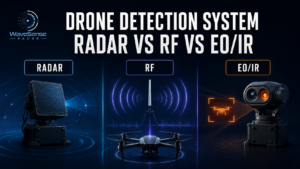
AESA Radar Vs RF Drone Detection
The technologies detect different things.
AESA Radar
Detects the physical target and estimates position and motion.
RF Detection
Searches for radio emissions associated with UAV communication.
An autonomous drone without an active control link can remain visible to radar.
RF sensing can provide additional information when a detectable communication signal exists.
Multi-sensor systems therefore often combine both.
AESA Radar Vs EO/IR
AESA radar provides wide-area radio-frequency surveillance.
EO/IR systems provide visual or thermal imagery.
A common workflow is:
AESA Detects → Radar Tracks → Camera Slews → Target Is Visually Confirmed
Accurate radar position data improves camera cueing.
This makes track quality and angular accuracy important even when radar classification is not perfect.
Why Does Radar Accuracy Matter For Camera Cueing?
A long-range camera normally has a narrow field of view when zoomed toward a small UAV.
If radar coordinates contain large angular uncertainty, the target may fall outside that field of view.
Accurate 3D tracks can allow the camera to acquire the object more quickly.
Therefore, buyers should evaluate:
- Range accuracy
- Azimuth accuracy
- Elevation accuracy
in addition to detection range.
Is Detection Range The Most Important AESA Specification?
No.
Maximum range is only one part of system performance.
A professional comparison should also evaluate:
| Parameter | Why It Matters |
|---|---|
| Target RCS | Defines target difficulty |
| Tracking Range | Shows usable surveillance |
| Classification Range | Shows target understanding |
| Azimuth Coverage | Defines horizontal sector |
| Elevation Coverage | Defines vertical sector |
| Scan Loss | Shows edge-of-sector performance |
| Angular Accuracy | Supports precise tracking |
| Update Rate | Supports maneuvering UAVs |
| Track Capacity | Supports dense airspace |
| Latency | Affects response time |
| False Alarm Performance | Affects usability |
| SWaP | Affects deployment |
AESA architecture should never replace these measurable performance specifications.
What Questions Should You Ask An AESA Radar Manufacturer?
Is The Radar Fully AESA Or A Hybrid Architecture?
Ask how the active array and RF channels are organized.
Is Beamforming Analog, Hybrid, Or Digital?
Do not assume AESA automatically means fully digital beamforming.
How Many Independent Receive Channels Are Available?
This affects signal-processing flexibility.
What Is The Electronic Scan Sector?
Ask for both azimuth and elevation coverage.
How Does Detection Range Change At Maximum Scan Angle?
This exposes scan-loss performance.
What Is The Track Update Rate At Maximum Track Load?
Maximum track count alone is insufficient.
What Target RCS Was Used For Range Testing?
The test target must be defined.
Can It Track Hovering UAVs?
Low-velocity performance should be demonstrated.
Does It Support Micro-Doppler Classification?
Request actual classification results.
What Is The Radar’s Power And Cooling Requirement?
This determines deployment practicality.
What Information Is Missing From Many AESA Datasheets?
Many AESA pages emphasize:
- Electronic scanning
- High target capacity
- Long range
- Fast tracking
But procurement teams often still need:
- Scan-loss data
- Edge-of-sector range
- Beamwidth
- Angular accuracy
- Track update rate
- Classification range
- Target RCS
- Latency
- Failed-module tolerance
- Power consumption
These parameters make an AESA specification much more meaningful.
Why Is “AESA Radar” Not A Performance Specification?
AESA describes radar architecture.
It does not guarantee one fixed level of:
- Range
- Resolution
- Accuracy
- Classification
- Update rate
A compact short-range AESA and a large long-range AESA can use the same basic architecture while providing completely different performance.
Therefore, procurement should define mission requirements first and antenna technology second.
How Should AESA Radar Be Field-Tested?
Testing should use representative UAVs and realistic flight profiles.
Useful scenarios include:
- Low-altitude approaches
- Hovering
- Crossing targets
- Multiple UAVs
- Sector-edge targets
- Different altitudes
- Different headings
- Real ground clutter
Testing only a large UAV flying near the array boresight can exaggerate practical coverage.
Why Should Sector-Edge Testing Be Included?
Electronic scan performance can change as the beam moves farther from boresight.
A proper acceptance test should therefore fly the same representative UAV through:
- Sector center
- Intermediate scan angles
- Sector edge
Then compare:
- Detection distance
- Track stability
- Accuracy
- Update quality
This is one of the best ways to verify whether advertised coverage is genuinely useful.
Why Should Multiple Drones Be Tested?
AESA’s beam agility is frequently promoted as a multi-target advantage.
That capability should be demonstrated under realistic target load.
A field test can compare:
- 1 UAV
- Several UAVs
- Dense targets
- Crossing tracks
The evaluator should check whether update rate, latency, track stability, and classification quality change as target count increases.
Should Hovering UAVs Be Included?
Yes.
A Counter-UAS radar should demonstrate performance against targets with very low translational velocity.
Hovering drones can approach the stationary-clutter region.
If micro-Doppler classification is advertised, the manufacturer should demonstrate that rotor information remains usable under representative range and aspect conditions.
AESA Radar For Airports
Airports benefit from accurate low-altitude surveillance because UAV targets may appear alongside:
- Birds
- Aircraft
- Vehicles
- Buildings
AESA can provide flexible target revisits and precise 3D tracking.
However, airport deployments must also consider interference, installation geometry, false alarms, and regulatory requirements.
Radar architecture alone cannot solve the complete airport drone problem.
AESA Radar For Critical Infrastructure
Critical infrastructure may require persistent surveillance around:
- Power plants
- Refineries
- Ports
- Communication facilities
- Industrial complexes
AESA radar can provide rapid electronic surveillance within defined sectors.
Complex sites may require multiple radar positions because buildings and industrial structures can create physical blind zones that electronic beam steering cannot remove.
AESA Radar For Border Surveillance
Border environments may benefit from electronically controlled sector surveillance where targets can appear across a wide area.
Radar requirements may prioritize:
- Long range
- High elevation coverage
- Multiple targets
- Low false alarms
However, terrain masking can remain a major limitation.
Several distributed sensors may provide more useful coverage than one radar located at a single position.
What Are The Main Limitations Of AESA Radar?
AESA provides powerful architectural advantages, but it still faces limitations.
Important challenges include:
- Higher hardware complexity
- Cooling requirements
- Calibration
- Power consumption
- Cost
- Scan loss
- Finite radar resources
- Physical obstruction
Electronic beam steering cannot overcome every problem created by terrain, weak RCS, or insufficient signal quality.
Can AESA See Through Buildings?
No, not in the general sense implied by that phrase.
Electronic steering changes where the radar beam points.
It does not automatically eliminate physical obstruction.
Buildings can still:
- Block targets
- Create multipath
- Produce clutter
Specialized NLOS sensing methods exist, but they should not be confused with normal AESA surveillance performance.
Can AESA Eliminate Radar Blind Zones?
No.
Blind zones can still result from:
- Terrain
- Buildings
- Antenna placement
- Elevation limits
- Minimum range
- Sector boundaries
Electronic steering can improve coverage flexibility inside the available field of view, but it cannot directly observe every physically obstructed location.
Site planning remains essential.
Does AI Make AESA Radar Better?
AI can improve selected processing functions such as:
- Target classification
- Clutter analysis
- Track behavior analysis
- Sensor fusion
However, AI does not change the fundamental electromagnetic information captured by the antenna.
Weak sensing cannot always be repaired by software.
The strongest system combines high-quality RF hardware, signal processing, tracking, classification, and site engineering.
AESA Radar Vs Low-Altitude Surveillance Radar
These terms describe different things.
AESA Radar describes an antenna and radar architecture.
Low-Altitude Surveillance Radar describes a surveillance mission.
A low-altitude radar may use:
- AESA
- PESA
- Mechanical scanning
- MIMO
- Other architectures
Likewise, AESA radar can be used for many missions beyond low-altitude UAV surveillance.
AESA Radar Vs Counter-UAS Radar
Counter-UAS Radar describes radar optimized to detect and track unmanned aircraft threats.
AESA describes one possible hardware architecture used to achieve that mission.
Therefore:
Not every AESA is a Counter-UAS radar.
and:
Not every Counter-UAS radar is AESA.
The distinction prevents buyers from choosing radar based on architecture alone.
How To Choose An AESA Radar For Drone Detection
Start with the threat and deployment requirement.
Define:
- Smallest expected UAV or RCS.
- Required detection distance.
- Required warning time.
- Lowest flight altitude.
- Horizontal coverage.
- Vertical coverage.
- Maximum target density.
- Required update rate.
- Classification requirement.
- Site clutter and obstacles.
Then evaluate whether AESA provides the appropriate architecture.
What Is A Better AESA Procurement Specification?
Instead of:
“The radar shall use AESA technology.”
use a measurable requirement such as:
“The radar shall demonstrate the required probability of detection, stable tracking, angular accuracy, update rate, and classification performance against the defined UAV or RCS across the required azimuth and elevation coverage.”
AESA can then be specified separately when its architecture is genuinely required.
This prevents a technology label from replacing actual performance requirements.
Future Of AESA Radar For Drone Detection
The next stage of AESA development is moving toward more software-defined and digitally controlled sensing.
Important trends include:
- Digital beamforming
- GaN T/R modules
- Multi-panel arrays
- Distributed radar networks
- Adaptive radar scheduling
- AI-assisted classification
- Multi-sensor fusion
- Higher-resolution tracking
Modern radar development increasingly combines electronically steerable arrays with flexible digital processing rather than treating the antenna as an isolated component.
Will Fully Digital Arrays Replace Traditional AESA?
Digital arrays provide greater processing flexibility, but they also increase:
- Converter count
- Data rates
- Processing requirements
- Power demand
- Cost
Hybrid systems can remain attractive where full element-level digital processing is unnecessary.
Future radar architectures will therefore continue to balance digital flexibility against practical SWaP and cost requirements rather than converging on one universal design.
Conclusion
AESA Radar is valuable for drone detection because electronic beam steering allows radar resources to move rapidly between search, tracking, and priority-target measurements, but AESA architecture alone does not guarantee long range, high resolution, or reliable UAV classification.
Real performance depends on antenna aperture, T/R modules, frequency, beamforming architecture, scan angle, receiver sensitivity, waveform, clutter processing, tracking software, and target RCS.
Buyers should therefore evaluate scan loss, edge-of-sector detection range, track update rate, angular accuracy, stable track capacity, classification performance, SWaP, and real field-test results instead of choosing equipment only because the datasheet says “AESA.”
FAQ
What Does AESA Mean In Radar?
AESA means Active Electronically Scanned Array. It uses an active array architecture and electronically controls radar beam direction.
Is AESA The Same As Phased Array Radar?
No.
AESA is a type of phased-array radar. PESA is another electronically scanned phased-array architecture.
What Is The Difference Between AESA And PESA?
Traditional PESA architectures use a centralized RF source feeding an electronically steered passive array, while AESA distributes active transmit/receive electronics across the antenna.
Does AESA Radar Need To Rotate?
Not necessarily.
A fixed AESA can scan electronically within its sector, while other systems mount AESA panels on rotating structures.
Can One AESA Cover 360 Degrees?
Not automatically.
Full 360° coverage may require several fixed panels or mechanical rotation.
Why Is AESA Good For Drone Detection?
Electronic beam steering enables flexible target revisits, multi-target tracking, and adaptive radar resource allocation.
Can AESA Detect Small Drones?
Yes, when the radar has sufficient sensitivity and appropriate signal processing.
AESA itself does not guarantee a particular small-drone detection range.
Does AESA Have Better Detection Range?
Not automatically.
Range depends on antenna gain, power, receiver sensitivity, waveform, target RCS, processing, clutter, and other factors.
What Is A T/R Module?
A T/R module is an active transmit/receive building block used in many AESA antennas for RF amplification, receiving, phase control, and related functions.
Does More T/R Modules Mean Longer Range?
Not necessarily.
Module count must be considered together with aperture, frequency, module power, receiver performance, beamforming, and radar processing.
What Is Digital Beamforming?
Digital beamforming uses multiple digitally controlled channels to form and steer antenna beams with greater flexibility.
Is Every AESA Fully Digital?
No.
AESA radars can use analog, hybrid, or digital beamforming architectures.
Can AESA Generate Multiple Beams?
Some AESA and digital-array architectures can form or process multiple beams, but practical beam count depends on RF channels and processing architecture.
Does AESA Performance Change At Large Scan Angles?
Yes.
Planar arrays can experience scan loss and changes in beam characteristics as the beam moves away from boresight.
Is AESA Better Than Mechanical Radar?
It provides significant advantages for rapid beam steering and flexible multifunction surveillance, but mechanical radar may remain suitable for simpler or lower-cost applications.
Can AESA Detect Drone Swarms?
Yes, suitable systems can support multi-target surveillance, but dense-swarm performance also depends on resolution, tracking algorithms, update rate, and processing capacity.
Can AESA Detect RF-Silent Drones?
Yes.
Radar detects physical objects and does not require the UAV to transmit a radio signal.
Can AESA Distinguish Birds From Drones?
AESA can provide radar measurements used by classification algorithms, but bird-versus-drone discrimination depends on features such as micro-Doppler, RCS, trajectory, and software.
What Is The Most Important AESA Specification?
There is no single specification.
Target-specific detection performance, tracking accuracy, scan coverage, update rate, scan loss, latency, target capacity, and false-alarm performance should be evaluated together.