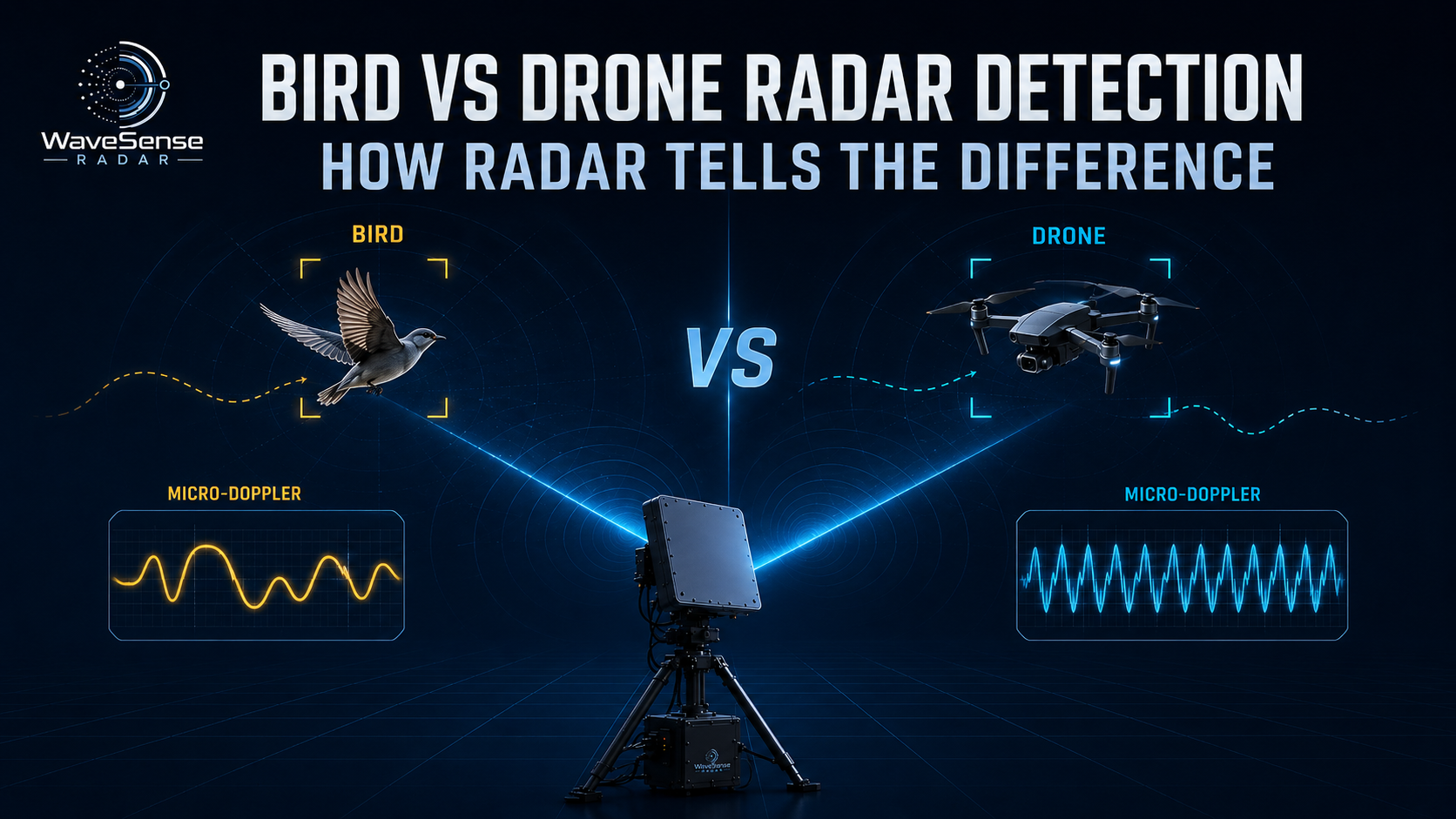
Bird Vs Drone Radar Detection: Can Radar Really Tell The Difference?
Yes, modern radar can distinguish many birds from drones by combining micro-Doppler signatures, radar cross section, speed, trajectory, acceleration, flight behavior, and AI-based target classification instead of relying on one radar feature alone.
The problem is difficult because small birds and commercial UAVs can occupy similar airspace and produce overlapping radar characteristics.
Reliable classification therefore requires more than detecting that “something is flying.”
Why Do Birds And Drones Look Similar To Radar?
Small birds and consumer drones can have similar apparent size, speed, altitude, and radar cross section.
Both may:
- Fly below 150 meters
- Hover or move slowly
- Change direction rapidly
- Produce weak radar returns
- Operate close to ground clutter
This makes conventional threshold-based classification unreliable.
Research has specifically identified overlapping RCS and velocity as major reasons drone-bird discrimination is difficult.
Why Can’t Radar Cross Section Alone Distinguish Birds From Drones?
Radar Cross Section, or RCS, measures how strongly a target reflects radar energy.
A small UAV and a bird can sometimes produce similar RCS values.
Therefore:
Small RCS ≠ Bird
and:
Large RCS ≠ Drone
RCS should be treated as one feature among several.
For a deeper explanation of how UAV radar signatures change with frequency, angle, and configuration, see our Radar Cross Section Of A Drone guide.
What Is Micro-Doppler?
Micro-Doppler describes small frequency shifts generated by moving parts within a target.
For a multirotor drone, these movements mainly come from rapidly rotating propellers.
For a bird, they mainly come from:
- Wingbeats
- Body movement
- Wing extension
- Wing retraction
These movements create different patterns in a radar spectrogram.
Experimental K-band and W-band measurements have demonstrated distinctive drone and bird micro-Doppler signatures. Read the original Scientific Reports study.
Drone Propellers Vs Bird Wings
A drone’s propellers usually rotate much faster than bird wings flap.
This produces different Doppler structures.
Drone
Typical features may include:
- Rapid periodic modulation
- Rotor blade signatures
- Multiple rotating components
- High-frequency micro-motion
Bird
Typical features may include:
- Slower wingbeat cycles
- Flapping patterns
- Strong periodic body-wing interaction
- More irregular biological movement
Radar software can analyze these differences to improve classification.
Why Is Micro-Doppler Better Than RCS Alone?
RCS mainly answers:
How strongly is the object reflecting?
Micro-Doppler helps answer:
What is moving inside or around the object?
That distinction is extremely useful.
A bird and drone might reflect similar signal strength, yet their wing and rotor movements can produce different time-frequency signatures.
This gives the classifier another independent source of information.
What Does A Drone Micro-Doppler Signature Look Like?
A multirotor UAV can generate repeated patterns associated with its rotating blades.
The exact signature depends on:
- Number of rotors
- Blade length
- Rotation speed
- Radar frequency
- Viewing angle
- Drone orientation
Therefore, there is no universal “drone pattern.”
Different UAV models can produce different signatures.
What Does A Bird Micro-Doppler Signature Look Like?
Bird signatures are influenced by wing motion.
During flight, a bird repeatedly changes the radial velocity of different parts of its wings.
The resulting radar return can contain periodic Doppler components.
Bird size, species, flight style, wingbeat frequency, and orientation all influence the pattern.
This creates significant variation within the bird category itself.
Can A Large Bird Look Like A Drone?
Yes.
A large bird can produce:
- Similar RCS
- Similar speed
- Similar altitude
- Similar track length
to some UAVs.
This is why simple rules such as:
“Slow + small = drone”
are unreliable.
A professional Bird Drone Classification system should analyze multiple features before assigning a target class.
Can A Small Bird Look Like A Mini Drone?
Yes.
Small birds and compact UAVs represent one of the most difficult classification cases.
Their reflected signal may be weak, while measurement quality decreases at longer distances.
Low signal-to-noise ratio can make micro-Doppler features harder to extract.
A 2026 study showed that drone-bird classifiers degraded as signal and phase noise increased, even though some engineered features remained more robust than others.
Why Does Signal-To-Noise Ratio Matter?
Signal-To-Noise Ratio, or SNR, describes how strong the target signal is relative to background noise.
High SNR provides clearer information.
Low SNR makes classification more difficult.
At long range, the radar may detect an object but not receive enough detailed information for confident classification.
Therefore:
Detection range and classification range should not automatically be treated as identical.
Detection Vs Classification
Radar detection asks:
Is an airborne target present?
Classification asks:
What type of airborne target is it?
The radar may detect something at long range but classify it only after:
- The target approaches
- More measurements are collected
- SNR improves
- Micro-Doppler becomes visible
- Track history develops
This is an important distinction when evaluating surveillance systems.
Tracking Vs Identification
Tracking determines:
- Position
- Speed
- Direction
- Trajectory
Identification tries to determine what the target actually is.
A stable radar track does not automatically mean the system knows whether the object is a:
- Drone
- Bird
- Helicopter
- Aircraft
- Unknown target
Classification confidence should therefore be reported separately.
What Features Can Radar Use To Separate Birds From Drones?
A modern classifier may evaluate:
Radar Cross Section
Provides target-reflectivity information.
Micro-Doppler
Reveals rotor or wing movement.
Velocity
Measures target speed.
Acceleration
Shows changes in movement.
Trajectory
Describes flight path.
Altitude
Provides vertical behavior.
Track Smoothness
Measures how movement changes over time.
Target Persistence
Shows how long the object remains detectable.
Combining these features creates stronger classification than using one measurement alone.
Can Flight Behavior Help Identify A Drone?
Yes.
Flight behavior can provide useful contextual information.
A drone may:
- Hover
- Move along straight lines
- Stop suddenly
- Maintain precise altitude
- Follow programmed routes
- Repeatedly inspect one area
Bird movement can be more irregular.
However, behavior alone is not sufficient because birds can glide and drones can fly unpredictably.
Can A Bird Hover Like A Drone?
Some birds can maintain nearly stationary flight for short periods.
Wind conditions can also make a bird appear almost stationary relative to the ground.
Therefore:
Hovering ≠ Drone
A classification system should examine rotor or wing micro-motion and other radar characteristics before making a decision.
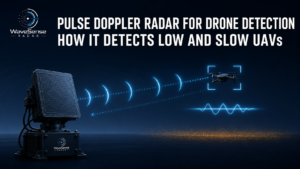
Can Radar Detect A Hovering Drone?
Yes.
A hovering drone presents an interesting radar problem because its body may have almost zero radial velocity.
However, its propellers continue rotating.
These rotating components can generate micro-Doppler features even when the drone itself is stationary.
Weibel states that its drone-detection architecture uses rotor micro-Doppler to distinguish hovering UAVs from clutter.
Why Are Hovering Drones Difficult For Traditional Radar?
Many traditional moving-target detection algorithms rely partly on target velocity.
Stationary objects are often suppressed because they are assumed to be clutter.
A hovering drone can therefore approach the clutter region.
Purpose-built UAV radar must detect:
Low speed + weak RCS + rotor micro-motion
without creating excessive false alarms from stationary surroundings.
Can Radar Distinguish A Fixed-Wing Drone From A Bird?
This can be more difficult than identifying a multirotor drone.
A fixed-wing UAV may not generate the same strong multi-rotor signatures.
Classification may therefore rely more heavily on:
- RCS
- Propeller characteristics
- Speed
- Trajectory
- Acceleration
- Flight persistence
This demonstrates why micro-Doppler should not be the only classification feature.
What About Gliding Birds?
Gliding birds can temporarily generate weaker wingbeat signatures because their wings are not actively flapping.
During this period, bird-vs-drone classification may become more difficult.
The radar may need to use:
- Track history
- Previous wingbeat observations
- Speed
- Trajectory
- RCS variation
before assigning a stable class.
This is another reason classification should be temporal rather than based on one radar frame.
Why Does Observation Time Matter?
One radar measurement provides limited information.
A longer observation window allows the system to collect:
- Multiple wingbeat cycles
- Rotor modulation
- Speed changes
- RCS fluctuations
- Turning behavior
- Track history
Classification can improve as more evidence becomes available.
However, longer observation time also increases decision latency.
Radar designers must balance speed and confidence.
What Is Classification Confidence?
Modern AI systems often assign a confidence score rather than making a simple binary decision.
For example:
Drone: 92%
Bird: 6%
Unknown: 2%
Another target may produce:
Drone: 52%
Bird: 45%
That second target should probably remain uncertain rather than automatically triggering a high-priority threat alert.
Why Is An Unknown Class Important?
A classifier should not be forced to label every target as either bird or drone.
Real airspace can contain:
- Balloons
- Aircraft
- Insects
- Debris
- Helicopters
- Unknown objects
An Unknown category allows the system to avoid false certainty.
This is particularly important for security applications.
How Does AI Improve Bird Drone Classification?
AI can analyze combinations of radar features that are difficult to separate using simple thresholds.
Machine-learning models may process:
- Spectrograms
- RCS sequences
- Doppler features
- Track characteristics
- Velocity profiles
Deep neural networks can learn complex patterns from labeled drone and bird datasets.
Robin Radar, for example, describes combining micro-Doppler information with DNN processing for classification.
Does AI Automatically Make Radar Accurate?
No.
AI performance depends heavily on training data.
A model trained on:
- Three drone models
- Two bird species
- Clear weather
- Open terrain
may not perform equally well against:
- New UAV designs
- Large bird populations
- Urban clutter
- Long-range targets
- Different radar hardware
AI accuracy should therefore be validated under representative conditions.
Why Is Training Dataset Diversity Important?
A classifier needs enough examples to understand natural variation.
A strong dataset should contain:
- Multiple drone models
- Multiple bird species
- Different target angles
- Different ranges
- Different speeds
- Different weather
- Different SNR
- Different flight behaviors
Otherwise, the model may memorize limited examples instead of learning robust distinctions.
Can Published 95% Or 99% Accuracy Be Trusted?
The number may be valid for the stated experiment, but it should not automatically be treated as field performance.
For example, one CNN-based radar study reported high validation and test accuracy on its specific drone/bird dataset.
The important questions are:
- What targets were tested?
- How large was the dataset?
- Was unseen data used?
- What SNR was tested?
- Was the test indoor or outdoor?
- Were new bird species included?
Laboratory Accuracy Vs Real-World Accuracy
Laboratory experiments control many variables.
Real sites contain:
- Trees
- Buildings
- Vehicles
- Rain
- Birds
- RF interference
- Ground clutter
- Multiple simultaneous targets
A classification model that performs extremely well on clean experimental data may experience lower confidence in operational conditions.
Field acceptance testing is therefore essential.
Why Is Radar Frequency Important For Bird Drone Classification?
Different frequencies interact differently with target structures.
Radar frequency affects:
- Target RCS
- Rotor visibility
- Wing signatures
- Resolution
- Propagation
- Antenna size
Experiments have compared drone and bird micro-Doppler at K-band and W-band and observed useful signatures at both frequencies.
There is no universal frequency that is automatically best for every project.
Can FMCW Radar Classify Birds And Drones?
Yes.
FMCW Radar can provide range and Doppler information useful for target analysis.
Researchers have used FMCW radar to collect micro-motion signatures from several rotor drones and birds and develop classification methods.
Actual performance depends on radar design, bandwidth, antenna, processing, target range, and environmental conditions.
What Is A Radar Spectrogram?
A radar spectrogram shows how Doppler energy changes over time and frequency.
Instead of looking only at target velocity, engineers can examine detailed movement patterns.
In a drone-bird classifier, spectrograms may reveal:
- Rotor modulation
- Wingbeat cycles
- Periodic motion
- Doppler spread
These images can then be analyzed by algorithms or neural networks.
Why Do CNNs Work Well With Micro-Doppler Spectrograms?
A spectrogram behaves somewhat like an image.
Convolutional Neural Networks, or CNNs, are effective at finding spatial patterns in image-like data.
Researchers can train a CNN to recognize differences between:
- Drone rotor structures
- Bird wingbeat structures
- Clutter
- Noise
This converts radar signal classification into an image-pattern recognition problem.
Can Radar Identify The Drone Model?
Potentially.
Micro-Doppler signatures can contain information about:
- Rotor number
- Rotation speed
- Blade configuration
- Airframe behavior
Research is moving beyond “drone or bird” toward classification between different UAV types.
However, reliable model-level identification requires larger and more representative datasets than basic drone detection.
Can Radar Count Drone Propellers?
In some conditions, rotor modulation contains information related to propeller configuration.
However, extracting blade count becomes harder when:
- Range increases
- SNR decreases
- Target orientation changes
- Several rotors overlap
- Radar resolution is limited
Propeller-count estimation should therefore be treated as an advanced classification capability rather than a guaranteed feature.
Can Radar Tell A Quadrotor From A Fixed-Wing UAV?
Potentially.
The two platforms have different:
- Propulsion systems
- Micro-motion
- Flight speeds
- Maneuverability
- Trajectories
A classifier can combine these differences.
However, radar should ideally use multiple features because some fixed-wing UAVs may present signatures closer to birds than multirotor drones do.
What Happens When Several Birds Fly Together?
A bird flock can create a complicated radar scene.
Multiple targets may:
- Merge in resolution cells
- Cross tracks
- Produce overlapping Doppler signatures
- Create many simultaneous detections
This can increase the difficulty of target counting and classification.
Radar resolution and multi-target tracking therefore become important.
Can A Flock Of Birds Be Mistaken For A Drone Swarm?
Potentially, especially if classification relies mainly on target count or RCS.
A professional swarm-detection system should distinguish between:
- Number of tracks
- Flight coordination
- Micro-Doppler
- Target spacing
- Trajectory behavior
A flock and a coordinated UAV swarm can both create dense aerial activity, but their detailed signatures may differ.
What Is Bird Clutter?
Bird clutter describes radar detections created by birds that are irrelevant to the security mission.
At some sites, bird activity can be extremely high.
Examples include:
- Airports
- Wetlands
- Ports
- Coastal facilities
- Agricultural areas
- Waste-management sites
Without effective classification, these targets can overwhelm operators with alerts.
Why Are Airports A Difficult Environment?
Airports contain many legitimate airborne and ground targets.
Radar may encounter:
- Birds
- Aircraft
- Service vehicles
- Buildings
- Ground equipment
- Unauthorized drones
Bird populations can also change seasonally.
A counter-UAS system must therefore distinguish drone threats without interfering with normal airport operations.
Why Does Bird Migration Matter?
Bird activity can change dramatically by:
- Season
- Time of day
- Weather
- Location
A radar system installed during a low-bird-activity period may perform differently during migration season.
This means bird-drone classification should ideally be tested across representative environmental conditions rather than during one short demonstration.
Why Is False Alarm Reduction So Important?
The purpose of classification is not merely academic.
Every false drone alarm can create:
- Operator workload
- Camera slews
- Security responses
- Investigation time
- Alert fatigue
If operators receive too many false alarms, genuine threats may receive less attention.
False alarm reduction is therefore a core operational requirement.
False Positive Vs False Negative
A false positive occurs when a bird is classified as a drone.
A false negative occurs when a drone is classified as a bird or harmless object.
Both matter.
Excessive false positives reduce usability.
Excessive false negatives reduce security.
A good classifier must balance both rather than optimizing only one metric.
Why Is Classification Accuracy Alone Not Enough?
Suppose 95% of all airborne targets are birds.
A classifier can achieve high overall accuracy simply by labeling most objects as birds.
Better performance metrics include:
- Precision
- Recall
- F1 score
- Confusion matrix
- False positive rate
- False negative rate
These statistics provide a clearer picture of operational performance.
What Is A Confusion Matrix?
A confusion matrix shows how often each target class is classified correctly or incorrectly.
For example:
| Actual Target | Classified Drone | Classified Bird |
|---|---|---|
| Drone | 92 | 8 |
| Bird | 5 | 95 |
This format immediately reveals both missed drones and false drone alarms.
Buyers should request confusion-matrix results when evaluating AI classification.
Why Should Buyers Ask About Unseen Targets?
A classifier may perform extremely well on target models included in its training dataset.
The harder test is:
Can it correctly classify a drone or bird type it has never seen before?
This measures generalization.
For real deployments, unknown targets are unavoidable.
Therefore, unseen-target testing is more valuable than simply repeating familiar training examples.
Can Weather Affect Bird Drone Classification?
Yes.
Weather can influence:
- Radar propagation
- Target SNR
- Bird behavior
- Drone stability
- Background clutter
Rain may also create additional radar returns depending on frequency.
Classification performance should therefore be validated under the environmental conditions expected at the deployment site.
Does Wind Change Classification?
Wind can alter both bird and drone behavior.
Birds may:
- Glide
- Hover relative to the ground
- Change wingbeat patterns
Drones may:
- Tilt
- Increase rotor speed
- Correct position continuously
These changes affect radar signatures.
A classifier trained only under calm conditions may not represent every operational scenario.
Does Distance Reduce Bird Drone Classification Accuracy?
It can.
As range increases, received target energy usually decreases.
Weaker SNR can make:
- Rotor signatures
- Wingbeats
- RCS fluctuations
harder to measure.
A system may therefore maintain a track at distances where detailed classification becomes uncertain.
This is why procurement documents should distinguish detection range, tracking range, and classification range.
Can Radar Classify A Drone Immediately After Detection?
Not always.
The first radar return may contain insufficient information.
The system may initially label the target:
Unknown
After several observations, it can collect:
- Doppler history
- Micro-Doppler
- Trajectory
- RCS variation
and update the classification.
This approach is often safer than producing an immediate low-confidence decision.
Can Radar Classification Change During A Track?
Yes.
A target might initially appear as:
Unknown
then become:
Probable Drone
and later:
Confirmed Drone
as more information becomes available.
Likewise, an initial drone classification may later be corrected to bird.
Classification should therefore be treated as a continuously updated estimate.
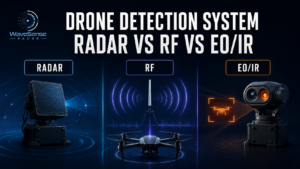
Why Combine Radar With EO/IR?
Radar can find targets across large airspace.
EO/IR systems can provide visual confirmation.
A common sensor workflow is:
Radar Detection → Classification → Camera Cueing → Visual Confirmation
This reduces dependence on automatic radar classification alone.
It is particularly useful for ambiguous bird-versus-drone cases.
Why Combine Radar With RF Detection?
Radar detects the physical target.
RF sensors analyze radio transmissions.
If radar detects a low-altitude object and RF equipment simultaneously detects a drone communication link from the same area, classification confidence can increase.
RF sensing cannot detect every autonomous or silent UAV, so radar remains an important independent layer.
What Is Multi-Sensor Classification?
Multi-Sensor Classification combines information from several technologies.
For example:
Radar: Position + speed + micro-Doppler
RF: Communication signal
EO/IR: Visual appearance
Software: Track correlation
Combining independent evidence can improve confidence and reduce reliance on one sensor.
How Does Drone Detection Radar Use Classification?
A purpose-built Drone Detection Radar does more than report a moving object.
Modern systems can combine:
- Detection
- Tracking
- RCS analysis
- Micro-Doppler
- Classification algorithms
to create a more useful airspace picture.
This is particularly important in environments with high bird activity.
Can Traditional Air Surveillance Radar Do This?
Traditional radar may detect many aerial objects but may not be optimized for small-UAV classification.
Purpose-built systems usually require stronger capabilities for:
- Low-RCS targets
- Low-speed targets
- Ground clutter
- Hovering UAVs
- Micro-Doppler analysis
Hardware and software must both support the intended mission.
What Should A Radar Manufacturer Provide?
When evaluating Bird Drone Classification, buyers should request more than a statement such as:
“AI classification supported.”
Ask for:
- Tested drone models
- Tested bird types
- Target ranges
- Target altitudes
- Classification range
- Confusion matrix
- False positive rate
- False negative rate
- SNR conditions
- Dataset description
Without these details, accuracy percentages can be difficult to interpret.
How Should Bird Drone Classification Be Field-Tested?
A useful acceptance test should include:
Multiple Drone Types
Test different UAV sizes and architectures.
Real Birds
Evaluate actual local bird activity where possible.
Different Ranges
Include near, medium, and difficult long-range targets.
Hovering
Test stationary multirotor UAVs.
Crossing Tracks
Create complex trajectories.
Low Altitude
Include ground-clutter conditions.
Unseen UAVs
Use models not included in the demonstration dataset.
This produces a more realistic classification assessment.
Should Buyers Accept A “99% Classification Accuracy” Claim?
Only after understanding how it was measured.
Ask:
99% of what?
Was it:
- Laboratory data?
- Field data?
- Known targets?
- Unknown targets?
- Balanced classes?
- High-SNR measurements?
- One drone model?
- Multiple bird species?
Without this context, the percentage provides limited procurement value.
What Is A Better Radar Specification?
Instead of writing:
“Radar must distinguish drones from birds.”
use a more measurable requirement:
“The system shall demonstrate drone-versus-bird classification under representative range, altitude, clutter, and SNR conditions, with defined false-positive and false-negative performance.”
This makes acceptance testing much easier.
What Is The Biggest Mistake In Bird Vs Drone Radar Detection?
The biggest mistake is searching for one perfect feature.
There is no universal rule such as:
RCS = drone
Hover = drone
Slow target = bird
Micro-Doppler = always correct
Reliable classification comes from combining evidence across time.
That is why modern systems increasingly use multi-feature processing and machine learning.
Future Of Bird Drone Classification
Future systems will increasingly combine:
- Micro-Doppler
- Dynamic RCS
- AI classification
- Track behavior
- Polarimetric radar
- Multi-frequency sensing
- EO/IR
- RF detection
- Multi-radar networks
Recent 2026 research continues to investigate both new model architectures and more noise-robust radar features for bird-versus-UAV discrimination.
The direction is moving from simple detection toward confidence-based target understanding.
Conclusion
Bird Vs Drone Radar Detection works best when radar combines micro-Doppler, RCS, speed, trajectory, flight behavior, signal quality, and AI classification instead of relying on any single target feature.
Birds remain a major challenge because their size, velocity, altitude, and RCS can overlap with small UAVs.
Micro-Doppler provides valuable information by separating rotor motion from wing motion, but its effectiveness can decline at low SNR or difficult target aspects.
For real projects, buyers should evaluate classification range, false positives, false negatives, unseen-target performance, local bird activity, and field-test conditions, not just a headline accuracy percentage.
FAQ
Can Radar Tell The Difference Between A Bird And A Drone?
Yes.
Advanced radar can combine micro-Doppler, RCS, trajectory, velocity, and machine-learning classification to distinguish many drones from birds.
Why Do Birds Cause False Drone Alarms?
Birds can have similar size, RCS, speed, and altitude to small UAVs.
Without good classification, radar may treat them as potential drone targets.
What Is The Best Radar Feature For Drone Vs Bird Classification?
There is no single best feature.
Micro-Doppler is extremely useful, but combining it with RCS, trajectory, speed, and track history provides stronger results.
What Is The Difference Between Bird Wing Micro-Doppler And Drone Rotor Micro-Doppler?
Birds produce signatures mainly from wing flapping, while multirotor drones generate faster periodic modulation from rotating propellers.
Can A Hovering Drone Be Detected?
Yes.
Its body may have little translational Doppler, but rotating propellers can generate detectable micro-Doppler.
Can A Gliding Bird Be Mistaken For A Drone?
Potentially.
When a bird stops flapping, some distinctive wing signatures may temporarily weaken.
Track history and other radar features become more important.
Can A Bird Flock Look Like A Drone Swarm?
It can create a similar multi-target situation.
High-resolution tracking, micro-Doppler, trajectory analysis, and classification are needed to separate the two.
Does AI Improve Drone Bird Classification?
Yes, but performance depends strongly on training data, radar quality, SNR, environmental conditions, and whether the target types were represented during training.
Is 99% Drone Classification Accuracy Realistic?
Such results may be achievable in specific datasets or controlled experiments, but the number should not automatically be interpreted as real-world performance at every site.
Does Classification Range Equal Detection Range?
No.
Radar may detect and track an object before receiving enough detailed information to classify it confidently.
Should Radar Be Combined With Cameras?
For many high-security applications, yes.
Radar provides wide-area detection and tracking, while EO/IR cameras provide visual confirmation.
How Can Buyers Verify Bird Drone Classification?
Request representative field testing with multiple drone models, real bird activity, different ranges, low-altitude flight, hovering targets, and clearly reported false-positive and false-negative results.