What Is Drone Detection Radar?
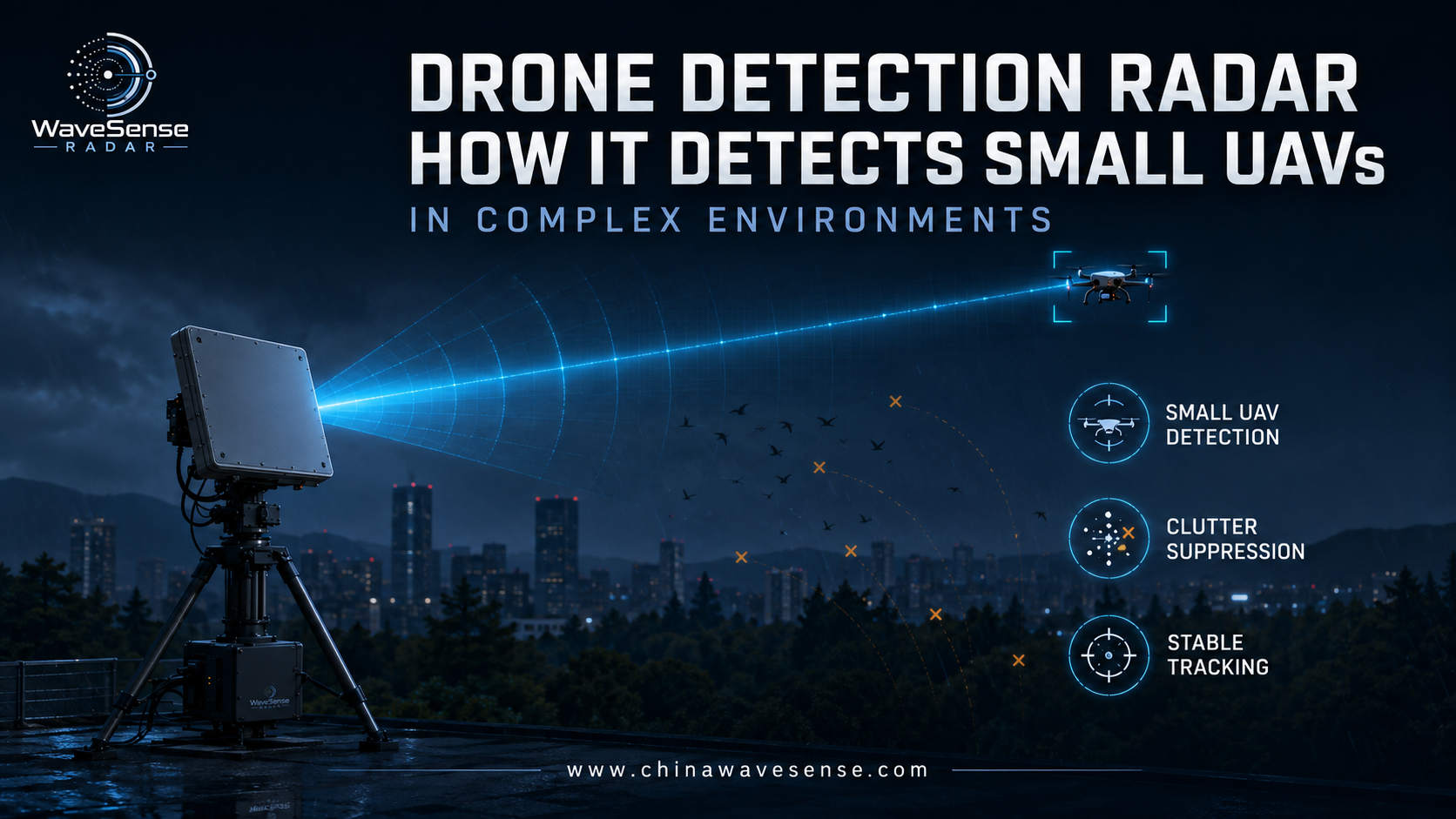
Unlike conventional air-surveillance radar, a drone radar must detect targets that are small, slow, low-flying, and sometimes almost stationary.
This makes reliable small-UAV detection a signal-processing challenge rather than simply a question of transmitter power.
How Does Drone Detection Radar Work?
A radar transmits electromagnetic energy toward a surveillance area.
When the energy reaches a drone, part of the signal reflects toward the radar receiver.
The system analyzes the return to estimate:
- Range
- Direction
- Speed
- Position
- Flight trajectory
Advanced systems also extract target features that support drone classification.
The FAA UAS Detection Technical Considerations explains several radar performance factors that should be evaluated when deploying UAS detection systems.
Why Are Small Drones Difficult For Radar To Detect?
Small drones present a difficult combination of low radar cross section, low altitude, low speed, and complex movement.
Many consumer UAVs contain plastic, composite materials, small motors, batteries, and limited metallic surfaces.
Their radar returns can therefore be much weaker than those from conventional aircraft.
Small drones also operate close to trees, buildings, vehicles, terrain, and other strong reflectors.
What Is Radar Cross Section?
Radar Cross Section, or RCS, describes how strongly an object reflects radar energy back toward the radar.
RCS is not simply the physical size of a drone.
It is influenced by:
- Material
- Geometry
- Orientation
- Radar frequency
- Observation angle
- Payload
- Rotor position
A drone can therefore present different radar signatures while turning or changing its orientation.
Why Does Drone RCS Matter?
A weak radar return reduces the distance at which a target can be detected reliably.
This makes RCS one of the most important factors when comparing drone detection specifications.
A manufacturer stating only:
“Drone Detection Range: 10 km”
does not provide enough information.
The tested drone or representative RCS should also be defined.
Can Two Similar-Sized Drones Have Different Radar Detection Ranges?
Yes.
Two UAVs with similar dimensions can produce different radar returns.
One drone may contain more conductive components or present a more reflective geometry.
Another may contain composite materials and produce weaker reflections.
Payload configuration can also change the target signature.
Physical dimensions alone should therefore never be used to predict radar detection distance.
What Makes A Drone Detection Radar Different From Traditional Radar?
Traditional surveillance radar often focuses on aircraft with relatively strong radar returns.
A Drone Detection Radar must work with much smaller targets surrounded by stronger background reflections.
Purpose-built systems therefore place greater emphasis on:
- High sensitivity
- Clutter suppression
- Low-speed detection
- Micro-Doppler analysis
- Automatic classification
- High update rates
These capabilities help extract small UAV targets from complex environments.
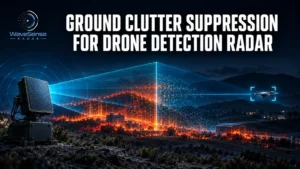
What Is Ground Clutter?
Ground clutter consists of unwanted radar reflections from the surrounding environment.
Typical sources include:
- Buildings
- Trees
- Terrain
- Vehicles
- Fences
- Towers
- Machinery
Low-flying drones can appear close to these reflections in radar data.
The radar must separate a weak airborne target from stronger background signals without creating excessive false alarms.
Experimental work with low-grazing-angle micro-UAV radar confirms that terrain clutter can significantly complicate small-UAV detection. See the research on micro-UAV detection in cluttered terrain.
Why Is Low-Altitude Drone Detection So Difficult?
Low-altitude targets often fly inside the strongest ground-clutter region.
A drone at 30 meters may be surrounded by returns from buildings, vegetation, vehicles, and terrain.
A drone at 300 meters may have a cleaner background.
This means detection performance changes with altitude even when the radar and drone remain identical.
How Does Radar Remove Ground Clutter?
Modern radar uses digital signal processing to separate targets from background returns.
Common approaches include:
- Doppler filtering
- Adaptive thresholding
- CFAR processing
- Track filtering
- Clutter maps
- Micro-Doppler analysis
These methods do not remove every unwanted reflection.
Their purpose is to increase the probability that meaningful moving targets can be separated from environmental noise.
What Is CFAR In Drone Detection Radar?
CFAR means Constant False Alarm Rate.
A CFAR detector continuously adjusts its detection threshold according to surrounding radar noise and clutter.
This prevents the radar from using one fixed threshold in every environment.
A threshold that works over open terrain may perform poorly near buildings.
Adaptive detection is therefore valuable for practical UAV surveillance.
Why Is False Alarm Rate Important?
A radar that detects everything is not automatically a good radar.
A security system may become difficult to operate if it produces excessive alerts from:
- Birds
- Vehicles
- Trees
- Machinery
- Weather
- Other moving objects
Professional evaluation should consider both probability of detection and false alarm performance.
The FAA specifically identifies clutter rejection and false detections as important considerations for UAS detection technologies.
What Is Probability Of Detection?
Probability of Detection, often written as Pd, describes how consistently a radar detects a target under defined conditions.
A radar detecting a drone once at 8 km does not prove reliable 8 km operational coverage.
A more meaningful test evaluates repeated flights.
The result should state how often the radar successfully detects the defined target.
What Is Probability Of False Alarm?
Probability of False Alarm, or Pfa, describes how often radar noise or clutter is incorrectly declared as a target.
Increasing sensitivity can improve weak-target detection.
However, excessive sensitivity may also increase false detections.
Radar design must therefore balance sensitivity and operational usability.
Why Should Buyers Ask For Pd And False Alarm Data?
Maximum range alone says little about reliability.
A better radar specification includes:
- Defined target
- Target RCS
- Detection distance
- Probability of detection
- False alarm criteria
- Target altitude
- Environmental conditions
These parameters allow two radar systems to be compared more fairly.
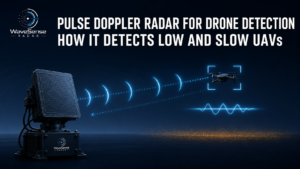
Can Drone Detection Radar Detect A Hovering Drone?
Yes, but hovering UAVs create a specific challenge.
A hovering drone may have almost zero translational velocity.
Traditional moving-target processing can therefore receive less Doppler information from the drone body.
The propellers still rotate.
Those rotating blades can create additional radar features known as micro-Doppler signatures.
What Is Micro-Doppler Radar?
Micro-Doppler Radar analyzes small movements within a larger target.
For drones, the rotating propellers can modulate the radar return.
These signatures can contain information about:
- Rotor movement
- Rotation rate
- Blade characteristics
- Target behavior
Micro-Doppler analysis is widely studied for small-drone detection and classification.
How Does Micro-Doppler Help Identify Drones?
Bird wings and drone propellers produce different motion patterns.
A radar can analyze these patterns together with:
- Speed
- Trajectory
- RCS
- Altitude
- Track behavior
Classification algorithms can then estimate whether a target is more likely to be a drone, bird, or another object.
Micro-Doppler therefore adds information beyond simple target position.
Can Radar Distinguish A Drone From A Bird?
Yes, advanced systems can improve bird-vs-drone classification by combining several features.
Useful characteristics include:
- Micro-Doppler
- Flight speed
- Acceleration
- Trajectory
- RCS
- Movement pattern
No single feature guarantees perfect classification.
Combining multiple target characteristics generally provides a stronger basis for classification.
Commercial systems increasingly use micro-Doppler and machine-learning techniques for this purpose.
Why Is Bird Vs Drone Classification Important?
Birds and drones frequently occupy the same low-altitude airspace.
A system that cannot separate them may generate unnecessary alerts.
This problem becomes especially important around:
- Airports
- Coastal sites
- Power plants
- Ports
- Farms
- Urban areas
Reliable classification reduces operator workload and improves threat assessment.
Can Radar Detect A Drone Without A Radio Signal?
Yes.
Radar does not require the drone to transmit a control or telemetry signal.
It detects physical targets through reflected electromagnetic energy.
This makes radar useful for detecting:
- Autonomous drones
- RF-silent UAVs
- Pre-programmed aircraft
- Drones using unfamiliar communication protocols
RF detection and radar therefore solve different parts of the drone-detection problem.
Multi-sensor C-UAS architectures often combine both technologies.
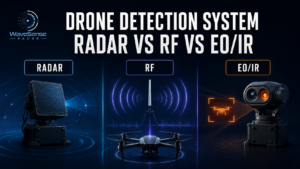
Radar Vs RF Drone Detection
Radar detects the physical aircraft.
RF sensors search for radio emissions associated with drones or controllers.
Radar can therefore detect certain autonomous or RF-silent targets that RF-only systems may miss.
RF systems can provide valuable information about communication signals and, depending on the system, drone or controller characteristics.
Neither technology solves every detection problem.
Why Combine Radar And RF Detection?
Radar and RF sensing provide complementary information.
Radar can supply:
- Position
- Range
- Velocity
- Track
RF detection may contribute:
- Signal presence
- Communication characteristics
- Protocol information
- Possible controller information
Sensor fusion can combine these independent observations into a more complete airspace picture.
Why Add EO/IR Cameras?
Radar is effective at finding and tracking objects over large areas.
A camera provides visual information.
A common workflow is:
Radar detects → radar tracks → camera slews toward target → operator or software verifies target.
This approach reduces the need for cameras to continuously search the entire sky.
Can Cameras Replace Drone Detection Radar?
Not completely.
Cameras depend strongly on:
- Visibility
- Lighting
- Line of sight
- Target size
- Background contrast
Radar uses a different sensing principle.
For high-value security applications, the two technologies often complement rather than replace each other.
What Is Sensor Fusion In Drone Detection?
Sensor fusion combines observations from multiple sensors into one operational picture.
A C-UAS detection architecture may combine:
- Radar
- RF detection
- EO cameras
- IR cameras
- Acoustic sensors
- Remote ID data
Fusion software can correlate detections and reduce uncertainty.
Dedrone and other current C-UAS platforms use multi-sensor approaches rather than relying on one detection technology alone.
Can Drone Detection Radar Work In Cities?
Yes, but urban environments are among the most difficult radar environments.
Cities create:
- Multipath reflections
- Building blockage
- Dense RF activity
- Moving vehicles
- Complex clutter
- Non-line-of-sight conditions
A radar that performs well over an open field may behave differently between buildings.
Urban deployment therefore requires site-specific testing.
What Is Multipath?
Multipath occurs when radar signals reach the receiver through more than one propagation path.
Signals may reflect from:
- Buildings
- Metal roofs
- Walls
- Vehicles
- Other large structures
These additional paths can complicate target localization and classification.
Dense urban environments therefore require stronger signal processing than open terrain.
Can Radar Detect Drones Without Direct Line Of Sight?
Conventional radar performs best when a clear propagation path exists.
However, NLOS drone detection is an active research area.
A 2026 study demonstrated small-UAS detection in dense urban and indoor environments using rotational micro-Doppler features from non-line-of-sight signals.
The reported experiment achieved an overall detection accuracy of 86.11% across five drone types under its specific test conditions. Read the NLOS sUAS detection study.
Does NLOS Radar Mean Buildings No Longer Create Blind Zones?
No.
Experimental NLOS detection does not mean a conventional surveillance radar can reliably see through every building.
Performance depends on:
- Frequency
- Propagation
- Building materials
- Geometry
- Multipath
- Algorithms
- Target characteristics
Physical obstruction remains an important deployment limitation.
NLOS techniques should therefore be evaluated using realistic site tests.
What Is A Radar Blind Zone?
A radar blind zone is an area where detection becomes unavailable or unreliable.
Blind zones can result from:
- Buildings
- Terrain
- Installation geometry
- Antenna coverage
- Minimum detection range
- Elevation limitations
A site survey should identify these areas before deployment.
Additional sensors can then be positioned to reduce coverage gaps.
Can One Radar Provide Complete Site Coverage?
Sometimes, but not always.
A small open facility may be covered by one correctly positioned radar.
A large industrial site may contain:
- Buildings
- Storage tanks
- Towers
- Cranes
- Hills
- Other obstacles
Multiple radar positions may provide better coverage than one extremely long-range unit.
Is 360-Degree Radar Always Better?
Not necessarily.
A 360-degree radar is useful when threats can approach from every direction.
A sector radar may be more appropriate when surveillance is concentrated on:
- A border
- Coastline
- Runway approach
- Restricted corridor
- Specific threat direction
Coverage geometry should match the protected site.
What Is 3D Drone Detection Radar?
A 3D Drone Detection Radar estimates three-dimensional target information.
Depending on system architecture, this may include:
- Range
- Azimuth
- Elevation
Three-dimensional tracking improves target localization and sensor cueing.
It can also support more accurate airspace visualization.
2D Vs 3D Drone Detection Radar
A 2D radar typically provides range and azimuth information.
A 3D radar adds elevation information.
For drone detection, elevation can help operators understand:
- Flight height
- Trajectory
- Restricted-volume entry
- Sensor cueing
The preferred architecture depends on the security requirement.
What Is A Phased Array Drone Radar?
A phased array radar controls the direction of its radar beam electronically using multiple antenna elements.
Electronic scanning can provide rapid target updates without mechanically steering a conventional dish through every direction.
Phased-array architectures are commonly considered for applications requiring fast tracking and flexible surveillance coverage.
What Is AESA Radar?
AESA means Active Electronically Scanned Array.
An AESA contains multiple transmit/receive modules that electronically control radar beams.
Benefits can include:
- Fast beam steering
- Flexible search patterns
- Multi-target tracking
- High update rates
- Reduced mechanical scanning requirements
System performance still depends on antenna size, power, waveform, frequency, processing, and software.
What Is FMCW Radar?
FMCW means Frequency-Modulated Continuous-Wave radar.
An FMCW radar continuously transmits a signal whose frequency changes over time.
The difference between transmitted and received signals helps estimate target range.
FMCW architectures are widely used in short- and medium-range sensing applications.
Research has also demonstrated FMCW radar for micro-UAV detection and micro-Doppler analysis.
FMCW Vs Pulse Doppler Radar For Drone Detection
Neither architecture is automatically better for every project.
FMCW radar can provide useful range and velocity information with continuous transmission.
Pulse-Doppler radar uses transmitted pulses and Doppler processing.
Actual performance depends on:
- Target RCS
- Required range
- Update rate
- Antenna
- Power
- Environment
- Processing algorithms
Buyers should compare measured performance rather than technology labels alone.
What Frequency Is Used For Drone Detection Radar?
Drone radars can operate in different frequency bands.
Examples include:
- S-band
- C-band
- X-band
- Ku-band
- Millimeter-wave bands
Frequency influences antenna size, resolution, propagation, clutter behavior, and target response.
There is no single frequency that is optimal for every UAV surveillance requirement.
Why Is X-Band Radar Common For UAV Detection?
X-band offers a practical balance between antenna size and target resolution.
This makes it suitable for systems designed to detect relatively small airborne targets.
However, frequency alone does not determine performance.
A well-designed radar also depends on:
- Antenna gain
- Signal processing
- Waveform
- Transmit power
- Receiver sensitivity
- Classification algorithms
How Far Can Drone Detection Radar Detect A UAV?
There is no universal drone detection distance.
Range depends on:
- Drone RCS
- Target altitude
- Radar design
- Antenna
- Frequency
- Terrain
- Weather
- Clutter
- Detection threshold
Commercial products may publish kilometer-scale detection capabilities, but ranges should only be compared when the test targets and conditions are clearly defined.
Detection Range Vs Tracking Range
Detection range and stable tracking range should not automatically be treated as identical.
Initial detection means the radar has identified a possible target.
Tracking requires repeated measurements to create and maintain a reliable trajectory.
A professional datasheet should clarify which performance figure is being published.
Tracking Range Vs Classification Range
Classification may require more signal information than basic tracking.
A radar may maintain a target track while still being uncertain whether the object is:
- A drone
- Bird
- Aircraft
- Unknown target
Buyers should therefore request classification performance separately when automated target identification is important.
Why Does Radar Update Rate Matter?
A radar must repeatedly update target coordinates.
Higher update frequency can improve tracking of maneuvering targets.
This becomes important when a drone:
- Accelerates
- Turns
- Dives
- Changes altitude
- Approaches rapidly
Long detection range is less valuable if the system cannot maintain timely target updates.
What Is Track Latency?
Track latency is the delay between target movement and updated information becoming available to the operator or connected system.
Latency affects:
- Camera cueing
- Threat assessment
- Interceptor coordination
- Alarm timing
Counter-UAS procurement should therefore consider both detection range and information delivery speed.
Can Radar Detect Multiple Drones At The Same Time?
Modern digital radar systems can maintain multiple tracks.
Actual capacity depends on:
- Radar architecture
- Processing hardware
- Software
- Scan strategy
- Target density
- Track quality requirements
The published maximum track count should be distinguished from the number of targets that can be reliably classified under real operational conditions.
Can Radar Detect Drone Swarms?
Radar can contribute to drone swarm detection, but swarm environments create additional challenges.
Targets may:
- Fly close together
- Cross trajectories
- Enter simultaneously
- Create dense track environments
Angular resolution, range resolution, update rate, and tracking software become particularly important.
A simple “maximum targets” figure does not fully describe swarm performance.
What Is Radar Range Resolution?
Range resolution describes how well radar can separate two targets located at similar distances.
Poor resolution can cause closely spaced targets to appear as one object.
This matters when several drones fly together.
Range resolution should therefore be considered for dense airspace and swarm-detection applications.
What Is Angular Resolution?
Angular resolution describes how well radar separates targets located at similar angles.
Two drones at the same distance but slightly different directions may be difficult to separate if angular resolution is insufficient.
This parameter becomes important for:
- Swarms
- Dense urban airspace
- Long-distance tracking
- Precision sensor cueing
Does Rain Affect Drone Detection Radar?
Rain can influence radar performance.
The effect depends on:
- Frequency
- Rain intensity
- Target RCS
- Radar processing
- Required detection range
A product specification should therefore distinguish ideal-range figures from tested environmental performance.
The FAA recommends evaluating how environmental and weather conditions influence UAS detection systems.
Does Fog Affect Radar?
Radar is generally less dependent on visible-light conditions than optical cameras.
This gives radar an important role during:
- Night
- Fog
- Haze
- Poor visibility
Radar performance can still vary with atmospheric and environmental conditions.
“Works in fog” should therefore not be interpreted as “performance never changes.”
Does Wind Affect Drone Detection?
Wind usually influences the drone and the surrounding environment more directly than the radar signal itself.
Strong wind may create additional movement from:
- Trees
- Vegetation
- Lightweight structures
The drone may also change speed and orientation.
Effective tracking software must therefore maintain target continuity despite changing motion.
Can Drone Detection Radar Work At Night?
Yes.
Radar does not require visible sunlight to detect physical targets.
Nighttime operation is one of radar’s main advantages compared with visible-light-only surveillance.
A radar can also cue thermal or infrared cameras for additional nighttime identification.
Can Radar Detect Autonomous Drones?
Yes.
An autonomous drone can still reflect radar energy even when it does not maintain an active radio-control link.
This makes Drone Detection Radar particularly useful against:
- GPS waypoint drones
- Pre-programmed UAVs
- RF-silent aircraft
- Some autonomous systems
RF-only detection may not provide the same physical-target coverage.
Can Radar Detect Fiber-Optic-Controlled Drones?
A radar detects the physical aircraft rather than relying on its command link.
A change in control method therefore does not inherently eliminate radar visibility.
Practical detection still depends on the UAV’s:
- RCS
- Altitude
- Range
- Speed
- Environment
This distinction is important as drone communication methods continue to evolve.
How Should A Drone Detection Radar Be Installed?
Installation should begin with the protected airspace rather than the equipment.
A site survey should evaluate:
- Terrain
- Buildings
- Vegetation
- Threat directions
- Radar height
- Required coverage
- Existing sensors
- Potential blind zones
Placement can have as much influence on operational coverage as the radar specification itself.
Does Installing Radar Higher Improve Detection?
A higher position can improve line of sight over nearby obstacles.
However, the highest available position is not automatically the best location.
Installation height can affect:
- Near-range geometry
- Structural requirements
- Maintenance
- Downward coverage
- Multipath environment
Site-specific modeling and testing provide better results than a universal height recommendation.
What Should Be Tested During Site Acceptance?
A practical acceptance test should include representative drone flights.
Useful scenarios include:
- Low-altitude approach
- High-altitude approach
- Hovering
- Crossing
- Rapid turns
- Multiple drones
- Different directions
- Different distances
- Real site clutter
Testing only one open-field flight provides limited evidence of real operational performance.
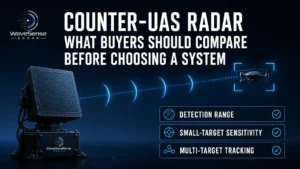
How Should Buyers Compare Drone Detection Radar Specifications?
Compare systems using the same operating assumptions.
Important parameters include:
| Parameter | Why It Matters |
|---|---|
| Target RCS | Defines target difficulty |
| Detection Range | Indicates early detection |
| Tracking Range | Shows usable track coverage |
| Classification Range | Indicates identification capability |
| Probability Of Detection | Measures detection consistency |
| False Alarm Performance | Affects operator workload |
| Minimum Range | Reveals near-field coverage |
| Azimuth Coverage | Defines horizontal surveillance |
| Elevation Coverage | Defines vertical surveillance |
| Update Rate | Influences track quality |
| Target Capacity | Matters for dense airspace |
| Environmental Rating | Supports field deployment |
A single maximum-range number is not enough for professional comparison.
What Questions Should You Ask A Drone Radar Manufacturer?
Ask the manufacturer:
What Drone Was Used For The Range Test?
The target model or representative RCS should be defined.
What Was The Drone Altitude?
Range can change significantly with flight height and background clutter.
Is The Published Range Detection Or Tracking Range?
These numbers may differ.
What Is The Probability Of Detection?
Reliable repeated detection matters more than one maximum-distance event.
How Is False Alarm Performance Measured?
High sensitivity should not create unusable alert volumes.
Can The Radar Detect Hovering Targets?
Ask whether micro-Doppler or another classification method is used.
Can It Detect RF-Silent Drones?
Radar should not depend on the drone transmitting a radio-control signal.
How Does It Perform Around Buildings?
Urban clutter and obstruction require separate evaluation.
What Information Is Missing From Many Drone Radar Datasheets?
Many datasheets emphasize:
- Maximum range
- Frequency
- Coverage
- Target capacity
Buyers also need operational information.
Useful missing data often includes:
- Test target
- RCS
- Pd
- False alarm criteria
- Tracking range
- Classification range
- Hovering performance
- Site assumptions
- Clutter conditions
These details help determine whether published performance can be reproduced at the customer’s site.
What Is The Best Drone Detection Radar?
There is no universal best radar.
The correct system depends on:
- Smallest expected drone
- Required warning time
- Protected area
- Terrain
- Installation environment
- Sensor integration
- Classification requirements
- Budget
A 20 km radar may be unnecessary for a compact site.
A short-range radar may be unsuitable for a large airport or border.
How To Select Drone Detection Range
Start with required warning time.
If the security team needs several minutes to:
- Detect
- Confirm
- Assess
- Respond
the radar must establish a reliable track before the UAV reaches the protected perimeter.
Required range should therefore be calculated from the operational response process rather than selected from a catalog alone.
Where Is Drone Detection Radar Used?
Common applications include:
Airports
Radar provides early warning of unauthorized UAV activity near controlled airspace.
Military Bases
Systems monitor low-altitude approaches and RF-silent airborne targets.
Critical Infrastructure
Power plants, refineries, communication facilities, and strategic sites can monitor restricted airspace.
Borders
Longer-range surveillance can detect UAV activity across defined approach sectors.
Prisons
Radar can help detect drones approaching secure facilities.
Public Events
Deployable radar can support temporary airspace monitoring.
Why Is Drone Detection Radar Important For Airports?
Airport environments contain many moving objects and strict operational requirements.
Detection systems must operate around:
- Aircraft
- Vehicles
- Buildings
- Birds
- Communication systems
- Navigation infrastructure
The FAA maintains specific guidance and technical considerations for UAS detection at airports.
See the FAA UAS Detection, Mitigation, and Response resources.
Why Is Radar Important For Critical Infrastructure?
Critical infrastructure may face drones that do not transmit recognizable RF signals.
Radar provides an independent physical detection layer.
It can also provide position information to:
- Security software
- EO/IR cameras
- Alarm systems
- Command platforms
Layered sensing improves situational awareness around high-value facilities.
Can Drone Detection Radar Operate As A Standalone System?
Yes, but standalone radar provides only part of the security picture.
Radar answers questions such as:
- Is something present?
- Where is it?
- How is it moving?
Other sensors may answer:
- What exactly is it?
- What communication link is it using?
- Who may be controlling it?
A complete system therefore often integrates multiple sensing technologies.
What Should A Complete Counter-UAS Detection Architecture Include?
A layered system may include:
Radar → physical detection and tracking
RF Sensor → signal detection and analysis
EO/IR → visual confirmation
Fusion Software → track correlation
Command Platform → operator awareness
The exact architecture should reflect the site, threat, legal environment, and response procedure.
Drone Detection Radar Vs Low-Altitude Surveillance Radar
The terms overlap but are not always identical.
Drone Detection Radar specifically emphasizes UAV detection and classification.
Low-Altitude Surveillance Radar may monitor a broader target set, including:
- Drones
- Helicopters
- Light aircraft
- Other low-flying objects
A radar may perform both roles depending on its design.
Drone Detection Radar Vs Counter-UAS Radar
The terms are often used interchangeably.
However, Counter-UAS Radar usually implies that the radar forms part of a larger C-UAS architecture.
A complete counter-UAS solution may combine:
- Detection
- Tracking
- Classification
- Identification
- Response coordination
Radar is usually the sensing layer rather than the entire counter-UAS system.
Future Development Of Drone Detection Radar
Future radar development is moving toward more intelligent processing rather than range alone.
Important directions include:
- AI-assisted classification
- NLOS sensing
- Better micro-Doppler analysis
- Improved swarm tracking
- Smaller AESA systems
- Multi-radar networking
- Automated sensor fusion
Recent research continues to explore machine learning and micro-Doppler methods for detecting difficult small-UAS targets in dense environments.
Conclusion
Drone Detection Radar is most valuable when it can reliably detect, track, and classify small UAVs inside the real environment where it will operate—not simply when it achieves the longest laboratory range.
Small drones create difficult radar targets because of low RCS, low altitude, hovering behavior, ground clutter, and complex trajectories.
Micro-Doppler processing, adaptive clutter suppression, high-quality tracking, and multi-sensor fusion can improve operational performance.
Buyers should therefore compare Pd, false alarm performance, target RCS, tracking range, classification capability, update rate, blind zones, and site conditions before selecting a radar.
FAQ
Can Radar Detect Small Drones?
Yes.
Purpose-built radar can detect small UAVs, but performance depends on RCS, range, altitude, clutter, radar architecture, and processing.
Can Radar Detect A Hovering Drone?
Yes.
Advanced systems can use rotor-generated micro-Doppler signatures together with other target characteristics to support hovering-drone detection.
Can Radar Detect RF-Silent Drones?
Yes.
Radar detects reflected energy from the physical aircraft and does not require the drone to transmit a control signal.
Can Radar Tell A Bird From A Drone?
Advanced radar systems can combine micro-Doppler, trajectory, velocity, RCS, and machine-learning classification to improve bird-versus-drone discrimination.
What Is The Best Frequency For Drone Detection Radar?
There is no universal best frequency.
Frequency selection depends on target size, required range, antenna dimensions, environment, resolution, and radar architecture.
What Is The Difference Between Detection And Tracking?
Detection establishes that a possible target exists.
Tracking uses repeated measurements to maintain its position and trajectory over time.
What Is The Most Important Drone Radar Specification?
No single parameter is sufficient.
RCS-specific detection performance, Pd, false alarm behavior, coverage, update rate, tracking quality, and deployment environment should be evaluated together.
Does Longer Detection Range Mean Better Radar?
No.
Operational value depends on reliable tracking, classification, coverage, warning time, and false alarm performance.
Can Drone Radar Work In Urban Areas?
Yes, but buildings, multipath, clutter, NLOS conditions, and blind zones make urban deployment more difficult.
A site survey and representative field testing are strongly recommended.
Should Radar Be Combined With Other Sensors?
For many high-security applications, yes.
Radar, RF sensing, EO/IR cameras, and fusion software provide complementary information and reduce reliance on a single detection method.